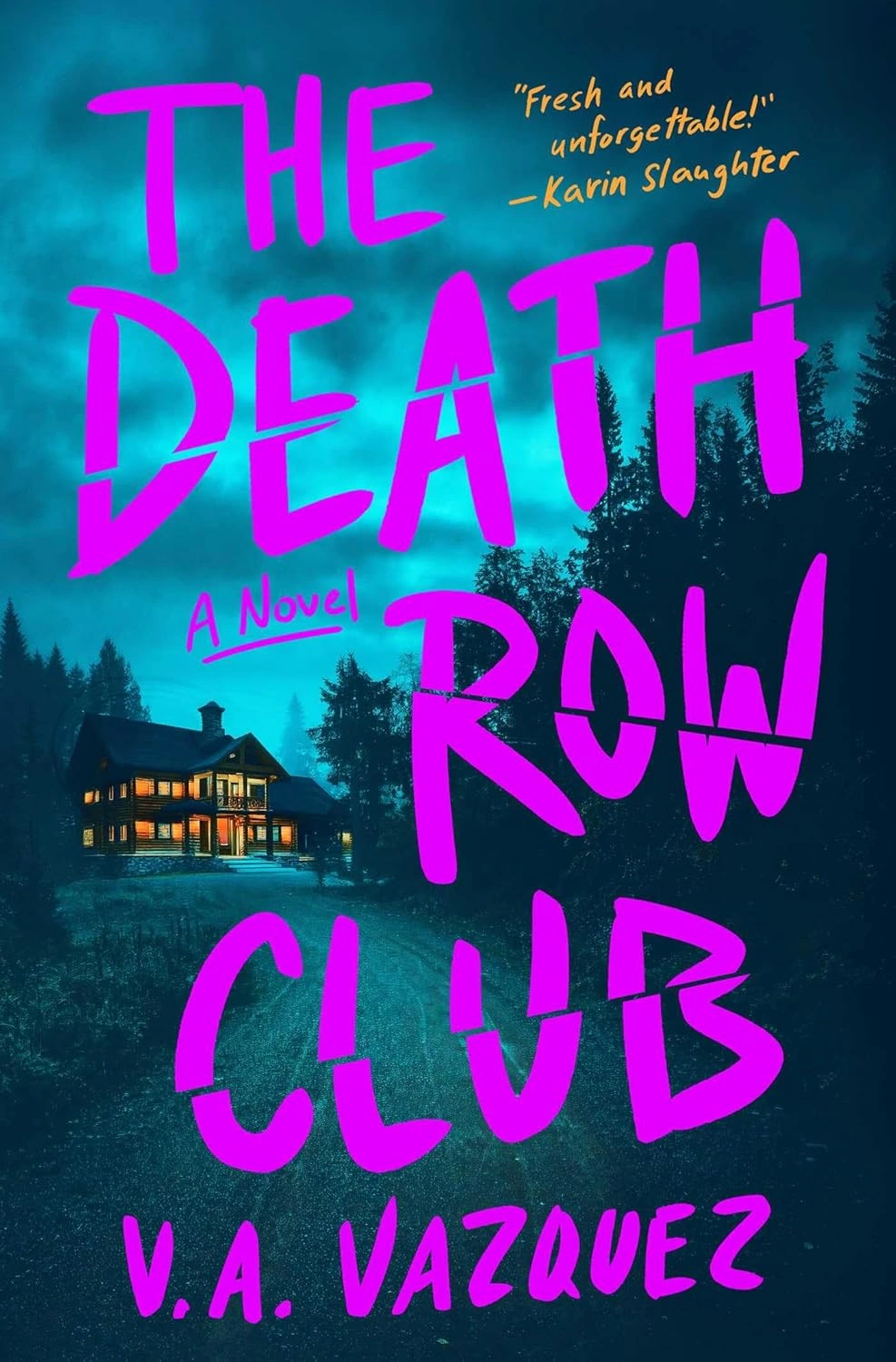
The Death Row Club by V. A. Vazquez
“The truth is, my parents were in love. One of my earliest memories is hovering in the doorframe while they danced, barefoot, in the kitchen — a dishrag thrown over my father’s shoulder, his arm wrapped around my mother’s waist as she hummed along with the radio. He was a good husband; he was an even better father.
“He also murdered five women.”
In V. A. Vazquez’s The Death Row Club, Nicola Fischer is a lower school art teacher, broke, jobless, and besieged by the press now that her father has been unmasked as the Ellicott Creek Ripper, and she herself has been accused of unwittingly luring girls into his car.
It’s all Greer Woods’ damn fault. Herself the daughter of a serial killer, she’d come to town with her true-crime show To Catch a Killer and pretended to befriend her, and what had she been doing all that time? Zeroing in on Nicola’s father. Now, Nicola’s life is ruined, she’s buried herself in boxed wine, and Woods won’t return her calls.
And that’s when she receives an invitation from the Death Row Club. It’s a remote weekend retreat for the children of serial killers and, curious, she goes. It’s a small group. Connor’s father was a cult leader. Imogen’s mother killed hospice patients. Zach’s father locked people in a walk-in freezer. Kemy’s trucker dad picked up women along the road. Ros’s father was the Paper Bag Killer.
And Greer is there, too. In fact, Greer founded the club. Was it really to help them all process their terrible circumstances, or was another motive at work? For that matter, what about the rest of them? They all seem to be hiding something.
She’ll find out soon enough.
In a remarkable, twist-filled narrative that at once pulls you in and pulls the rug out from under you, The Death Row Club invites the reader to join Nicola as she tries to uncover the truth, and stay alive in the process. Sadly, the same can not be said for every one of them. Soon, a body will be found floating in the lake. Someone else will be found chained in a shack.
And who is that woman in the woods?
Audacious, fresh, and full of genuine surprises, The Death Row Club is the addictive new thriller you’ve been waiting for. Just be sure to leave the light on when you read it.
From Real-life Shock to Fictional Suspense
The author explains how it all began: “I had a favorite teacher in high school. We were very close; after school, you could often find me sitting on the floor of his classroom, finishing my homework while he graded essays at his desk. He inspired me to fall in love with literature, and eventually, to become an English teacher myself.
“A few years after I graduated, the news broke that he had been arrested for multiple crimes. I was completely blindsided and initially struggled to reconcile my memories of him with the horrifying new information that was coming to light every day. He was eventually convicted and, in a twist that you cannot make up, ‘exiled’ to Canada. (He was given the choice between serving jail time in the U.S. or probation in Canada; he chose the latter). At my twentieth high school reunion, I found myself back in his classroom for the first time since graduation, surrounded by memories of my youth. Moments that had seemed innocuous at the time, like a sonnet slipped under my vocabulary quiz, took on a more sinister air. I kept asking myself the same question: How had I not realized that he was a dangerous predator?
“Not long after, I started reading about the wives and children of serial killers – people who, like me, once trusted someone who turned out to be capable of terrible things. Their stories were diverse. Some swore that the warning signs had always been there; others admitted that they had been completely in the dark. Some weren’t shocked at all because their parent had always been abusive; others were completely blindsided. Some stood by their husbands throughout the trial, while others immediately cut ties. Some came to terms with the truth quickly; for others, it took weeks, months, or even years before they were finally able to accept what their loved ones had done.
“I recognized pieces of myself, and my former adolescent self, in all of them. I wanted to write a thriller that encompassed those conflicting responses. The result was The Death Row Club.”
So, if she recognized pieces of herself, who was she most like?
“My initial impulse is to say that I’m more like Nicola. We’re both teachers; we both pursued degrees in the arts. But when I consider it more carefully, I’m not sure that’s actually true. Nicola has a tendency to shy away from her outsider status, while Greer leans into hers. Greer never pretends to be anything other than her father’s daughter, even co-creating a reality TV show centered around them solving crimes together. This decision makes her fairly unpopular with the other club members, who can’t understand why she refuses to quietly disappear from the public eye the way they have.
“In that sense, I probably have more in common with Greer. Back in elementary school, I was bullied relentlessly for having queer parents. Not only did I refuse to distance myself from them, I covered my locker in gay pride memorabilia and took it upon myself to educate my classmates. Growing up in the pre-Obergefell nineties, at a conservative religious school, this led to me getting ostracized. However, like Greer, I’ve always been determined to never let other people’s judgments define me, and to stand by the people I care about and who care about me.”
The Road to Publication
That determination showed during the publication process: “Let’s start with the fact that, growing up, I never intended to become an author. I’d relocated to Scotland to live with my husband in a small rural town, surrounded by sheep and rolling hills, about a half-hour train ride from Glasgow in one direction and Edinburgh in the other. Getting a teaching license abroad can be difficult, and so I found myself unemployed and painfully bored. My husband encouraged me to try writing a book, and so, with nothing else to do, I started drafting my first psychological thriller about a content creator who reenacts famous murders with cute boys that she meets on Tinder – until one of her matches turns out to be the real thing. I was lucky enough to make it into the final Pitch Wars class, and when the showcase rolled around, I landed an agent with my very first query letter.
“If you’re thinking this story sounds too good to be true, it’s because it was. That first book died on submission, and the next one spent two years in revisions before my agent felt it was ready for editors. That book was this one, and thankfully sold in about a week at auction. All things considered, it was a a relatively smooth journey, but that stretch was tough. (Many thanks to my agent, though, for never letting me take the easy way out; it was definitely worth it in the end!).”
Next up is another psychological thriller, about a freelance executioner who begins to suspect that the prisoner she’s been tasked with executing is innocent. When Vazquez was interviewed, she was just wrapping up the first draft, and “I’m so excited to see how it develops over the next few months!” After reading The Death Row Club, you’ll be, too.
About V. A. Vazquez:
 V. A. Vazquez was born and raised in Buffalo, New York, where she currently teaches English. She received her BA in English from Barnard College and used to live in Scotland in a town inhabited by more sheep than people.