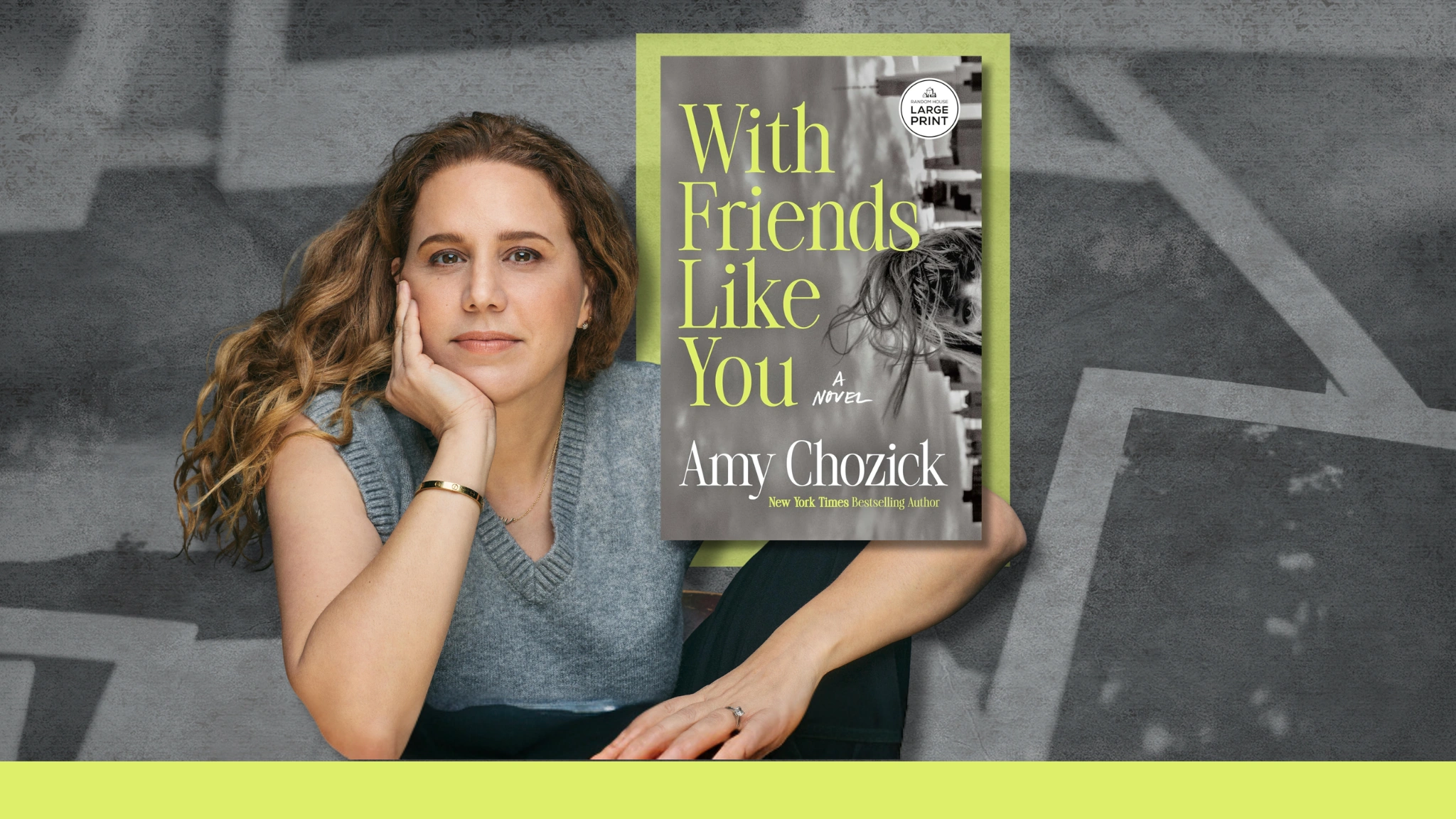
Amy Chozick made her name covering presidential politics for The New York Times, but in her latest novel, With Friends Like You, she turns her sharp eye to a different kind of mystery: the complicated bonds between women, the isolating realities of new motherhood and the lengths we’ll go to find the people we’ve lost. Blending psychological suspense with humor and insight, the novel follows a new mother whose search for a vanished best friend leads her into an unexpected world of elite escorts, buried secrets and questions about identity, belonging and the friendships that shape us. We spoke with Chozick about drawing on her journalism background, balancing thriller elements with comedy, researching sex work with nuance and why female friendships can leave us more haunted than romantic relationships.
Emily’s search for Daisy becomes an all-consuming obsession. What drew you to explore the idea of looking backward for answers when someone’s present life feels unstable or unfulfilling?
I spent most of my career as a journalist at The New York Times, so I think my default when something feels destabilizing is to report it out. To look for answers. Nothing is more destabilizing than new motherhood. It’s also strangely lonely. Even though you are never alone. So, I thought it makes sense if Emily starts to report out what happened to her best friend — the one person who she felt truly knows her — in this postpartum haze. When I was three-weeks postpartum, Vogue asked me to profile Stormy Daniels and I left my newborn to go to strip clubs in Milwaukee — which is what first gave me the idea of Emily not just trying to find her friend, but trying to find her friend who disappeared into the world of sex work.
The novel combines suspense, dark humor and an honest portrayal of new motherhood. How did you balance these very different tones while telling Emily’s story?
The novel — and the screenplay I am writing based on it — were definitely a tonal challenge. I wanted the voice to be funny and conversational and satirical about all the absurdity of consumerism and motherhood. There’s darkness baked in, but there’s also real love, and so many moments that make you laugh, and that felt like real life. We have enough dreary postpartum stories. I wanted this to read like a psychological thriller about female friendship that makes you laugh and keep turning the pages.
Friendship sits at the heart of the book. What interested you most about examining the intense, sometimes messy bonds between women, particularly when those relationships are shaped by nostalgia and memory?
I’ve always been drawn to exploring complicated dynamics between women, whether that’s sisters or female friends — relationships that can save us or undo us. My HBO Max series, The Girls on the Bus, based on my first book, Chasing Hillary, is also about female friendship. I think there’s this real yearning at the heart of Emily and Daisy that reflects my own yearning — for that one friend who understands you in a way even your romantic partner doesn’t. Female friends can burn so hot for each other and then disappear from each other’s lives in a blink, leaving you sometimes even more unsettled than a breakup. There’s closure with a breakup. With a friendship that ends suddenly, as it does with Emily and Daisy, you can spend your whole life not only wondering about that person but also the girl you were when you were with her.
Daisy’s disappearance leads Emily into worlds she never expected to encounter, including sex work and elite escort networks. What kind of research went into these elements of the story, and what assumptions did you hope to challenge?
As a journalist, I spent a lot of time talking to sex workers — whether that was for my profile of Stormy Daniels for Vogue or when I did a story about “Hookers for Hillary” during the Democratic primary in Nevada. I also read “An Honest Woman” by Charlotte Shane, and other memoirs by sex workers, to help me better depict both the day-to-day and the emotional complexities of the profession. I definitely wanted to be mindful not to fall into familiar tropes or portray Daisy as a victim. The women I’ve talked to were all very in control and confident about their own choices and careers. And I wanted to make clear that this could be any girl’s path, depending on our circumstances. We’re not any better than any other woman because we happened to get office jobs.
Without giving away spoilers, the novel asks whether reconnecting with someone from our past can heal us — or further complicate our lives. What do you hope readers take away from Emily and Daisy’s relationship by the end of the book?
I think, more than anything, Emily is on a journey to discover who she really is and to belong. Even though things get really messy between her and Daisy, Daisy does, in the end, help Emily come out the other side knowing who she is. I hope any reader who has struggled with their own identity — not just women or mothers — sees themselves in these characters. At its heart, this is a story about the pull of belonging, the cost of surrender, and the thin line between devotion and destruction. And yes, it’s also about the false promise of a “village” in modern America — what we’re all left to figure out on our own, and the friends we rely on to survive it.