
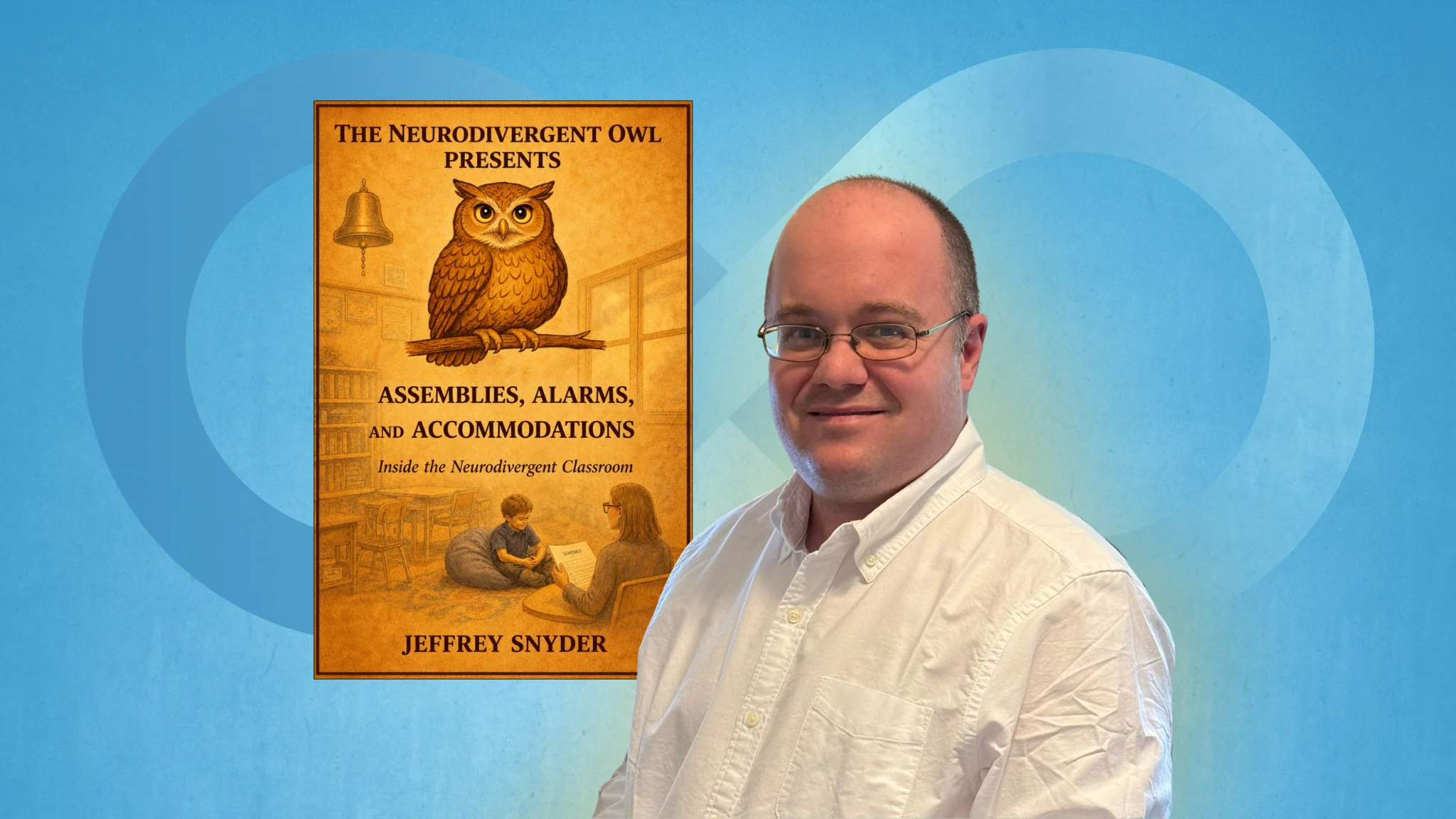
For neurodivergent students, everyday school experiences can present challenges that often go unnoticed or misunderstood. In his book The Neurodivergent Owl, author and self-advocate Jeffrey Snyder draws on his personal experiences growing up with autism to shed light on the importance of understanding, flexibility and individualized accommodations in education. Through his advocacy platform, Going the Distance, Snyder is dedicated to raising awareness and helping schools create more inclusive environments where every student has the opportunity to thrive. In this Q&A, Snyder discusses his educational journey, the misconceptions surrounding neurodivergence and the changes he hopes to inspire for future generations of students.
In your book you reflect on your experiences growing up neurodivergent and navigating the challenges of public school. What inspired you to share your personal journey, and what do you hope readers take away from your story?
To begin with, I was first diagnosed with autism at 21 months old, and I did not speak until age 4. I played differently, and most of the time I played by myself or on the periphery of others. I loved Disney movies and watched them continuously. It’s kind of neat that I have brought Disney into my training vocation in several presentations.
When the COVID-19 pandemic gripped us all in 2020, I found myself faced with a decision. I was to either lie low on the couch and computer or create a platform where I could share my story and experiences with others. I knew there was relatedness between myself and other people managing autism or neurodivergence. We share so many similar daily life experiences, and many of them are met with anxiety and dysregulation. I love to write and share my lived experience. The “Going the Distance” platform was created and set in motion, helping me to foster my purpose and get the word out for understanding and accommodation.
During the pandemic, I was one of several individuals who contributed to the book This is Autism written by Aidan Allman-Cooper and the late Jessica Leichtweisz. You might say that this contribution laid down the foundation that was to become The Neurodivergent Owl.
You describe how fire drills and other school safety procedures can create overwhelming sensory experiences for neurodivergent students. How did these experiences shape your understanding of the importance of accommodations, and changes would you like to see schools make?
I’ve had auditory sensitivities to many things since I can remember and still do to this day. This results in sensory overload that can last well past when the noise has passed.
My first fire drills in first grade were awful. The sudden noise blaring, the chaos of being gathered to go outside, the fear of what was really happening, the intimidation of the firemen’s uniform and the uncertainty of what is to come next were daunting. After the fire or safety drill, for the next few days and weeks, I would have anticipatory anxiety wondering when the next “drill” would be launched so I’d have to repeat the overwhelming experience. I would try my best to hide my sensory overload by wearing one or several emotional “masks.”
The fire drill was the benchmark for shaping the understanding of accommodation. The teachers took time to work with me and understand what could be done to reduce fire and safety drill anxiety. A couple accommodations included making me aware that the fire drill would be coming, having an aide escort me out of the room and outside individually, meeting the fireman and police to understand they don’t need to be intimidating and the use of noise cancellation headphones. My fire drill plan was written into my IEP. With these simple accommodations, the anxiety of the fire drill was significantly decreased.
Schools have made progress in this area, but there is much more awareness work to do. I encourage them to take some time and find out where each neurodivergent individual is with respect to the school experiences discussed in The Neurodivergent Owl. I ask that this be done proactively and on an ongoing basis. Anxiety reduction from sensory overload is an achievable goal with some compassionate work.
Throughout the book you emphasize that there is no “one size fits all” approach to supporting neurodivergent students. What are some of the most meaningful accommodations you received during your education, and how did they influence your confidence and ability to succeed?
I would say probably the biggest accommodations made to me were, again, the advanced notice of a school safety drill (particularly during fire drills) so that I could mentally prepare myself for what was to come. Having advanced notice might ruin what the administration is trying to do in creating that element of surprise, but having a flexible set of mind is not only beneficial to the student but to the support system as well.
If a student can’t handle being in a cafeteria where loud noises are common, then maybe the fit is better off in a library or the student’s classroom or home base. If the student attends a school dance and is expected to stay for the whole event, then there is some flexibility to have the student attend the dance for as long as they can tolerate it.
Accommodations can go a long way to making the school experience easier for neurodivergent students, even if it goes against what is being designed for the rest of the school.
You discuss how everyday school experiences, such as lunch periods, assemblies, crowded hallways and school dances, can present unique challenges for Neurodivergent students. What do you think teachers and administrators often misunderstand about these situations?
The biggest misconception that teachers and administrators come across with an individual trying to get out of a large lunch period, assembly, crowded hallway or school dance is the fact that they tend to believe that the student is trying to be a detriment to the process. A while back, my psychologist told me that an administrator or teacher may react by saying that the student is being prepped for the real world by taking part in large crowd settings. However, just because a neurotypical student might react the same way doesn’t mean a neurodivergent student would.
Some teachers and administrators may also argue that there are some school assemblies that the student cannot miss, like an administrative meeting, a class meeting, or an assembly about an important topic such as bullying, drugs, etc. But take for a moment what is going through the mind of a student during a school assembly: they are amongst a large group of students that they have very little in common with, and there is a lot of noise going on at once, students talking as they make their way into the cafeteria, gymnasium, or auditorium, and the administrators and teachers calling for silence to begin the assembly. Each time these moments happen, the student is absorbing the noise like a sponge. Their minds are going 1,000 mph, and all they want to do is get out of the moment.
If there is an assembly that is too important to skip, I believe there should be one of two ways: the student remains with their support person or teacher at the nearest exit, and if they get overstimulated, then they have the right to leave the assembly to decompress for a few minutes or for the entire assembly, or schools can livestream the assembly for the student to watch in his or her classroom, and they can bow out if need be.
When scheduling a school assembly, the administrators often overlook the fact that some students can’t handle being in a large crowd setting and that there does need to be an option offered for the student, even if it is geared towards school matters or special guests, and if they do act out, it’s misinterpreted as bad behavior. Perhaps giving out advanced notice of an assembly can help the student regulate or prepare for what is to come, and if the subject of the assembly is something that the student will have trouble with, then they should have the option to skip it and go on with their alternative or pre-scheduled activities.
In your chapter on Field Trips, you recount a memorable high school trip to New York City, including a special trip to the Russian Tea Room that served as an accommodation. Why was that experience so meaningful to you, and what can educators learn from it about including inclusive experiences outside the classroom?
To begin with, I went to New York City as a senior in high school that was meant for students taking part in art or French classes. Now, there might be some readers that live in New York City who agree with me that New York can be a very overstimulating environment, with the crowds hustling, the traffic roaring and the overstimulations that can come about from something unexpected.
Yes, we did have a set schedule to follow; however, my art teacher and the high school French teacher knew me firsthand to consider the possibility of something like the Russian Tea Room as a good “decompression” activity. Being at RTR allowed me to destimulate and be in an environment that is on my level.
In recent years, my hometown school district of Seekonk Public Schools has been doing multi-day class field trips to Washington, D.C., and additional selected locations such as New York City, Gettysburg, Philadelphia, and Baltimore for 8th graders and trips to Europe at the high school level to countries such as Italy, Greece, France, Portugal and Spain for various students at all grade levels.
It’s important to consider that just because the student has a set schedule to follow on these field trips, teachers and administrators running the trip should consider an alternative activity for sensory-friendly students. For example, at Arlington National Cemetery, rather than attending the Changing of the Guard at the Tomb of the Unknown Soldier with the entire group, an accommodation can be made to visit the Kennedy gravesites where the student can not only pay their respects but also stim and just be themselves.
Some teachers and administrators may look at this and think that a sudden diversion for a particular student ruins the whole point of the field trip; however, some students enjoy them because they have an interest or they feel like they need a place to calm down. Another example is Westminster Abbey in London, where the student can go not to take in the sights but to sit in a pew and decompress because of the quiet environment.
It also helps if the student is put in the lead chaperone’s group during the field trip just like I was when I went to New York, especially if the lead chaperone has had a student in his or her class and knows what their needs are.
You founded Going the Distance in 2021 as a platform for self advocacy and public speaking. How did your experiences as a neurodivergent student inspire you to become an advocate, and how has your work influenced the way you approach educating others about neurodiversity?
Well, there are two main factors to the creation of Going the Distance.
The first factor is, again, giving me the opportunity to give back to the educators that helped and supported me on my educational journey from pre-K through grade 12.
The second factor is that more and more children (and even adults) are being diagnosed as neurodivergent, and many families are looking for guidance and support for their loved ones.
As the number grows, more and more resources need to be opened up for neurodivergent individuals, and public schools need to be trained on ways to support neurodivergent students, especially those who come from families that cannot afford to send their children to a specialized school. It’s like if there is a neurodivergent individual who is placed in a retail environment and you expect them to be able to manage it right away.
Well, they cannot adapt the same way as a neurotypical, and there needs to be a sense of flexibility incorporated because, again, there is no such thing as a “one size fits all” approach. It’s as I say at the beginning of the book, “Everyone is born, but not everyone is born the same.”