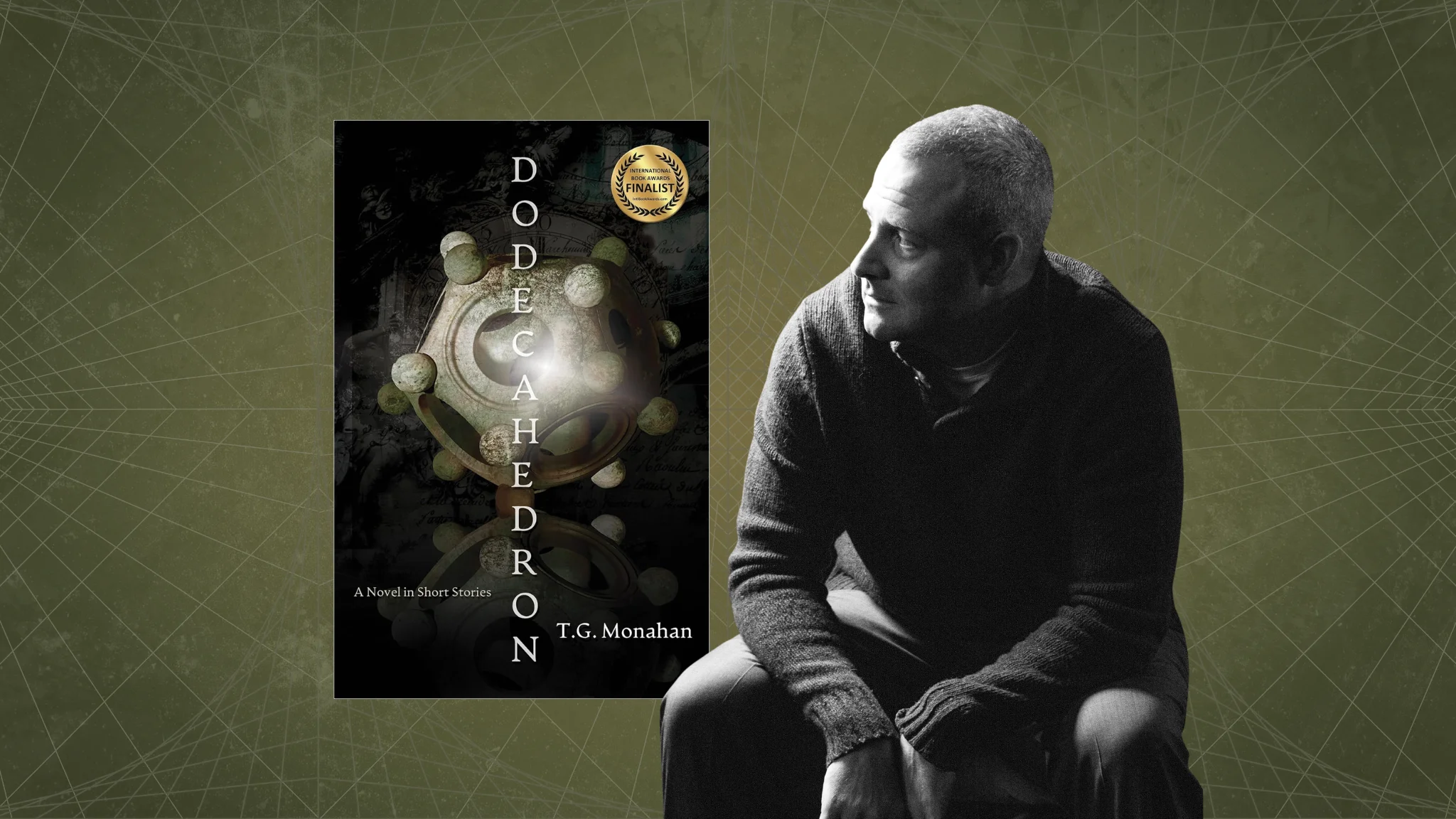
In Dodecahedron, T.G. Monahan weaves together history, folklore, mystery and magical realism to tell the story of a small Upstate New York town whose past is far more complicated than it first appears. Spanning generations and unfolding through 12 interconnected stories, the novel explores how legends take shape, how communities create shared identities and how the decisions of those who came before continue to shape the present. At the heart of it all is a mysterious ancient object that raises questions about what we know, what we believe and how much of history remains beyond our understanding. We spoke with Monahan about the inspiration behind the novel’s unconventional structure, the research that brought its fictional world to life and the enduring relationship between history and the stories we tell ourselves.
Dodecahedron is described as a novel in short stories, with twelve interconnected chapters spanning different periods of history. What inspired you to tell Donnybrook’s story through this structure?
Dodecahedron was originally two (2) books: Dodecahedron, a series of 12 interconnected short stories about generations of people living on land in North Carolina that would eventually become a military base, inspired by my Marine Corps service in Cherry Point, North Carolina; and Greenville, a collection of magical realism folktales set in the Catskill Mountains. Over time, the works merged into the version you have today. I had always intended for Dodecahedron to take an experimental structure, with each story standing alone in terms of character and situation, but each building upon the others and—most important—each revealing a little bit more of the long-term consequences of a single decision in time. The novel’s structure reflects my belief that we are living in a world shaped by the actions of others. “History” is not something that happened before, something you read about in texts. History is going on around us, and we are a part of it, every day.
The dodecahedron is at the center of the novel, carrying a different story and significance across generations. What does it represent?
Roman dodecahedrons are real and continue to mystify historians and archaeologists. They can be found all over Europe, particularly where the Roman legions were most active. To this day, no one has definitively concluded what their purpose was, although theories abound. So, the dodecahedron symbolizes the unknowable. It’s a reminder that even in 2026, with all our technology and supposed knowledge, we still can’t crack what seems like it should be an easy puzzle. Now, take that mystery and transport it across the ocean to Upstate New York. Now you have an even more profound mystery—and a potentially useful one, at that. What better way to create common cause for a tiny population than to gift them an unsolvable mystery?
The novel blends historical events, folklore, local legends and elements of mystery. How did you approach balancing historical detail with imaginative storytelling, particularly when exploring the origins of Donnybrook and the Norumbega legend?
All the history and legend that comprise Dodecahedron’s mythos were carefully researched and respectfully presented. I read first-person accounts of Black soldiers in World War I, a book about the “carnival campaign” of 1840 (“Tippecanoe, and Tyler too”), books about the natural history and biology of Tahiti, and legends about Norumbega. Stories begin to suggest themselves when you delve into history and legend. The process isn’t always quick. Some of these stories, “Crossroads at Montfaucon” and “Leading Light,” for example, took literally years to craft. Other stories didn’t make the final cut. One, entitled “Clarence Darrow Wasn’t Available,” became a one-act play, now published in The Whistle Pig October 2026 edition.
In creating Donnybrook, I envisioned a quintessential Northeast town that blends all American cultures of the time: white, Black, and Native. That idea suggested a connection to Norumbega, the legendary Norse settlement that also supposedly saw a melding of European and Native American cultures. Donnybrook stands as a symbol of what we in America were before pernicious racial pseudo-science took over the zeitgeist in the early 19th century and what we still can be.
Several characters become invested in uncovering or shaping Donnybrook’s history. What do these characters reveal about the human desire to discover the truth, leave a legacy and believe in something beyond the evidence
Without giving spoilers, one of the side effects of the dodecahedrons’ discovery was that Donnybrook began to attract scientists, antiquarians, historians, etc. It became, overnight, a tiny oasis of academia. Subsequent generations dreamed of making it a permanent Chautauqua. The Chautauqua movement at the turn of the 19th to 20th centuries was to education what the Second Great Awakening of the mid-19th century was to religion. Beneath it all, however, as the text shows, the townspeople were largely content with a folk explanation of how the dodecahedrons came to North America. It was the work of local townspeople—part white, part black, and part Native—that ultimately chipped away the legend to reveal the history beneath. These people were driven by an intense desire to go further than story, to history. This is in contrast to people like Quilliam, who, when faced with the challenges of true historical research, takes the “easy” way and profits off the legend.
How did you develop this fictional town, and what role does its sense of community play in connecting the stories?
Donnybrook is based partly on towns near where I live, Schoharie in particular. Living in this region in Upstate New York is to live with centuries of history. Above my own backyard is a barn built in 1950, which, when built, is said to have been the most technologically advanced in the state. When I drive to court for work, I pass stone forts that the colonial militias used when fighting the British and Native Americans in the late 1700s. On my street you can still see ruins from an old highway from the 1800s. One begins to see just how much “history” is alive and how we are all living in the shadow of people and decisions that came before.
Communal identity is, I think, a powerful balm against the vicissitudes of life. People who feel a sense of belonging to something have a better chance of brooking whatever the world throws at them. People who can claim a shared experience—such as, in this case, a common legendarium—are more likely to pull together in difficult times. Without giving away the game, I believe it’s that sentiment that lies at the bottom of the series of decisions made in this novel. At the same time, however, it’s quite an indirect route to mass salvation—almost a long con, if you will. So, it raises questions about the ethics of direct versus indirect means of helping others.
Questions arise about who gets to shape history and how easily fact can become legend. What were you hoping readers would consider about the relationship between historical truth, collective memory and the stories communities tell themselves?
This is the central question of the novel and, I think, the central question of history. So much of what we think we know isn’t true or has been garbled down the years so that it no longer reflects the truth of what actually happened. In my forthcoming novel, Stranger in the Kingdom, a character compares this process to a radioactive isotope spontaneously decaying into something stable. The reality of our past gets lost in a succession of ever more palatable fantasies, often leading us farther and farther away from the truth. Legends and myths have their place, no doubt. Encoded with wisdom, they teach us important practical and moral lessons. But living in a free, open, democratic society demands that all of us scratch beneath the surface to the facts below, lest we find ourselves swimming in agitprop.