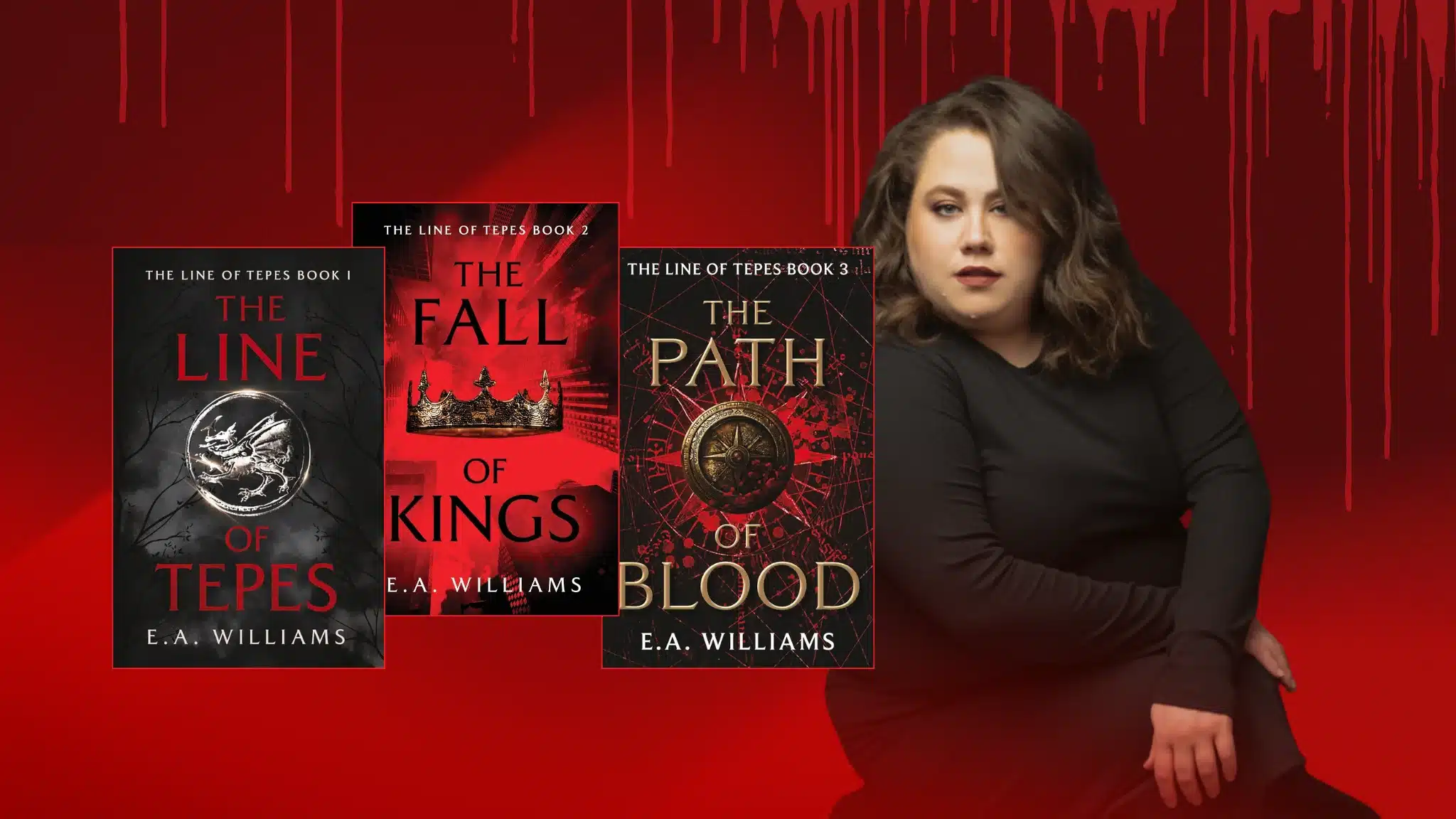
In The Line of Tepes, E.A. Williams puts a fresh spin on vampire mythology, bringing the legend of Dracula into a modern-day supernatural thriller filled with ancient secrets, dangerous alliances and family betrayal. When Emma King’s grief leads her into a world of vampires and dark forces, she discovers that sometimes the only way to fight a monster is to turn to an even bigger one. In this Q&A, Williams discusses the inspiration behind the series, the complicated relationships at its heart, the influence of Texas on her storytelling and her approach to blending horror, humor and suspense.
In The Line of Tepes, you reimagine vampire mythology through the story of Emma King, a young woman whose grief over her grandmother’s death leads her into a dangerous supernatural world. What inspired you to combine the familiar mythology of Dracula with a modern-day thriller, and when did you know this was a story you wanted to tell?
The Line of Tepes is a story that has been haunting me for a while. I have been a vampire fan for as long as I have been able to read. It started with Bunnicula in kindergarten, and I was hooked, but so many of the stories out there had this distinct boundary between vampires as monsters and vampires as romantic obsessions. I have always seen it as more of a grey area. Vampires were people once. People are complicated and messy. I wanted a story that accepted its vampires as dynamic characters that could help as much as they harmed, who were as dangerous as they were seductive, but most importantly I wanted a vampire with fangs. The Line of Tepes answers one important question for me, and that is who the villain would have to be if you were willing to turn to Dracula for help. When I found my answer, I found my story. The violent betrayal of Emma’s mother, someone who should protect Emma unfailingly, made her a monster of the highest order, and by giving her a cult full of death-worshipping sycophants, I knew my characters wouldn’t think twice about turning to a bigger monster for help, fangs and all.
Emma’s relationship with her mother adds a personal dimension to the supernatural danger she faces. How did you approach writing this complicated family dynamic?
Approaching Emma and Melissa’s family dynamic was a tightrope. My own family is very close, and the abuse Melissa puts Emma through for the sake of her cultish devotion to “the Divine Mortal” was as far from my own mother as anyone could get. That was the starting block for the family dynamic, though, that love we have for our families that seems to bloom even in the worst conditions. We want to love our family. We want them to keep their promises and to be good people. When I was writing about their mother-daughter relationship, I wanted to ground Emma in the need for that love, and every time we see Melissa use that against her, it becomes clearer just how monstrous she is. So I guess I started with love, and once everything was sent through that lens, I let Melissa’s selfishness distort it, and what was left was their relationship.
The series draws on the legacy of Dracula while introducing readers to a world of ancient bloodlines, dangerous secrets and supernatural power. How did you balance honoring classic vampire lore with creating your own mythology?
The more you begin looking into vampires, the more you come to realize that there isn’t one myth that connects them all. In honoring one, you neglect another, and even Dracula ignores some of the more gruesome traits from the legends of his native Transylvania. The legacy of Dracula is in part, at least to me, in the seamless way the story can be adapted to a new time, a new place. I took some liberties in regard to the real-life history of Vlad Tepes, Stoker’s reported inspiration for Dracula, but I was more interested in exploring the grey area between agency and revenge than I was reinventing the wheel, or fang. The changes I made, mainly an ability to go into sunlight and having a reflection, specifically serve the story and in a meta nod to Stoker himself, are directly addressed by the characters. This is not a story where the characters have never seen a scary movie. When a smart character finds themselves in a dangerous situation with another smart character, it ups the stakes, pun intended. The balance is struck in the acknowledgement of Dracula as a fiction and Vlad Tepes as the reality.
How did your experiences growing up in Texas influence the setting, and what makes the landscape and culture of your home state such an interesting place for stories about monsters and magic?
Texas is a strange place to grow up. I know every place has its own ghost stories and urban legends, a house down the street where a kid went missing or an old lady who is really a witch, but Texas is a state that exists in legends told and retold between highways and cattle trails. People who grew up here and leave talk about the state like it’s a secret, while residents simply shake their heads and mumble, “Y’all wouldn’t understand.” I grew up on the outskirts of Houston, grazing the heartbeat of one of the largest cities in the country, and somehow I still saw horses every morning on my way to school. Texas is a place where the past connects the present in a tangible way, an almost spiritual way. It is impossible to drive through the city at night, with street lights flickering, the steam of the day’s heat sizzling off the sidewalk as a stranger walks by, a stetson or baseball cap pulled low, and not imagining what secret they might be carrying. Texas invites you, with every endless highway and boisterous promise of bigger and better everything, to imagine what lurks under all of that confidence, all of that space, the open roads, the towering cities.
With your background in film and playwriting, do you approach scenes visually or cinematically as you write, and how do you maintain that balance of tension, humor and horror across the series?
My background in film has definitely influenced everything about The Line of Tepes. Writing scripts is a very different beast than writing a novel, but at its heart storytelling often has similar bones. So much of screenwriting is getting the beats to hit at the right time, holding the tension just long enough to get your audience to squirm to the edge of their seat, and I certainly used that structure to my advantage. I have always approached writing this series as if each book were a season of television, where each chapter is a scene that has to cut to a commercial. The ending of that scene, whether it is funny, horrifying, or nail-biting, needs to drag the audience back. I want my reader to flip the page, promising themselves “just one more chapter” as dawn creeps in past the drapes. Sometimes I cast a wide cinematic net and draw the proverbial camera back, allowing the reader to get the bigger picture, but more often than not it is about the close up. That subtle clench of the jaw before a fight breaks out, the glimmer of a knife handle in someone’s pocket and a blushing cheek — each signal to the audience an action before anyone moves. I like giving the audience that sneak peek; that way a great camera angle and well-lit scene tell a story before anyone speaks. There is a lot of tension in a setting if you can get it right.
Across The Line of Tepes, The Fall of Kings and The Path of Blood, Emma’s world expands as the stakes grow. How did your understanding of Emma and the other characters evolve as you wrote, and was there a moment when a character surprised you by taking the story in an unexpected direction?
I am constantly surprised by my characters. Which has been a good thing and a bad thing, good for the depth of the story I am trying to tell and bad for my editing deadlines. I love an intricate plot, a story that winds itself up in knots that have to be untangled by a reader willing to start pulling. From a writing perspective that means that there is a lot of work that has to be done at the beginning to set up those plot lines. It also means that the characters need to have fleshed-out storylines, motives, emotional entanglements and all the accompanying complications. Then I carefully put all my fleshed-out characters into my very intricately developed scenes, and BAM, it doesn’t work. Why? Because the more real a character feels, the more realistic their choices become. Suddenly they aren’t making rational choices; they are making emotional ones. As much as this story has been about Emma’s grief and the battle against her mother’s dangerous fanaticism, it was also her discovering that independence doesn’t have to be lonely. A development I was not expecting as I sat alone at my writing desk at one am, blurry-eyed and annoyed, first at Emma and then myself. That said, there are two characters that I both love and hate writing. Fields and Otto are birds of a different feather. Whenever they are on the page, anything could happen. The plan I had for Fields’ stiff butler stereo type and Otto’s smart-mouthed witch was absolutely wrecked the second I put them on the page. There was something gothic and feral in both of them that demanded attention, taking up space well beyond their intended plots. I am excited to throw them together in the fourth book and see what happens, but also a little scared.
What do you hope stays with readers as they approach the end of Emma’s journey?
As we get closer to the end of Emma’s journey, I hope that my readers are growing with her, discovering those seeds of courage inside themselves that are overlooked for the sake of politeness or a smoother path. A good story isn’t about making all the right choices; it is about making your choice and owning the story it tells.