
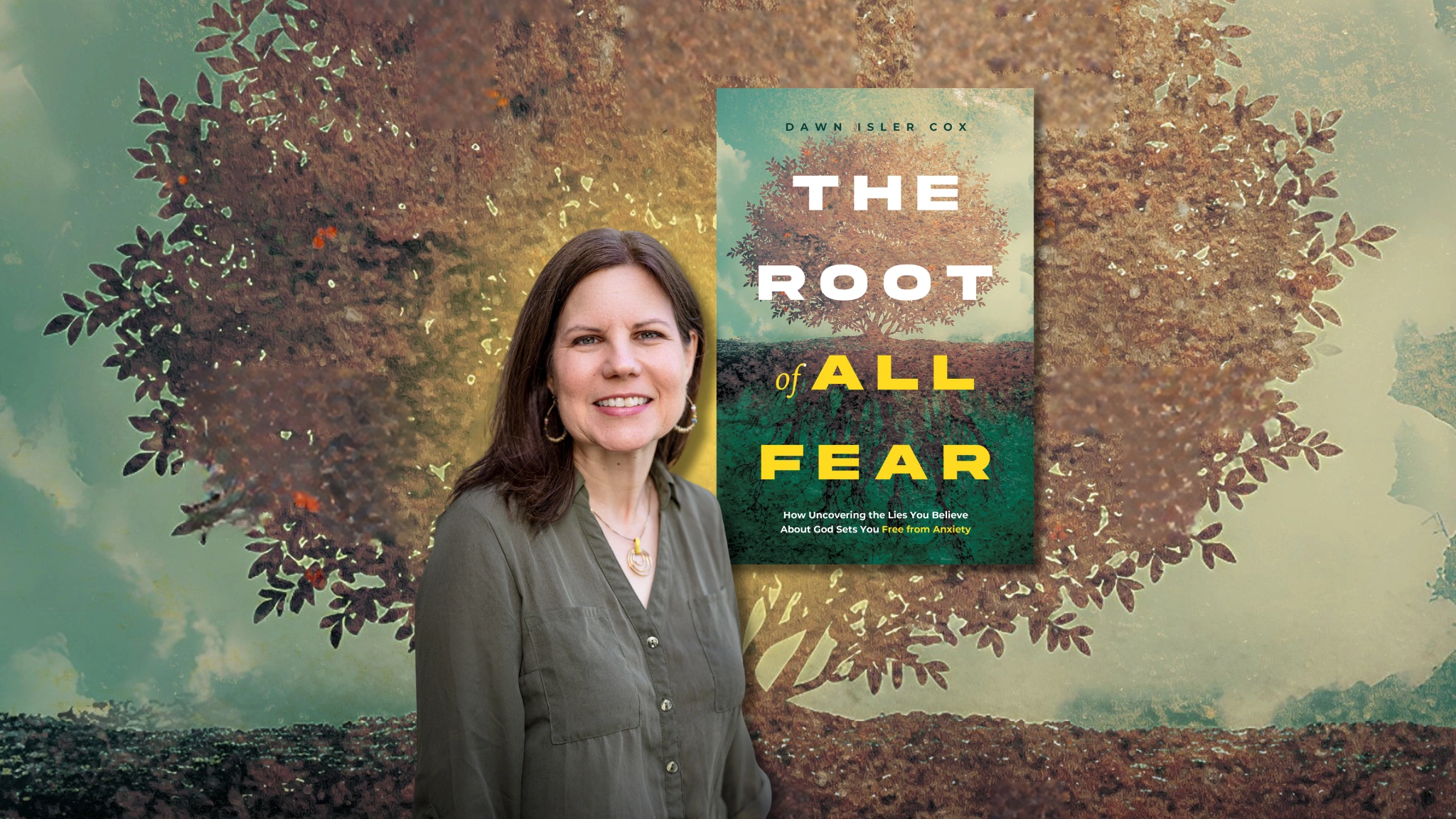
In a culture marked by chronic worry, overthinking and fear, Dawn Isler Cox believes anxiety often reveals something deeper than difficult circumstances — it exposes what we truly believe about God. In her book, The Root of All Fear, Cox uses the vivid “Berry Bush” metaphor to help readers identify the hidden root lies fueling anxious thoughts and replace them with the truth of God’s character. In this conversation, she shares the personal experiences that shaped the framework, the “God lies” she wrestled with most deeply and the practical habits that have helped her cultivate peace, trust and freedom in Christ.
The Berry Bush metaphor is central to your book. Can you share how you developed that image and a specific moment when it crystallized for you as a teaching tool?
About fifteen years ago, I was asked to lead a women’s retreat with the theme of living free from lies. While I was preparing for it, I came across a brief paragraph in Nancy DeMoss Wolgemuth’s Lies Women Believe and the Truth That Sets Them Free that compared lies to poisonous berries. She pointed out that you have to get to the root to destroy the plant. That imagery struck a profound chord in me. I began to view my chronic patterns of worry and rumination through the lens of the Berry Bush illustration. I asked myself, “Why was I feeling like this?” and kept asking “Why,” trying to get to the specific, hidden root feeding me these poisonous thoughts. It wasn’t long before I realized that my surface-level worries weren’t just random anxieties; they were actively pulling me to believe a fundamental lie about the character of God.
I continued to question my thoughts using the Berry Bush metaphor. When I noticed anxiety in others, I would share this illustration with them, and they found it helpful too. I began integrating it into my ministry and saw how it resonated with those who had felt entirely stuck in rumination. The Berry Bush provided a visual, a way to understand what was happening in their minds. When I saw others successfully using it to take their thoughts captive, I was convinced that this wasn’t just a personal coping mechanism that only worked for me, but that it was a repeatable, powerful tool that could help change others’ journey with Jesus, too.
The absolute crystallization moment for me came when I realized that identifying the problem was only half the battle. It clicked that we couldn’t just recognize what the root lie was but needed to replace it with the truth and have roots and fruit that feed off the truth. The Truth Tree provided a beautiful counter image. We couldn’t just tear out the lies about God; we had to intentionally plant a tree, rooted firmly in His true character, that would bear the fruit of peace, safety, confidence, and freedom. That moment is when the metaphor became a complete, life-changing framework that I wanted to share with others.
You identify three core root lies about God (untrustworthy, disapproving, not in control). Which of those was hardest for you to confront personally, and how did God help you uproot it?
In The Root of All Fear, I talk about five main “God lies” that often feed our anxiety: God is not good, God doesn’t love me, God doesn’t approve of me, God is not trustworthy, and God is not in control. Out of all of them, the hardest one for me personally was the lie that God didn’t really love me.
As a little girl, one of the first songs that I remember singing was “Jesus Loves Me.” I grew up knowing in my head that God loved me. But when I started paying attention to my anxious thoughts, I realized that deep down, I was struggling to actually believe it. When life got difficult, my default setting was to question His love. I found myself struggling, constantly striving to prove my worth to Him, paralyzed by a fear of disapproval, and quietly convinced of His indifference or detachment from my daily pain.
That realization was painful because it showed me the difference between what I said I believed and how I was actually living.
One of the biggest things God taught me during that season was that healing does not happen alone. God used other believers to help remind me of what was true when I could not see it clearly myself. When I felt entirely detached and down, I needed the body of Christ to remind me of the truth. I needed others to sing of His love over me when I couldn’t find the melody myself and to tangibly be His hands and feet. Through honest conversations, prayer, encouragement, and care, God used His people to bridge the gap from my head to my heart, helping me move from simply knowing the concept of His love to fully believing in and resting in it.
I think that is one of the beautiful things about a Christian community. Sometimes when we are struggling to believe the truth for ourselves, God uses His people to help hold onto it with us until we can stand firmly in it again.
What practical first step would you tell someone to take when they realize their anxiety is feeding a “God lie”?
The very first step is to pause and be honest with God.
When we realize our anxiety is connected to a lie about God, our first reaction is often to panic, feel ashamed, or try to push the thoughts away. But instead of spiraling, I think it is so important to stop for a moment and acknowledge what is happening.
Let’s approach Jesus the way that the father of the demon-possessed boy in the Gospel of Mark did. He asked Jesus to help, saying, “If you can.” When Jesus called him out on it, the father replied, “Lord, I do believe; help my unbelief.” I love that posture because it reminds us that God is not asking us to pretend like we have great faith. We can come to Him honestly and say, “God, I am struggling to trust You right now, and I need Your help.”
When we take a moment to pause and reflect on what we are thinking, it will help us to shift from just reacting to anxiety to actually paying attention to the root underneath it. Instead of focusing only on the fear itself, we can begin asking deeper questions like, “What am I believing about God right now?”
From there, it can help to write your thoughts down or talk with a trusted friend who can help you process what is going on. But for me, the most important first step is to slow down, bring the fear into the light, and invite Jesus into it instead of hiding it or fighting it alone.
Community and confession are emphasized as essential to digging up root lies. What do healthy, safe practices for vulnerability look like in a church or small group context?
Vulnerability is a beautiful concept, but living it out can feel incredibly risky. For a small group or church community to become a safe space to confess our deep “God lies,” we must intentionally cultivate a place where people feel safe being honest, without fear of shame or judgment. So many people walk into church feeling like they have to appear strong or pretend they have everything together. But when we hide our struggles, the root that lies underneath them will stay hidden too.
Real healing happens when we bring those struggles into the light with trusted people who reflect the heart of Jesus.
First, healthy vulnerability must always be modeled from the top down. I think it is especially important for leaders to go first. Safety begins when leaders share their own “Berry Bush” moments, their own late-night spirals, and the specific root lies they themselves have had to wrestle with. When a leader goes first, it breaks the stigma of shame and gives everyone else in the room permission to take off their masks.
I also think a healthy community means learning not to try to “fix” people immediately. If someone confesses deep anxiety or doubt about God’s character, our natural default is to respond with trite platitudes, quick advice, or a surface-level Bible verse, trying to patch things up in a nice, neat way. We don’t want to feel uncomfortable! However, a community that has safe practices takes a moment to pause, actively listen, and hold space for however messy it might get. Instead of scrambling to fix the surface symptoms or scolding someone for a lack of faith, healthy practices look like asking gentle, diagnostic “why” questions. It looks like saying, “Thank you for sharing that weight with us. Let’s sit in this together and ask the Holy Spirit to show us the truth.”
Yes, vulnerability is important, but wisdom and trust matter. Not every space is safe for every story, and people should never feel pressured to share more than they are ready to share. It should grow slowly over time.
Confidentiality is a must, but the ultimate goal of group confession is intercession. For me, the best safe practice would be moving from policing the “berries” to cultivating the “Truth Tree” collectively. When a member uncovers a root lie—such as believing God is distant or unreliable—the group’s job is to stand in the gap for them. We do this by speaking and praying the true character of God over them when they are too weary to see it themselves. A healthy small group shouldn’t be a place where we manage each other’s behavior; it should be a safe garden where we help each other confront the poisonous berries of fear, dig together to uproot them, and then plant deep roots reminding us of God’s goodness.
Ultimately, I believe the church should be one of the safest places on earth for people to say, “I’m struggling,” because the gospel itself is built on the reality that we all need grace.
You describe moments when prayer produced surprising, “flabbergasting” answers. Can you share one brief story of an answered prayer that reshaped the way you view God’s character?
For months, my husband and I had been praying for our nine-year-old daughter, who had developed a deeply sensitive heart for the homeless. We kept asking God to provide a tangible, safe opportunity for her to act on those feelings and serve someone in need.
The answer came on a day when I was completely overwhelmed. I was buried under a massive ministry project, flat out of time, and my daughter asked if we could go to the library. Feeling the pressure of my looming deadline, I reluctantly agreed to take her to a branch across town near where I had to run another errand. It was a library we had never visited before. As I put the car in drive, I breathed a frantic, somewhat selfish prayer: “Lord, please make this quick.” When we arrived, the street parking was completely full. But right as I was about to give up, a car pulled out, leaving a perfect parallel spot. I thanked God for the small victory and backed in. As I got out, I noticed two men nearby wearing neon vests. I assumed they were construction workers and waved, but as I grabbed our bag of books, one of the men approached me. He gently told me they were incredibly hungry and asked if I could help.
I searched in my wallet but had no cash. I searched in the car and found nothing but a few leftover crackers in a lunchbox. But right across the street was a Dollar General. Pointing to it, I offered to buy them lunch, even though a voice in the back of my mind was sighing, “Oh brother, this is going to delay my work even more.” What happened inside that store completely broke me. My daughter grabbed the shopping cart, her face absolutely beaming. She walked down the aisles with this gentleman, encouraging him to get whatever he wanted and eagerly pointing out snacks he might like. She was completely in her element. After checking out, we stood outside the store and prayed over them.
Driving home, tears started to fall as I realized the breathtaking way God had just answered two completely different prayers at once. He didn’t answer my hurried, superficial prayer for a fast workflow track. Instead, He answered the deep prayer of surrender that my husband and I had been praying for our daughter’s heart.
That moment profoundly reshaped my understanding of God’s character and my expectations of prayer. I realized that God is not a vending machine executing our immediate timelines; He is a loving Father who is always orchestrating something infinitely bigger than our daily to-do lists. He cared deeply about the physical hunger of those two men, and He cared deeply about the spiritual growth of my nine-year-old daughter. He is Love—that is entirely who He is—and He is constantly at work, inviting us out of our busy schedules and into the beautiful privilege of sharing that love with His children.
How should someone respond when suffering or tragedy seems to contradict the truth claims (e.g., “God is good” or “God is in control”)?
Suffering is the ultimate testing ground for our theological roots. Pain has a way of shaking us so deeply that the gap between what we say we believe and what we actually feel can suddenly seem enormous. In those dark moments, the loudest whispers we hear are almost always: God is not good, God won’t take care of you, and God doesn’t care about you.
For me, the first and most vital step in responding to suffering is anticipation. Just knowing that these specific “God lies” are on their way to target my thoughts helps me prepare my heart for the battle. When tragedy strikes, the enemy does not just attack our circumstances; he attacks our understanding of God’s character. So, when those thoughts show up, instead of panicking or feeling ashamed, I can pause and say, “There it is. I knew that lie would come.” Recognizing it is often half the battle.
We see this exact battleground play out in the Bible in the life of Job. He experienced unimaginable grief, loss, and suffering, and yet when we look at his story, we see that the real war wasn’t just about what he lost; it was about his theology. Underneath it all was the question: what would he ultimately believe about God? Job wrestled deeply, wept loudly, and asked agonizing questions. He didn’t pretend that it didn’t hurt, forcing himself to believe shallow answers. However, he did something crucial: he continued bringing his grief to God instead of allowing resentment to turn him away from God completely.
Because I expect these “God lies” to show up in the midst of pain, I can have a proactive plan ready to meet them, just as Job did when he famously declared, “Though He slay me, yet will I trust Him” (Job 13:15). That phrase is the ultimate “even if” mindset.
Instead of panicking or feeling like a spiritual failure because I’m wrestling with deep pain, I can look at those intrusive thoughts and say, “Hey, I recognize this lie about God’s character.” By calling it out, I have stripped the thought of its power to shame. Every single one of us will confront these agonizing moments. But when we refuse to acknowledge that a “God lie” has entered our minds, it quietly burrows into our hearts, taking root and eventually bearing the bitter fruit of anger, deep resentment, pride, and isolation. But when we acknowledge them honestly and bring them into the light, we can begin to replace them with truth.
Responding to suffering faithfully doesn’t mean we pretend it doesn’t hurt, or that we don’t cry out in our grief. It means that like Job, while we weep on the ash heap, we actively refuse to let the pain rewrite who our Father is. We choose to stand up and declare, just as Job, “Even if.” Even if I cannot understand this tragedy right now, my Father is still good, He is still in control, and He is holding me.
For readers who want to create their own “Anxiety Action Plan” and Berry Bush exercise, what are three daily habits you recommend to replace lies with biblical truth over time?
Building an Anxiety Action Plan is not about finding a quick fix. For me, healing has looked much more like creating daily rhythms that slowly renew my mind and keep redirecting my thoughts back to the truth. Moving from the Berry Bush to the Truth Tree is really a process of learning to stay rooted in God’s character over and over again.
One of the biggest things that has helped me is surrounding myself with Scripture. I found that when my mind was constantly ruminating on what-if scenarios, flooded with fear and anxious thoughts, I needed to be immersed in truth throughout the day, not just during a quick, quiet time in the morning. John Piper uses the phrase “Bible Bath,” and that image has really stayed with me. What helped me most was making Scripture part of my environment: memorizing it, praying it, listening to worship music, writing verses down, and hanging them around my house where I would regularly see them. Over time, that steady exposure to truth began reshaping the way I thought about God and about my fears.
Another practice that has helped me is taking an anxiety audit at the end of my day. Anxiety thrives in the dark, and we often try to ignore it or hide it out of shame. I try to pause and reflect on where anxiety showed up and what might have been underneath it. If you do this, here are some questions you could ask yourself: Where did fear grip you? Were you “catching” anxiety from others, or were you “spreading” it through your reactions? And then, in that anxious moment, don’t scold yourself. Treat it as a flag pointing to a root.
Instead of condemning myself for feeling anxious, I try to get curious about it. What was I believing in that moment? What fear was driving my reaction? Bring it straight to Jesus, invite Him into that specific memory, and say, “Lord, this berry of fear is growing from a lie. Show me what it is and draw me closer to You here.”
Lastly, I think it is important to have intentional ways of abiding in God throughout the day and to learn how to speak truth back to our own thoughts. So often, we sit and listen to fearful thoughts without challenging them. But we need to preach truth to ourselves the way the psalmist did when he said in 42:5, “Why are you downcast, O my soul? Put your hope in God.” A tool that completely revolutionized this for me was practicing the “Sixty-Sixty Experiment“ from John Burke’s book, Soul Revolution. It involves setting an alarm on your phone every 60 minutes for 60 days to pause, check in with God, and ask, “Am I abiding right now, or am I running on fear?” This practice will interrupt the rumination cycle and point our thoughts back to the truth.
For me, these kinds of daily habits have not been about perfection. They are simply ways of continually turning our minds back toward truth and allowing God to cultivate peace, trust, and freedom over time slowly.