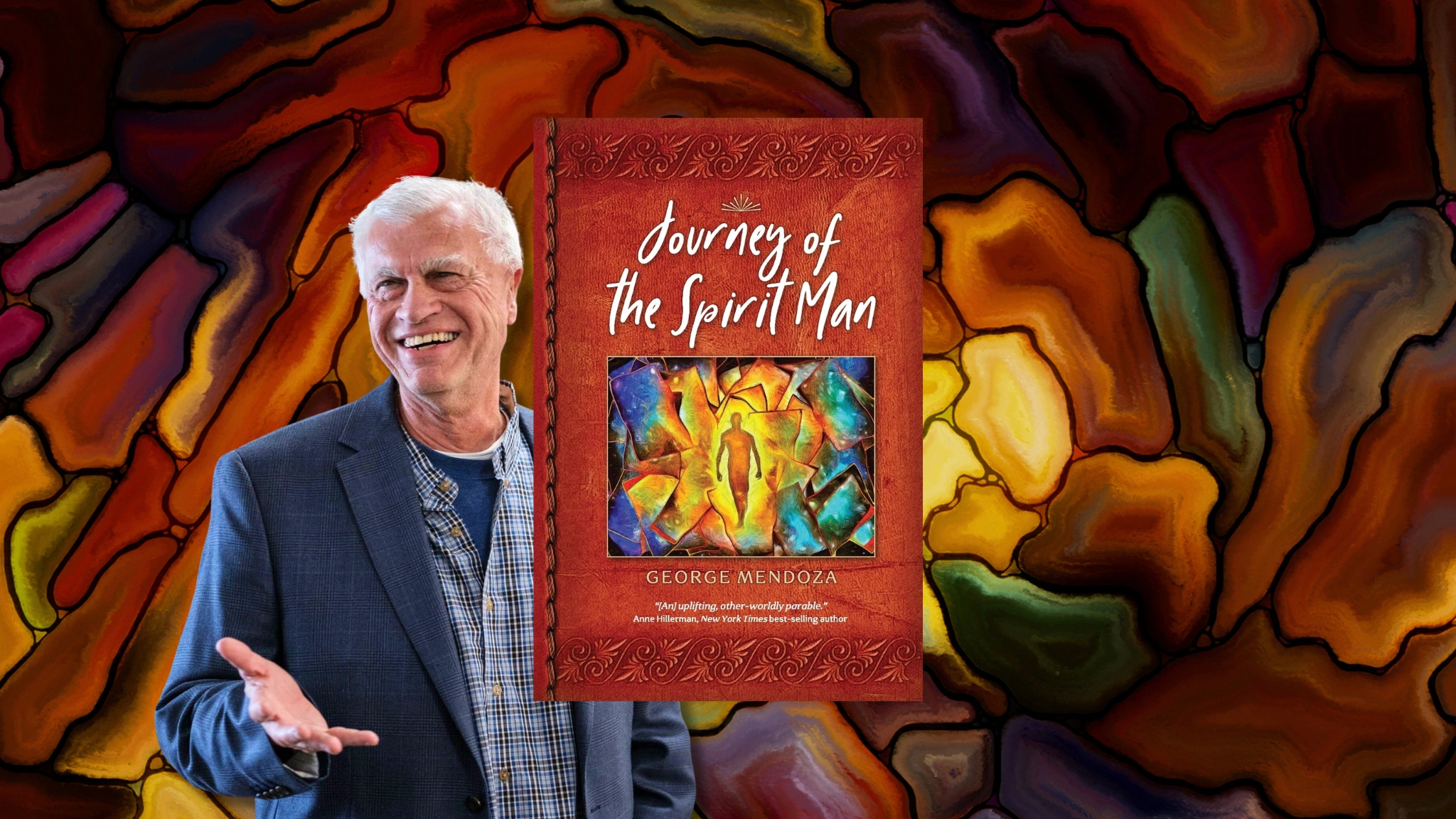
George Mendoza’s Journey of the Spirit Man is a sweeping tale of adventure, spiritual transformation and self-discovery, inspired in part by the author’s own remarkable life experiences. Following a devastating hiking accident that led to vivid, recurring visions, Mendoza began weaving together elements of fantasy, psychology and personal reflection into an epic novel about resilience, redemption and the search for purpose. In this conversation, he discusses the real-life events that shaped the story, the autobiographical threads behind his characters, the influence of New Mexico’s landscapes and the enduring message of hope at the heart of Journey of the Spirit Man.
In your author’s note, you explain that the novel grew out of vivid visions you experienced after a serious hiking accident. How did those experiences shape the story, and where do you draw the line between personal inspiration and fiction?
After my serious hiking accident in 2011, when I fell thirty feet, broke my arm and teeth, and began suffering cluster headaches, I started to have many vivid visions. These visions lasted for months due to the headaches, which were very painful and terrible to deal with. One of these visions was of me walking through a magical gate of sorts. I saw an arena of death and hell. I saw white sand dunes in the desert with nomad riders. I saw a slice of heaven in Paradise. I saw ancient lands like Egypt. I would say some of it was personal, but mostly it was fiction. As a world traveler, I have seen many distant lands, and I have had many high adventures in my life. I drew on these experiences and the power of imagination to write this epic story.
Michael begins the novel as someone who defines himself almost entirely by achievement, confidence and winning. Why was it important for you to strip those certainties away so early in the story?
Michael is an egotistic maniac. I had to bring him down into a harsh reality after he walked through the magical gate and into a dream world, which was like hell, where he had to learn many lessons of the spirit. All his fame and glory faded away in the dream world, which tested his courage and stamina just like a champion runner in the so-called real world. Was his long journey real? I will leave that scenario up to the reader. If you ask me, I really don’t know if Michael was real or a myth!
The novel blends psychological struggle, spiritual symbolism, fantasy and adventure. What drew you to combine these genres instead of telling a straightforward fantasy or coming-of-age story?
This is a very interesting question for sure. Michael is me. The Spirit Man is me. Therefore, Michael and the Spirit Man are one. I was lost, depressed, and suicidal. In my story, Michael is a long-distance runner. I am a runner. I ran away from my fears. Michael runs all over the place in my story. I prayed to God, or the gods, for a divine healing so I could see again. But nothing happened. I had to pick up the pieces in my own life just like Michael has to continue his journey as the Spirit Man. A good friend of mine told me that my story is about my journey from darkness back into the light. Michael had everything. He was a champion runner, a wealthy, popular student and athlete, and yet, in one race that he lost, his whole world fell apart. To me, the magic gate symbolizes a transformation of the human spirit despite all the odds. Michael faces a lot of defeat and despair in my story as well as hope and inspiration. He becomes a better person. Like Dorothy in The Wizard of Oz, Michael eventually finds his way back home.
New Mexico is more than just the setting—it feels like a character. How did the Organ Mountains, the desert landscape and the region’s history influence the world-building of Journey of the Spirit Man?
This is an easy answer! New Mexico is the land of enchantment, and the vast desert all around me I call The Wastelands of Shook! As a kid, I explored the Organ Mountains with my beagle dog, Sammy, and I would ride with my friends into the West Mesa and all over the state of New Mexico. There are many magic adobe gates in New Mexico, and I have walked through all of them! As I told you before, I am the great Spirit Man, alive and well! I have many more stories to share with you, my friend!
The friendship between Michael and Mark is central to the novel, especially their arguments about ego, humility and what it truly means to have “spirit.” What message were you hoping readers would take from their relationship?
The relationship between Michael and Mark is based on a true story between myself and my blind best friend, T.G. Gibbs, from the New Mexico Blind School. I went blind at fifteen, moved from New York City with my mother, and enrolled in the blind school in Alamogordo, New Mexico. I was feeling sorry for myself. I was lost as hell, depressed, suicidal, and I wanted to quit life itself. I was sitting on the front steps of the main administration building, crying and feeling sorry for myself. T.G. Gibbs would have nothing to do with my pathetic blind ass! T.G. Gibbs was a wild-looking cowboy with a floppy hat and rose-colored sunglasses. He kicked my butt in just like Mark kicked Michael’s big ego ass! “Where is your spirit, Spirit Man?” I wanted to use T.G. Gibbs’ real name in my book, but I just could not write it down, so I made Mark Lucero a composite character in my story based on Gibbs. Mark pushed Michael to become a better person. Gibbs pushed me to overcome my disability and blindness.