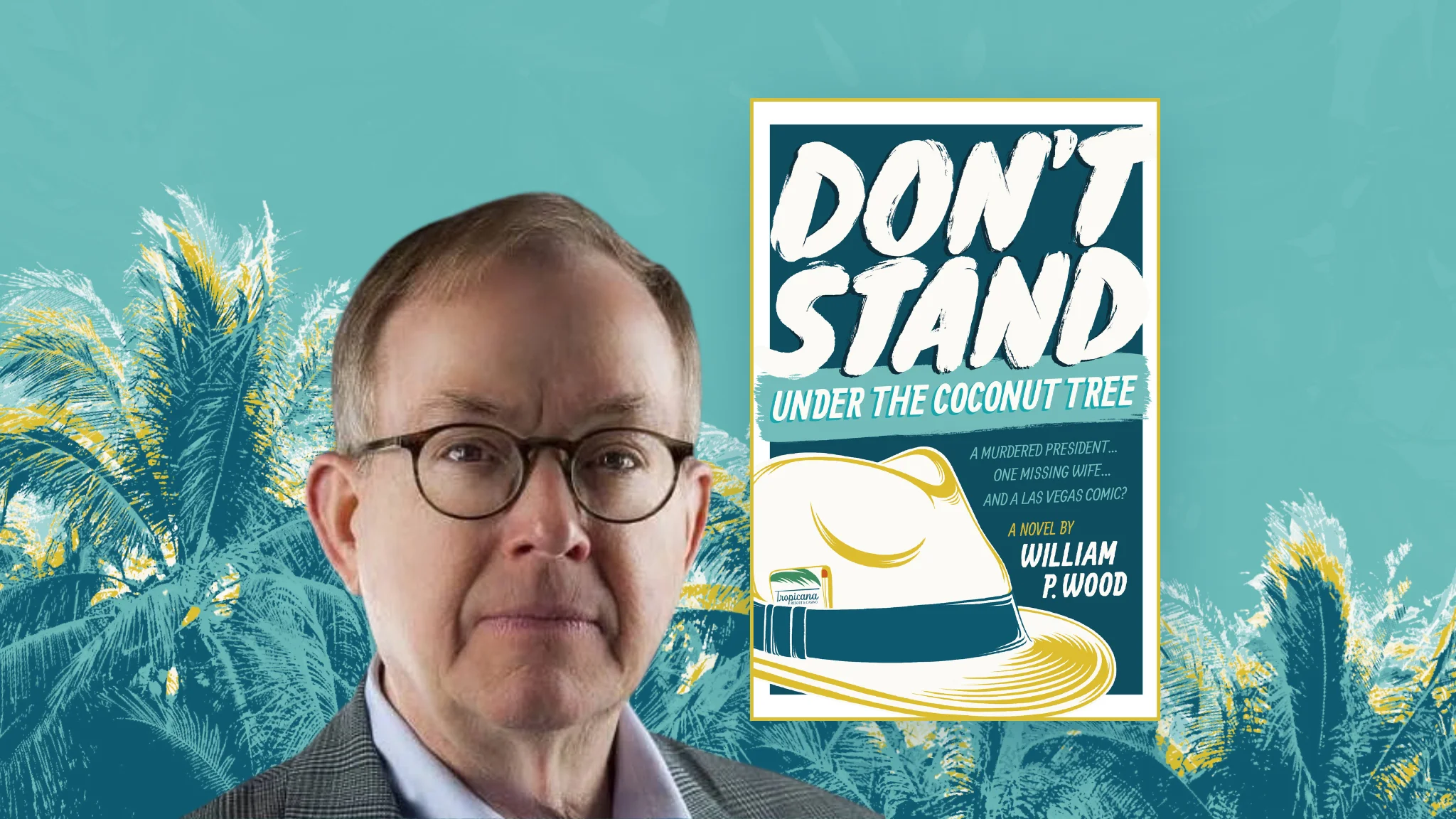
In Don’t Stand Under the Coconut Tree, acclaimed author William P. Wood takes readers on an unpredictable journey through 1960s America, blending comedy, conspiracy, romance and speculative intrigue. At the center of it all is Lonny Day, a Las Vegas comedian and presidential impersonator whose career comes crashing down after the President’s assassination — just as his marriage begins to unravel. What follows is a strange and increasingly surreal search for his missing wife, Doris, that leads Lonny from mobsters and eccentric characters to mysterious experiments, questions of immortality and possible extraterrestrials. In this Q&A, Wood discusses the inspiration behind Lonny’s unforgettable voice, the balance between absurdity and emotional depth, and the larger questions about love, fate and the limits of human control that lie beneath the novel’s humor.
The novel begins with Lonny Day’s career collapsing almost instantly after the President’s assassination. What drew you to the idea of exploring such a serious historical moment through the perspective of a comedian whose livelihood depends on impersonating the President?
It’s obvious that big, world-changing events change big things. But my courtroom experience, time and time again, showed how even small crimes could completely upend people’s lives. Lonny is a small boat in the great scheme of things, but he gets swamped when the president he’s based his career on is assassinated. John F. Kennedy, Lonny’s meal ticket, famously said, “Life is unfair,” as Lonny soon discovers in his frantic hunt for his missing wife.
I was captivated by the idea of a guy whose whole world depends on one thing, finding everything topsy-turvy in an instant. Reality starts looking pretty shaky to him. Besides, I’m nuts about magicians and stand-up comics who risk everything every show. Who better to experience a serious, momentous event than through a funny man who’s suddenly not funny?
How did you develop Lonny’s distinctive comic voice, and what did that voice allow you to explore that a more conventional narrator might not have?
Lonny popped up without any help from me. He spoke, acted, and yakked away, mostly on his own. He’s a very insistent character. I’d finish work for the day, and he kept talking, agitating, seeing the nutty things happening in his world, so, wearily, I had to get back and write it down.
I know show business, from writing for the CBS-TV series “Kaz” to the movies based on my novels, Rampage and Broken Trust. I spent time on TV and movie sets. Vic Mizzy, most famous for composing the theme to The Addams Family, was a family friend. Like Lonny, he was a fountain of show-biz stories. But Lonny Day is his own guy, as he would adamantly insist. He’s unique in all of my novels. He’s real. I fully expect to run into him someday.
Lonny’s search for Doris takes him from Las Vegas into an increasingly strange world of conspiracies, eccentric characters, mysterious twins and even possible extraterrestrials. How did you balance the novel’s escalating absurdity with the emotional seriousness of Lonny trying to save his marriage?
As his whole existence spirals out of control, Lonny has one bedrock, one anchor, as he searches for Doris, who he loves deeply, unreservedly, and with more than a slight blind spot. He believes they have a terrific marriage, alongside his career in Las Vegas and TV. So as he encounters danger, eccentrics, and maybe even something more in the obsessed ventriloquist and his sinister dummy, Lord Fanshawe, he keeps his marriage and Doris as his sure guides. He also has his old friend at the Tropicana casino, Roberta, the former rodeo queen, to keep his head on straight.
When he’s beaten up by mob-goaded goons, or when he escapes from the mad veterinarian Dr. Tamm, who wants to exhibit him as a prize medical discovery, Lonny’s grip on reality is sustained by his vision of winning Doris back and by Roberta’s practicality. Like a lot of show-biz folks, he’s single-minded and obstinately optimistic once he makes his mind up.
At one point, Lonny recognizes that his relentless pursuit of success has contributed to his problems with Doris. How important was it for you that his journey involve some self-reflection beneath the comedy and chaos?
Lonny is not the most self-aware or reflective guy. But as his quest to find his wife takes him farther and farther down the rabbit hole of an America reeling from assassination, he gets a glimmer, then a sharp slap upside the head, that his pursuit of success has hurt Doris. He’s let her down. His adventures with nuts, kooks, and maybe extraterrestrials have shaken him up enough to see his selfishness and narcissism more clearly. Not completely. There are limits to introspection and self-flagellation, after all.
The story eventually brings Lonny to a Hawaiian island where questions of extraterrestrial life, extraordinary abilities and extending human life begin to converge. What interested you about mixing those speculative elements with a story rooted so firmly in 1960s America?
I’ve always been fascinated by the fascination with magic, UFOs, and fringe science about making human beings immortal. Most of my novels and movies have been solidly rooted in law, crime, and courts. So when Lonny embarks on his quest for Doris, it seemed like a hoot to have him find out where her fixation on longevity led. The reclusive billionaire’s resort and lab on Maui, and his quasi-health-and-longevity cult, were nascent aspects of things going on in the 1960s, and they really flowered as the deranged decade rolled on. Lonny and Doris learn that everything they know is wrong.
The title takes on a deeper meaning in the novel’s final lines, when Lonny realizes that sometimes there is a “coconut with your name on it” no matter where you stand. What does Don’t Stand Under the Coconut Tree ultimately mean to you, and what do you hope readers take from that idea?
“Don’t stand under the coconut tree” is a warning sign and, as Lonny realizes, a portent posted everywhere on Maui, where he finally finds Doris. Like most show-biz folks, Lonny has a strong streak of fatalism. His quest and its conclusion have convinced him there is an inevitability to life’s trials and tribulations. I thought of John O’Hara’s use of the famous tale of “the appointment in Samarra” as the title of his first and best novel.
Like Lonny, I hope the reader recognizes and accepts the scope given to us to ride the waves of life. Not the immortality Roberta and the obsessed billionaire vainly run after, but our days and the people we care about, and, if we’re fortunate, care about us in turn. There are limits to what we can grasp or avoid. So be it.