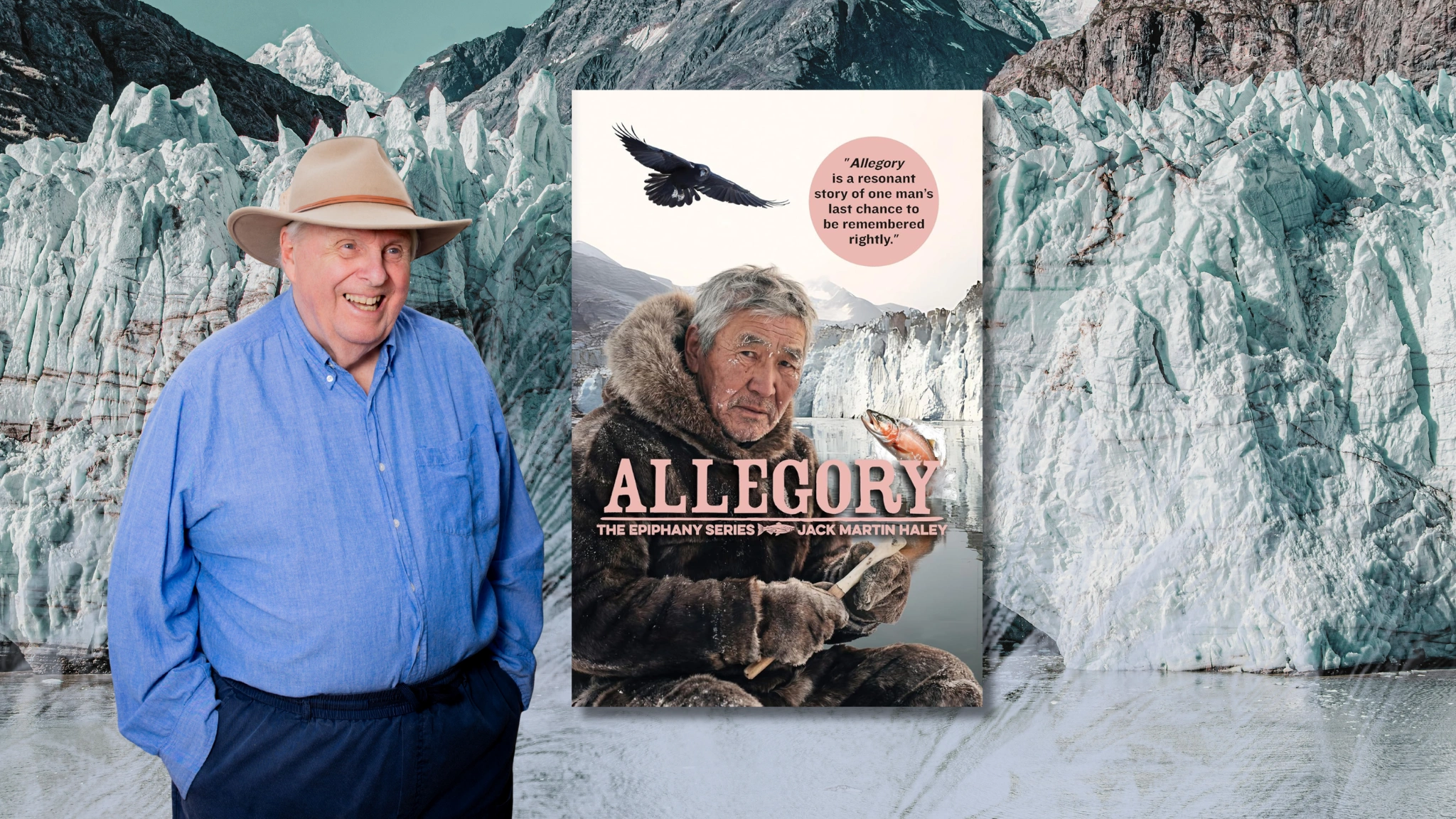
For nearly seventy years, Jack Martin Haley carried the seeds of Allegory with him. Inspired by oral stories he first heard while living among the Gwich’in people of Alaska in the late 1950s, the novel blends folklore, memoir, history and fiction into a meditation on honor, identity, faith and cultural survival. In this interview, Haley reflects on the enduring influence of Indigenous oral tradition, the symbolism of the salmon’s journey, the challenge of portraying painful historical realities with honesty and respect and why the story of Christian Grandson remained with him for a lifetime before finally finding its definitive form.
You attribute Allegory to stories you first heard in 1958 and carried for decades. How did those early oral accounts shape the novel’s central figure, Fred/Christian Grandson and how?
The original idea for the old man and a battle with the King Salmon was inspired by Hemingway’s The Old Man and the Sea; the allegory is the same — the quest for respect. Fred, the old man, Sarge, and Christian Grandson (“my ass”) are a composite of two old men consumed with the need to regain respect from a community from which their star had fallen. Each one brought life experiences to the story of Christian Grandson who was indeed the great grandson of the legendary shaman, chief, and first Christian, Shahnyaatii, aka Christian Grandpa. Fred’s story, derived from several distillations, is, as with oral tradition, somewhat different in each telling by several storytellers. My rendition after nearly 70 years is different in many ways, too numerous to recall. The metaphor remains the same, though: to regain lost respect and a place of honor among his people. Much of him is based on a single storyteller versus a composite of voices.
What drew you to exploring the tension between Indigenous spiritual tradition and Christianity, and did writing about that tension change your own perspective?
In the 1950s: Here was a culture newly thrust into the 20th century, the remnants of their past still very fresh, as was the growing influence of the encroaching vanoodlet and manifest destiny. I was fascinated, even as a boy, with early cultures and the effects change had on them. Here were the new people, white people—vanoodlit—with their boats with huge wheels on the back, and their ways of speaking insisted that the dinjii naii should speak only the vanoodlit language. So, it became critical that I tell this story from the vanoodlit as interlopers while maintaining the dignity of the dinjii naii.
Allegory blends memoir, folklore and fiction. Can you describe your process for translating oral histories and remembered episodes into a fictional narrative while remaining respectful to Gwich’in culture and the original storytellers?
I am enough of a Gwich’in speaker that I can pick up the native rhythm and translate it into the story; even so, I find myself, as I write the narrative, slipping into the tempo, such as when the old man lies down to take a nap: Christian Grandson sat down to rest, they say. And he closed his eyes. He was tired and just wanted to rest a little. And they say he never opened his eyes again. And that’s all.
The salmon and fish-wheel imagery recur as sacred, sacrificial and redemptive motifs. Why did you choose the salmon’s journey as the structural and spiritual motif?
Alaska is salmon, a way of life for the people of the Yukon. It just made sense for this story to take place in this mystical setting; Fred’s journey from despair to honor is an allegory, and the salmon’s journey is an allegory of life through many challenges and perils to the ultimate conclusion: achieving life’s one goal, mission accomplished. The parallels between the old man’s quest and the salmon’s quest are to me a metaphor for life. Through Allegory, I hope readers can relate to their own journeys.
Our lives are a parallel to the old man’s. Every life’s journey is an allegory.
The novel portrays hard truths: alcoholism, public humiliation, illness and cultural erasure. How did you balance depicting these painful realities with honoring the dignity and resilience of the Gwich’in people you know and grew up among?
It is a fact of life in every society, and the good thing about terrible facts of life is that there are always people — Indigenous, Black, white and Asian — who come from the community and effect change. Such is the way of the Gwich’in. At the time of this writing, it was the way of things. They cannot be ignored, and as a writer, it’s my job to portray accurately what I see.
You began publishing this material decades ago and have now released it as the first of the Epiphany series late in life. What prompted you to return to and finally resurrect Allegory now and how has your relationship to the story changed.
This story, through all of its iterations, has haunted me since the day I first heard it. I kept telling it, writing it, rewriting it, telling it, and retelling it and finally it was finished. I went to my bookshelf and pulled the RECORD, a notebook in which I wrote the first ever draft as it was told to me. And, guess what, amazingly it hasn’t changed that much!
Over the years, through many careers as a nonprofit executive, scout executive, and camp director, where I honed my storytelling skills; as a broadcaster; short story writer of fantasy, science fiction, and westerns; newspaper editor, columnist and reporter. The old man has been with me. I love that old man; his failings, his determination and his gentle wisdom — which I cherish most — have been in my heart and soul always. He has appeared in three different volumes: A Rainbow for a Dying Old Man (c. 1973), Epiphany, an Allegory (2025), and now Allegory.