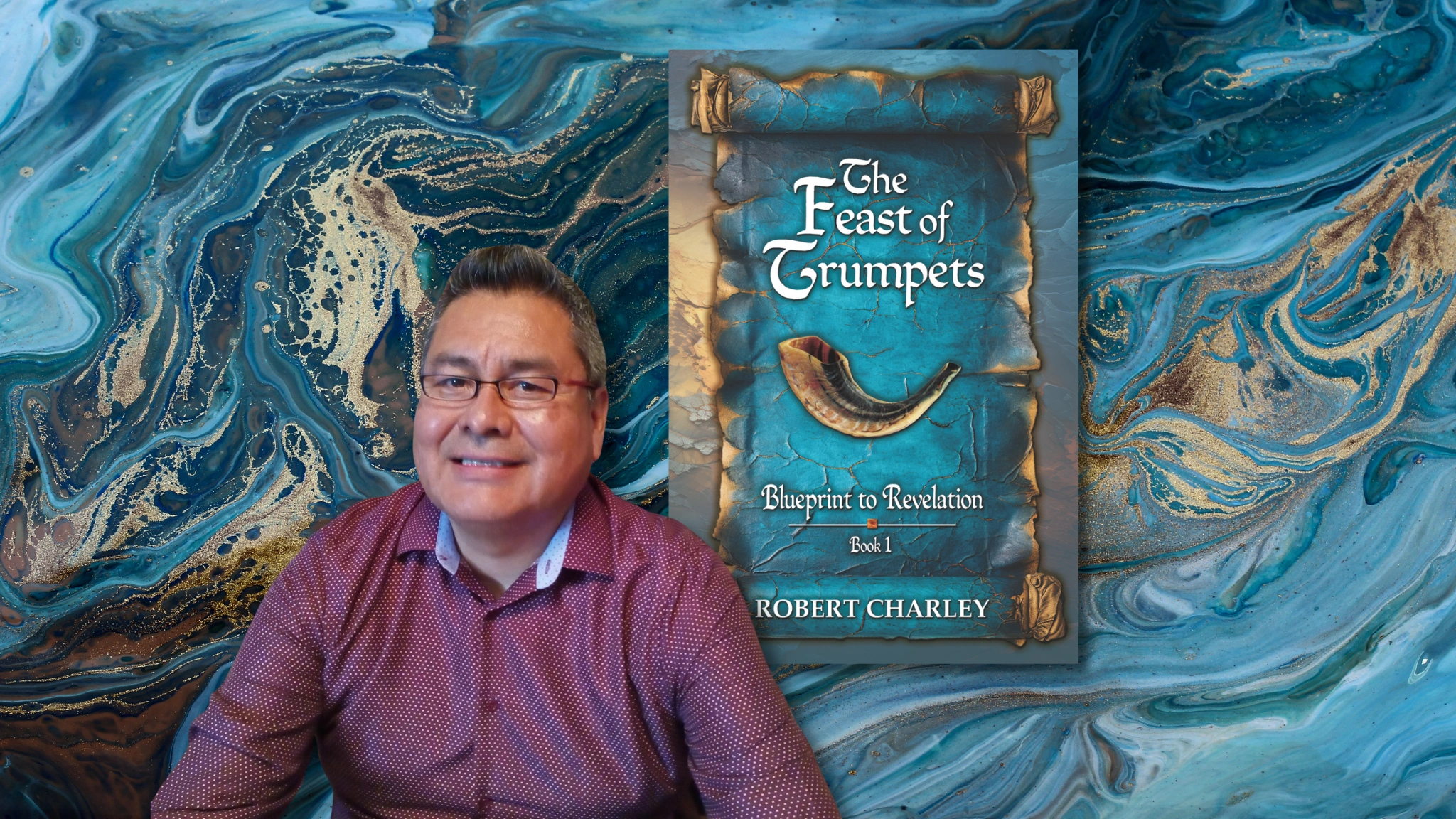
For many readers, the Book of Revelation is the Bible’s most mysterious and intimidating text, filled with vivid symbolism, apocalyptic imagery and competing interpretations. In The Feast of Trumpets: Blueprint to Revelation, author Robert Charley offers a different approach, arguing that the key to understanding Revelation has been hiding in plain sight within the Old Testament’s biblical feast days and Hebrew worldview. Drawing on decades of Bible study and Hebrew scholarship, Charley presents a framework that connects the Torah, Jewish traditions and the New Testament into a unified prophetic narrative. In this interview, he discusses what led him to this perspective, why he believes Revelation should inspire hope rather than fear and what he hopes readers will discover as they revisit one of Scripture’s most debated books.
You argue that the key to understanding Revelation is through the biblical Fall Feasts, particularly the Feast of Trumpets. What first convinced you that this was the missing interpretive framework?
Before I started studying Jewish sources. I used to read the entire Bible from Genesis to Revelation every year for 15 years straight. Different English translations. For one year, my wife ordered an Artscroll Tanach for her personal studies, and what we liked was the Hebrew names of God and commentary. This perked my interest in Hebrew; at the same time, in my walk with God, I was looking for direction. I went to a Bible conference and heard a message by T. D. Jakes and sensed the call to study the Bible in depth. I looked into Bible colleges, which did not work out, and stumbled into the Center for Biblical Hebrew and met Uri Harel. He taught the Torah from the perspective of what this Hebrew word means and not from Rabbinic commentary. I went to his class and continued every week for the next two years. I learned the Aleph-Bet and how to write in Rashi script. (Although since I have not used it, I forgot it.)
Another great influence on me back in the nineties was Dr. John Maxwell, whom I listened to regularly on his Injoy Life Club tapes. One of the greatest teachings I got from him was what he called a growth plan. He stated growing does not occur by happenstance; growth comes on purpose, by dedicated study: daily, weekly, and yearly. Nonstop, over time it will compound. So I applied this principle to my Hebrew studies. I heard a rabbi say he read a Torah commentary volume every year, then started a new volume the next year. So I took up that practice. For the last 20 years plus, my goal has been to complete a Torah commentary set every year.
After five years of studying the Bible from a Hebrew perspective. I started teaching again to teenagers, then to adults, at a church I attended. I taught the whole Torah like Uri; we read every verse from Genesis to Deuteronomy, verse by verse. After we finished as a group, I asked the group, “What should we study next?” They all came back and said, Revelation. I never intended to teach Revelation; it just happened.
Since my focus was on the Old Testament for five years, I had not read Revelation for several years. When I read Revelation to put the study together, with my new Jewish perspective. Revelation came alive; I understood the symbolism. The idioms and what was taking place in the book. I realized God is fulfilling the Fall Holy Days.
Through the years, from 2010 to today, I taught other groups and churches the Torah from Genesis to Deuteronomy and finished with Revelation. Teaching the Torah first gave the students a basic framework for understanding Revelation.
Throughout the book, you describe Revelation as a book that should be understood rather than feared. Why do you think so many Christians have come to associate Revelation primarily with the Antichrist and the end of the world instead of the revelation of Jesus Christ?
I believe most people read Revelation having no biblical knowledge. Yes, it is a scary book, but we have to look at the big picture and understand what God is doing with man and planet Earth. He is re-creating the Earth, and it begins with birth pangs and preparation for the Messiah’s return, who I believe is Jesus Christ. A title Jesus uses in Revelation chapter one is “he who holds the keys of Death and Hades; he has authority over death.” This is basic Christian doctrine: that Jesus will resurrect the dead, that even in the face of death, you will be born again in a new body, not reincarnated. You will be you. One chapter I wrote is The Revelation of the Resurrection to convey that message.
A recurring theme in the book is the idea of “blueprints” — that Old Testament events, feast days and customs foreshadow New Testament fulfillment. How do you determine when a biblical parallel is an intentional blueprint rather than a coincidence?
Jesus said, in his famous Sermon on the Mount, “Do not think that I came to abolish the Torah or the Prophets! I did not come to abolish, but to fulfill. Amen, I tell you, until heaven and earth pass away, not the smallest letter or serif shall ever pass away from the Torah until all things come to pass. Therefore, whoever breaks one of the least of these commandments and teaches others the same shall be called least in the kingdom of heaven. But whoever keeps and teaches them, this one shall be called great in the kingdom of heaven. Matthew 5:17-19 TLV.
First, Jesus taught that he did not come to end the Torah, as many Christians teach. He confirms the Torah. Jesus said, Whoever teaches others to break the Torah will be called least in the Kingdom. But whoever keeps and teaches the Torah will be called the greatest in the Kingdom. How clear can this be? But modern Christianity teaches that after he died, he abolished the Torah. If you teach this, you make Jesus a liar, and you will be least in the kingdom.
Number one, I am convinced the Torah is active because heaven and earth have NOT passed away. Therefore, the Torah pattern is in Revelation because God relayed the message to Jesus, and Jesus relayed the message to John. (Recall, Jesus said the Torah is valid.) Also, John is Jewish; he was a disciple of John the Baptist before following Jesus. John the Baptist’s father was Zechariah, from the course of Abijah; he was a descendant of Aaron. He was a legitimate priest. So I wonder if John was a Levite or a priest. Of course, both knew the Torah.
So when I read Revelation through Jewish lenses, the number seven is prevalent. The fall feasts are all in the seventh month. The customs, seals, and trumpets. Etc. Zichronot, Malkiyot, and Shofarot are all there. Those under the altar are like Akeidat Yitzchak, the Binding of Isaac; although they are under the altar, Isaac was on the altar.
You point readers back to the original Hebrew language and worldview, even discussing God’s name, Yehovah, and the symbolism behind Hebrew words and letters. How has studying Hebrew changed your own faith and the way you read Scripture today?
I would say Hebrew has solidified my faith and brought clarity to the New Testament. The writers of the New Testament did not have a New Testament when they wrote their doctrines; they only had the Torah and Tanach. Plus additional writings from that period of history. They assume you already know the Old Testament. So when I became a Christian, as I already mentioned, I read the entire Bible every year. So I had a basic understanding, more than the average Christian. Most Christians only read the New Testament, so when New Testament authors mention Abraham or Esau, most people don’t have a clue what they are explaining because they have no background to the story in Genesis.
When I understood from the Jewish perspective, common events came alive. John writes about an event that took place on the Feast of Tabernacles (John does not write about the Feast of Tabernacles) and how Jesus talked about living water. Mayim chiam. Most Christians don’t have a clue what Sukkot is or the water-drawing. Jesus also talks about the light of the world on Sukkot. Unless you know what was happening on Sukkot generations ago, you only get a glimpse of what Jesus is saying. Jesus says, Abraham saw my day and rejoiced. Here again, people miss it. They don’t understand this relates to Akeidat Yitzchak and Yehovah Yireh. And also, Jesus wanted to be baptized by John the Baptist; Christians don’t understand why. Recall John’s father was a Cohen. Knowing the Jewish perspective has brought a depth of knowledge in the New Testament, and like the book of Revelation, a lot of Christians miss the deeper meaning.
One of the book’s strongest messages is that judgment begins with the church before it comes to the world. What do you hope modern Christians take away from your discussion of the seven churches in Revelation, especially in light of today’s cultural challenges?
First, one thing I realized when I started writing this book is that not all churches are the same; maybe they do not have the same language or the same song style. Maybe some have old organs and pianos, or maybe some have modern styles like a concert stage, or others have no music. Maybe some have ritual prayers they recite first, and others don’t. Some are wealthy, and some are poor. We are all different, but like the menorah, connected to a single branch that sprouts into seven. We are all united by Jesus Christ, a Jew from the tribe of Judah. His teachings and his death and resurrection unite us.
With change, technology, and the increase of knowledge. Get back to the basic teachings of Jesus. Here again, many Christians believe Jesus, out of the blue, spoke these words for the first time to mankind and ignored that the lawyer asked what the greatest commandment in the law is.
And one of them, a lawyer, questioned Him, testing Him, and saying, Teacher, which is the great commandment in the Law? And Jesus said to him, “You shall love the Lord your God with all your heart, and with all your soul, and with all your mind.” This is the first and great commandment. And the second is like it: “You shall love your neighbor as yourself.” On these two commandments all the Law and the Prophets hang. Matthew 22:35-40.
When you show them he quoted Deuteronomy 6:5 and Leviticus 18:19, they are astonished that it’s written in the Old Testament. Study your dusty Bible, the entire Bible. Get in the habit of reading it.
Get in the right relationship with God and your fellow man. Worship God only, and if you have any broken relationships, get back in harmony with them. Be accountable for your actions and make it right if you have wronged anybody. If you live an immoral lifestyle, return to Jesus and change your lifestyle and mirror him.
Change is coming to the entire world. If you follow Jesus’ teachings and the Torah, the world culture will hate you for it. Persecution is coming for the church and the house of Israel. Resolve in your heart to stand for the Lord. Pray and understand the revelation of the resurrection. Don’t be surprised when the trials come. Settle your accounts with your fellow man. Reflect Jesus and show your love for one another.
For all humanity I say, the white horse is here, and the red horse is at the door. Prepare for hardship. The Feast of Trumpets is an examination by God of all mankind.
You state that your goal is not to win theological arguments but to make the voice of Jesus Christ ‘clear, audible and understandable. After readers finish this book, what is the one transformation or realization you most hope they experience?
God is real. Prophesy is real. There are evil forces in the world. Through Jesus, there is hope for the future. I am convinced Jesus opened the first seal in 2020; that year shook all of humanity. Today we say pre-pandemic and after-pandemic. It changed our world. It is here. Yom Teruah is a hidden day, so the world did not recognize it. If it follows the pattern, the red horse will enter the scene and shake the entire world again. Expect it. All these events will transpire upon all the sons of Adam. Once the birth pangs are over and the earth is re-created, humanity will still have another thousand years on earth.