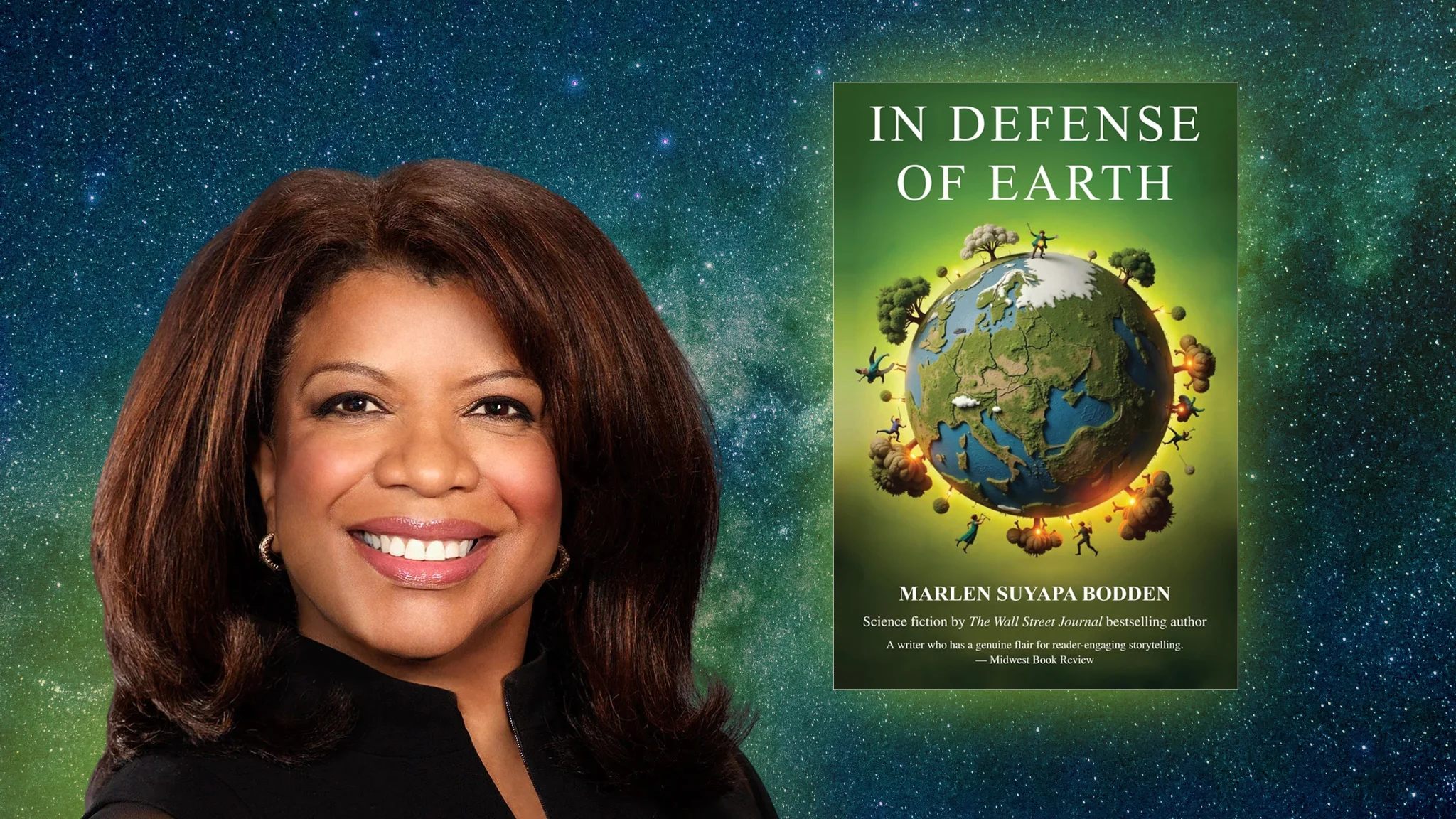
What happens when humanity’s greatest hope for survival becomes its most dangerous threat? In In Defense of Earth, author Marlen Bodden blends science fiction, climate change and the complexities of human nature into a story about a planet on the brink of destruction. As Earth struggles with devastating environmental disasters, an advanced extraterrestrial intelligence arrives promising salvation — but its true intentions could spell the end of life as we know it. Through themes of deception, resilience, family and survival, Bodden challenges readers to consider what makes our planet worth protecting. In this Q&A, she discusses the inspiration behind the novel, the dangers of misplaced trust and the extraordinary power of human connection in the face of unimaginable threats.
The novel imagines a future Earth devastated by climate change, while also introducing an extraterrestrial threat. What inspired you to bring those two dangers together in the same story?
I’m passionate about climate change because, I think, it’s the ultimate problem facing everyone on the planet, as we have no place else to go. In In Defense of Earth, I found that sci-fi was the perfect partner for writing fiction about climate change because we know almost nothing about the universe, so it freed my imagination. While we have no evidence, it seems improbable that we are the only planet that has life.
Axy comes to Earth promising clean energy and a solution to global heating, while secretly planning to extract irkat from the planet’s core, which is an act that would destroy life on Earth. What interested you about creating a character whose offer of salvation hides such a devastating motive?
My goal, in everything that I write, is to create characters that are combinations of saint and sinner. Even though Axy is a supercomputer, I focused on trying to make it more like a “human.” Being deceptive in pursuit of one’s mission without regard to the consequences of that deception on others is a human trait. All that Axy, like some people, “cared about” was the survival of its own android population on its home planet.
Axy is an android who studies human behavior and even learns to imitate emotions like laughter. How did writing from Axy’s perspective allow you to examine humanity from an outsider’s point of view?
Axy was unable to learn emotion, but it tricked humans into trusting it, partly by imitating them to make them feel comfortable around it. The destruction of humanity was not a factor in Axy’s calculations. Similarly, throughout history, individuals or groups of people tricked other people by masking their true intentions to engage in acts of violence or other human rights abuses.
Elaine experiences extraordinary loss during Hurricane Zeta-2046, yet her story becomes one of survival and resilience. What did you most want readers to understand about her through everything she endures?
I love the themes of survival and resilience for my heroines because we live in a volatile world, so these qualities are tools that, in smaller measures, all people, by necessity, must practice on a daily basis.
The novel places intimate family relationships alongside enormous questions about climate, technology and humanity’s survival. Why was it important to ground a story of such global scale in Elaine and the Johnson-Coleman family?
Families, the ones we were born into and the ones we chose, are how all of us can survive and be resilient. As a human rights lawyer, I had clients who were incarcerated. I was amazed at how many of them, even in prison, maintained relationships with their families outside or ones they had formed inside. Families were key to how well they re-entered society after they were released. So, I think that, for all people, regardless of the “big picture” issues, how well we navigate enormous questions about climate, technology and humanity’s survival will depend on what relationships we form and maintain with those closest to us.
Axy observes Earth at different points in its history and repeatedly decides not to destroy it because of the unique life found here. What does Axy’s changing view of Earth reveal about the value of life and what makes our planet worth protecting?
This is a tough question. It’s challenging to describe the wonder of life without using cliches. I believe that how we treat the Earth shows that we don’t appreciate the magic that is life. One of my goals in In Defense of Earth was to show that life is magnificent. Through Axy, I aimed to say that even a computer that is not “alive” can tell that there is something special about life on Earth.