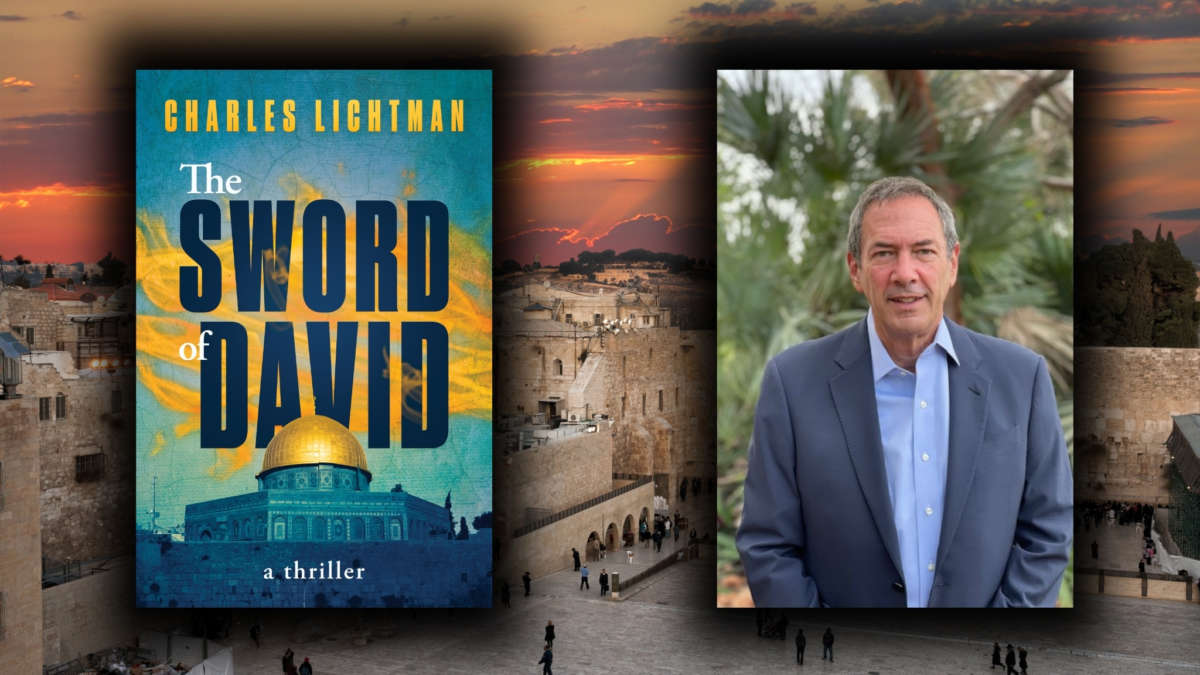
Charles Lichtman was a man with a plan. Well, boy with a plan. And I’ll be darned if he didn’t make himself proud. The New York Times reviewer Alan Dershowitz boldly claims that this book is “A Jewish Da Vinci Code with an even better ending.” High praise!
The Sword of David (Post Hill Press) introduces readers to The Siege of Jerusalem, 70 A.D. The High Priest sees the oncoming disaster and attempts to assuage it by protecting the holiest, most sacred religious relics. The Foundation Stone survives, but unfortunately the same can’t be said for the Ark of the Covenant and the Ten Commandments. 2,000 years later an Israeli Special Forces officer finds the hidden chamber containing the long-lost Ark after surviving his own, much more modern, terrorism attack. A quest for the Ten Commandments ensues, and he’s not alone in the search. A nefarious, mysterious enemy agrees that finding it is worth a great price, and the race is on.
This novel is globe-trotting, high-flying, thrill-seeking, code-breaking, secret-revealing and of course, twist-ending. We were excited to ask the author all about the passion project that stems from years of childhood dreams and is brought to life by countless hours of fruitful research. Read our full review here.
Q: You wanted to write spy thrillers from an early age. What made you fall in love with the genre, and what would you consider to be the biggest influences on your own work?
A: When I was a young boy, my Uncle Al took me to see From Russia With Love. Afterward, I told him that I loved James Bond and that the movie was the greatest ever made. Uncle Al then went upstairs and came back with a bag filled with nine paperback versions of Ian Fleming’s Bond novels. I read them one after another and then literally told my parents that when I grew up, I wanted to write spy novels. I still have those books to this day. I never strayed from my goal and The Sword of David is now my second Middle East-based thriller. Of course, my best influences were Fleming, Ludlam, Clancy, Silva and Steven Spielberg.
Q: Speculation regarding the whereabouts of the Ark of the Covenant has produced many stories, one of the most popular being George Lucas’ Raiders of the Lost Ark (1981). What drew you to this particular legend?
A: First, there is so much mystery and power attributed to the Ark of the Covenant. Mystery as to what happened to the Ark, and power in as much as, according to the Old Testament, God manifested his or her presence on Earth through the Ark. No one is more powerful than God, right? So in order to make a fictional story come together in the end, and be both wholly satisfying and seem as if the final event in the story really happened, only the existence of the Ark, on display for the world to visibly see, with all of its glory and power, made the conclusion logically viable.
Q: What other legends or conspiracies might you like to explore in a future project?
A: I think tracking down what happened to the ten missing tribes of the twelve that existed in Israel would be a fascinating venture. That dates back to 722 BCE which is when the ten tribes were apparently scattered all over the world. I’m guessing that through genetic tracing, there is a lot of Jewish blood in a people who might not want to hear that. To be sure, I don’t really know where this will lead me.
Q: The research for this novel must have been rather extensive. How did you approach this process, and what aspects did you find most challenging?
A: I love conducting the detailed research necessary to make a fictional story feel real. Doing research is not work for me: it’s playtime. Basically, I come up with the locale or premise that I need to get perfect as I write my story, and I don’t stop until I’m convinced I have it locked down right. For The Sword of David, I traveled to Rome, Paris, Istanbul, London and Israel many times. I photograph every place I visit so I can go back to the pictures and describe the location accurately, so the reader feels like he or she is there.
Q: Toggling between both Klein and the terrorists, the novel travels through a diverse group of countries, many of which you’ve also visited. To what extent did your own travels support your research and shape The Sword of David?
A: I actually conduct significant research before I depart for any location because I don’t want to waste time and make the trip a guessing game. I go to locales to make sure I have it right and to add color or learn other facts you can only compile by being right where the written scene is to occur. As an example, I probably spent 40 hours just in the Western Wall Plaza and the Temple Mount area in Jerusalem exploring every inch, trying use a movie director’s eye to assess what has the best visuals.
Q: What sets The Sword of David apart from other terrorist thrillers?
A: First, it is not formulaic. It’s not just good guy versus bad guy. But, I also do kill off characters that the reader would think were essential and who I know will be popular, because after all, the book deals with terrorists who wreak havoc where one least expects it. Most importantly, no thriller writer ever finished a book with the unexpected but satisfying ending that concludes The Sword of David. I wrote the book with that ending in mind from the moment I started the project.
Q: Can readers expect to see more of Klein?
A: Yes, and I have a lot planned for him as well. But I’m not sharing that just yet!
https://booktrib.com/wp-content/uploads/2021/09/Chuck-Lichtman-Headshot-300×300.jpg
About Charles Lichtman:
Chuck Lichtman is an expert in Middle East affairs and issues regarding terrorism. His newest novel, an action-packed spy thriller, The Sword of David, is available now. He has twice been recognized as “Lawyer of the Year,” founded a national voter protection program, and is an avid photographer and pianist. He lives in South Florida with his wife and two dogs.