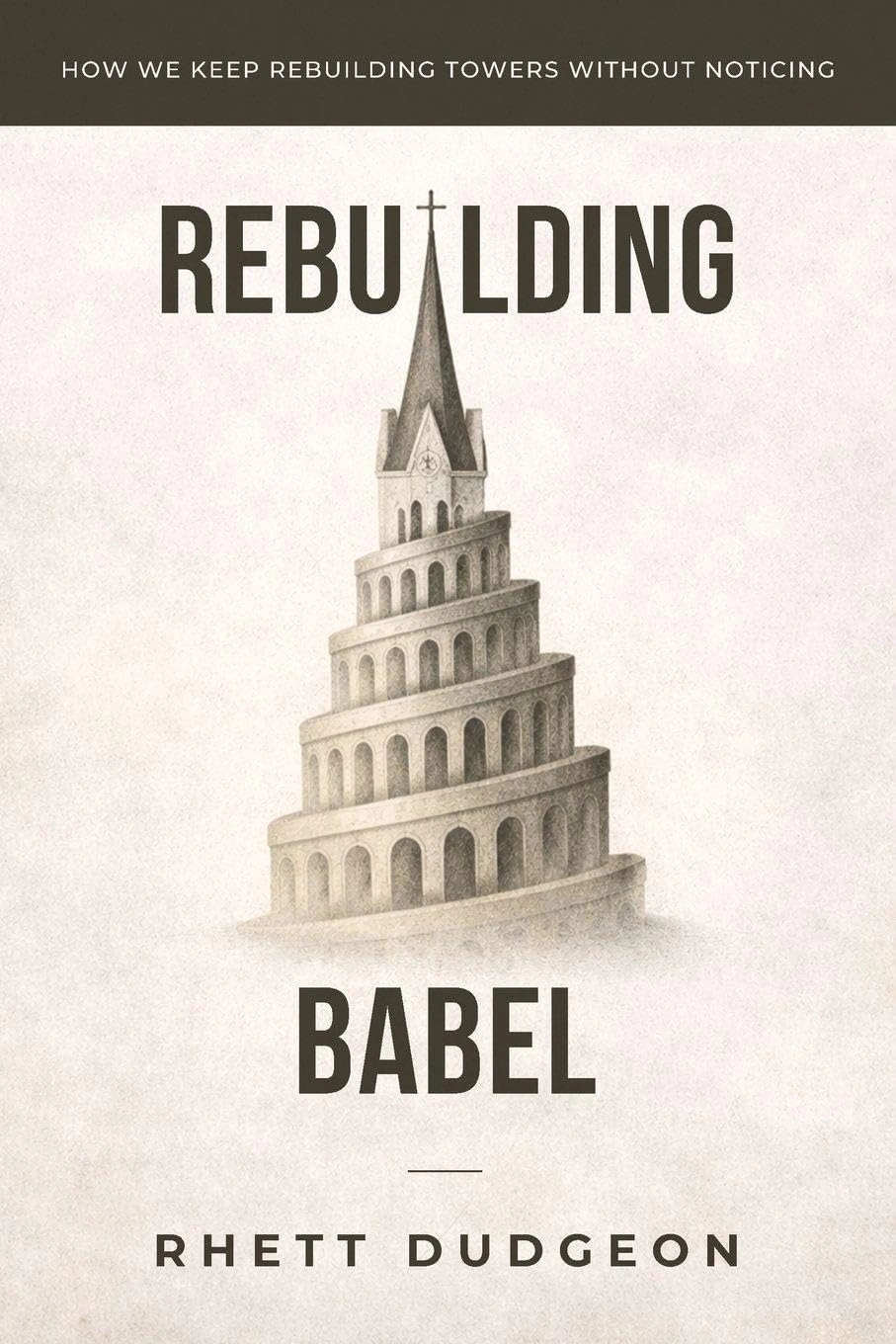
Rebuilding Babel by Rhett Dudgeon
Rhett Dudgeon‘s Rebuilding Babel is a debut from a Bible college graduate turned construction worker and “ministry dropout,” and that background shows up everywhere in the best way — the writing is grounded, plainspoken, and refreshingly unpretentious for a book that’s ultimately doing serious theological and historical work.
The book opens with a story about the author’s dog, Winston, and a misidentified “tick” that turns out to be something far more embarrassing. It’s a small, self-deprecating anecdote, but it sets up the whole project perfectly: we march forward confident in our diagnoses, Dudgeon suggests, and sometimes we’ve simply gotten it wrong. From there, the book uses that same approach to ask a much bigger question — has the modern institutional church, brick by brick, rebuilt the very tower God scattered at Babel?
Structurally, the book is organized into five distinct “books” that trace a clear arc: from Genesis and the image of God, through the Fall and the priesthood of believers, into the early church of Acts, through the slow institutional drift of the Constantinian era, and finally into an examination of the tithe and the modern church’s relationship to money and buildings. That’s a lot of ground to cover, but Dudgeon paces it well, and the five-part division gives the reader natural places to breathe between the heavier historical sections.
Trading the Tower for the Table
The strongest material lays out the book’s central image with clarity: the early church in Acts 2 wasn’t built around strategy or structure but around a shared table, devoted teaching, and daily presence. Dudgeon contrasts that table with the tower — the impulse to build something impressive, visible, and self-sustaining rather than something simply faithful. It’s a metaphor he returns to throughout, and it holds up well as an organizing thread across chapters on empire, tithing, and the priesthood of all believers.
What impressed me most was the research. Dudgeon is pulling from the Didache, Justin Martyr, Tertullian, Origen, Pliny the Younger, and other early Christian and Jewish sources to ground his argument about what the earliest church communities looked like, not just what we assume they looked like. That historical grounding gives weight to chapters like “When Empire Wore a Cross” and the multi-chapter arc on how the tithe changed shape over centuries.
The humor deserves its own mention. Between a dinner-table story about accidentally eating a host family’s food and the Winston anecdotes, Dudgeon has a gift for using self-deprecation.
A Hopeful Vision of What Church Could Be
The epilogue is where the book’s pastoral heart is most visible. Rather than ending on critique, Dudgeon pivots to a direct, almost liturgical address to the reader, insisting that the point was never to tear down the church but to become it and to carry the temple rather than build one.
Rebuilding Babel will land best with readers who’ve felt some version of the disillusionment Dudgeon describes in his introduction — the sense that church has started to feel like more mess than medicine — but it doesn’t require that starting point to be worth reading. It’s a well-researched, warmly written, and hopeful book about what gets lost when community calcifies into institution, and what it might look like to recover the table instead of the tower.
About Rhett Dudgeon:
 Rhett Dudgeon is an unlikely author — a Bible college graduate, ministry dropout, construction worker, husband, and father. Raised among hardworking, unpolished people, his writing is shaped less by ivory towers and more by lived experience, hard questions, and honest faith. Though new to publishing, he writes from a place of deep concern for those who feel lost, wounded, or quietly wandering. Having studied theology, stood in pulpits, and seen behind the curtain, Dudgeon writes with clarity, humility, and compassion. He lives in Ohio, where he builds, learns, dreams, and continues asking what faithful life looks like in the real world.