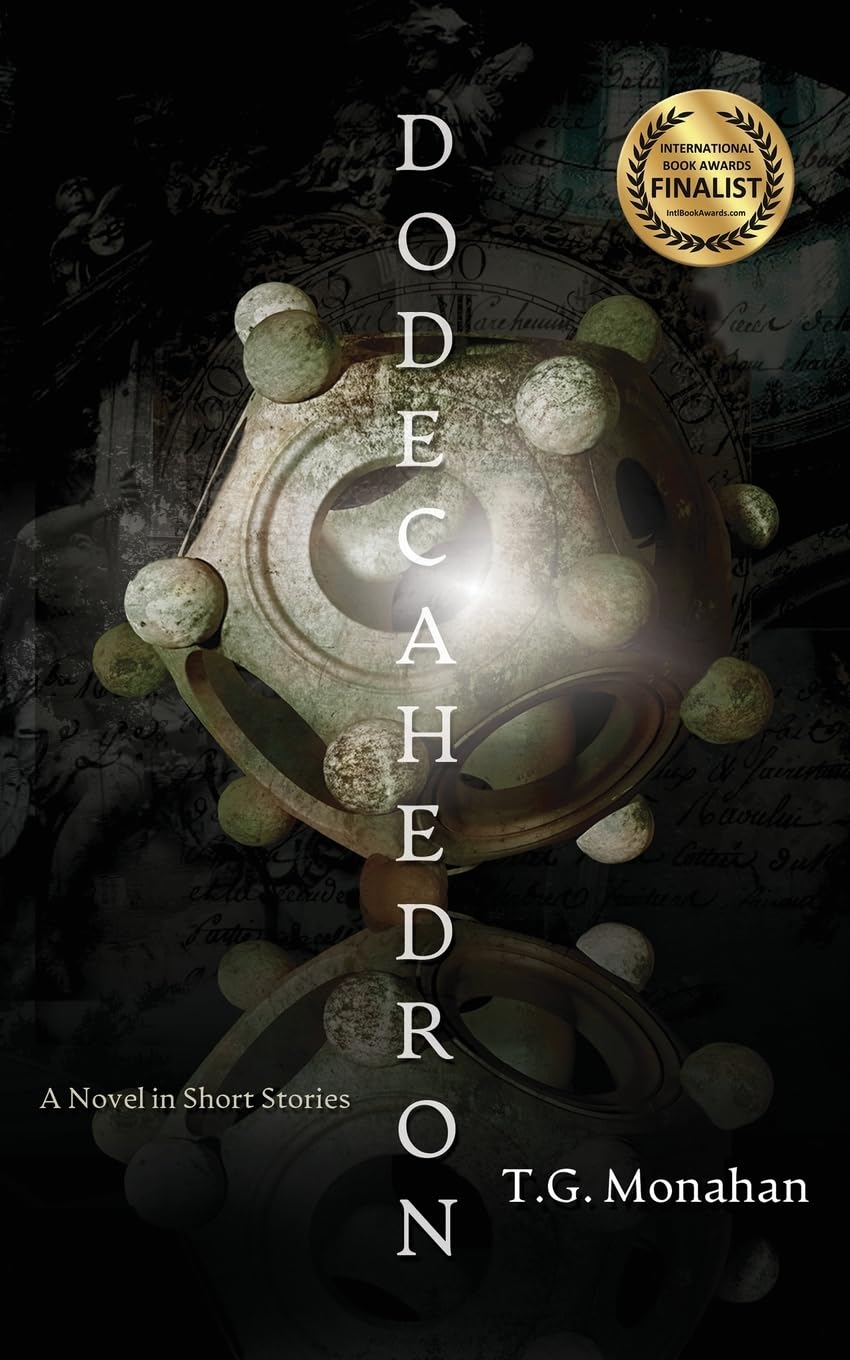
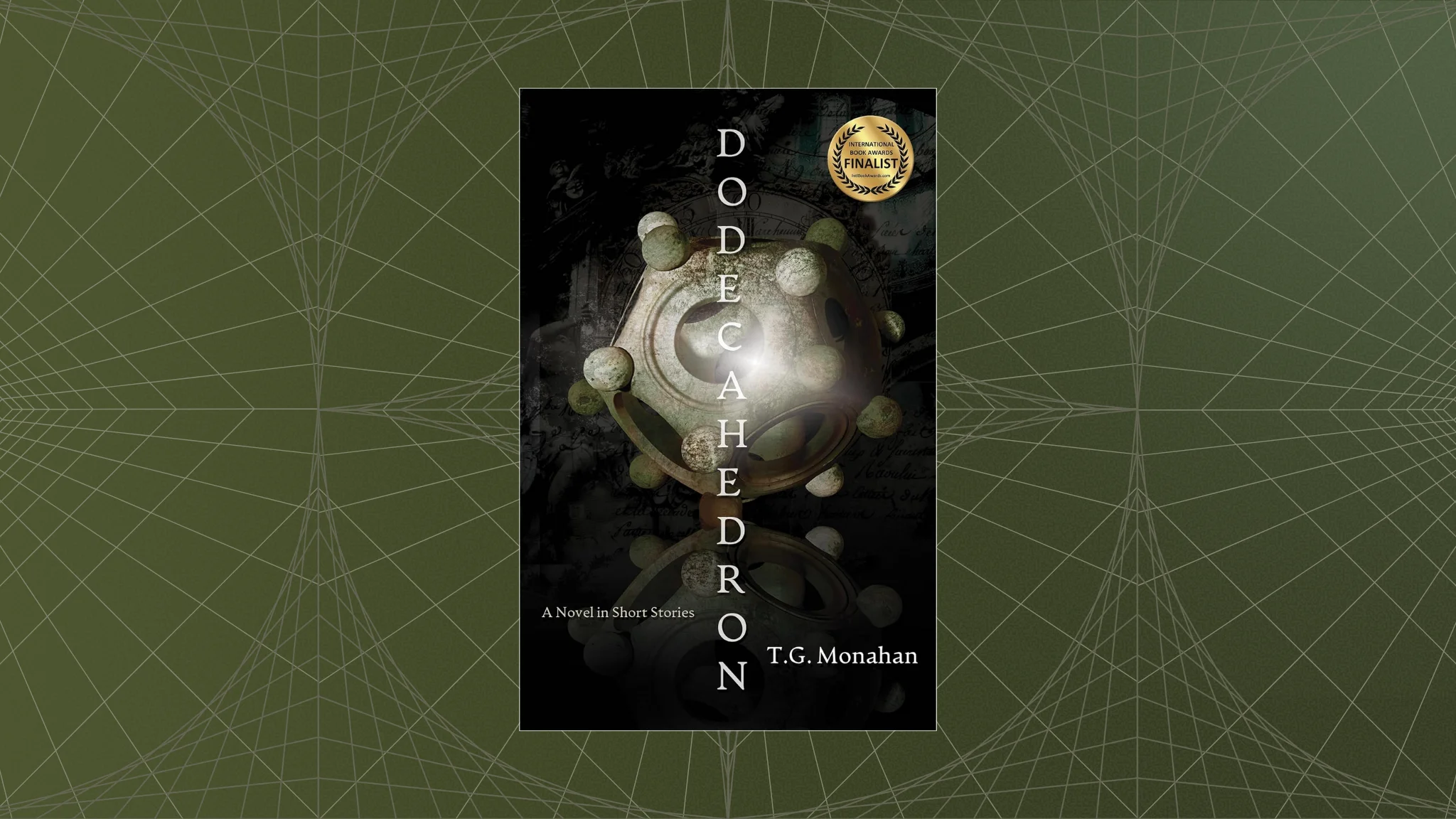
Dodecahedron by T.G. Monahan
Every town has its stories: The local hero. The notorious villain. The treasure that put the place on the map. Ask enough questions, though, and the accounts start to differ. Someone’s grandfather remembers it another way. Someone else has a document. And another has a very good reason for preferring the version everybody already knows.
In T.G. Monahan’s Dodecahedron: A Novel in Short Stories, the fictional town of Donnybrook, New York, has enough competing accounts to keep its museum occupied for generations. Twelve interconnected stories move across centuries, following the people who discover, preserve, embellish and occasionally commandeer its history. At the center are the mysterious twelve-faced artifacts that give the novel its title.
How did these apparently ancient objects end up in upstate New York? The explanations involve a Dutch explorer, possible Viking connections and a novelist whose relationship with historical evidence is, shall we say, flexible. But the artifacts are only part of the puzzle. Equally intriguing are the people who need them to mean something.
A Past That Keeps Evolving
The stories jump back and forth across a timeline that begins in 1634 and ends in the near future. We read an account of the explorer who “discovered” the hill overlooking the area where the town would eventually be built. We meet Addy Montrose, a young Marine officer arriving in Donnybrook with her daughter and a carefully plotted romantic future. A visit to the museum quickly complicates those plans. Elsewhere, two Black American soldiers navigate a French town under fire during World War I, their shared fascination with Donnybrook’s mysteries drawing them into danger. An undergraduate defends a sweeping historical theory before professors who would appreciate a little more proof. A schoolteacher struggles to keep her husband’s literary ambitions from swallowing her own work.
The connections emerge gradually, sometimes through a name or an artifact we’ve encountered before. A passing reference may turn out to explain something we hadn’t even thought to question. Just when you think you understand someone’s place in Donnybrook’s history, another chapter gives you cause to reconsider.
There’s something of the Rashomon effect here, expanded across generations. Different accounts of the past become the foundations on which people build their futures. Those futures, in turn, supply fresh material for the next storyteller. A novelist’s imaginative treatment of local history, for instance, can become someone else’s deeply personal conviction. What happens, though, when that person acts on it?
A Town Full of Would-Be Legends
Monahan mixes an expansive vocabulary with slang, military shorthand and profanity. Shakespeare and Tolkien rub shoulders with pop-culture references, and his characters trade allusions like competitive tennis pros volleying. The narration is equally exuberant, with descriptions that tumble through unexpected comparisons, often revealing as much about the observer as the place or person being described. Readers who enjoy verbal play will find plenty to savor. The language also lets us hear how these people think about themselves. They’re forever casting themselves as adventurers, misunderstood geniuses or indispensable guardians of something grand. Their everyday circumstances don’t always cooperate.
Consider Ben Quilliam, guiding schoolchildren around a Revolutionary War battlefield while his divorced parents prepare fresh hostilities between their rival inns. His historical commentary becomes painfully relevant to his own predicament. It’s a wonderfully comic situation, until we realize how much of his life he spends refereeing their grievances, and how badly he wants to leave.
Esther, his mother, has her own history of deferred ambitions. Her frustration is understandable even when her behavior is difficult to excuse. Monahan gives us access to these characters’ reasoning without requiring us to accept their preferred versions of themselves.
He also varies how we encounter their stories, moving among intimate character perspectives, a journal entry and text messages. A school history paper attempts to put events in order, but by then we’ve seen enough to recognize what its tidy account leaves out.
You’ll have to read Dodecahedron for yourself to see how Monahan pulls all this off. Following the connections and contradictions woven between these tales is an intellectual pleasure, while discovering what they mean to the people living them can be funny one moment and unexpectedly moving the next. This is literary fiction that appeals to both the head and the heart.
About T.G. Monahan
 Todd Gregory (“T.G.”) Monahan was born and grew up in Northern New Jersey. He attended Don Bosco Prep High School, graduating in 1995, and Rutgers University, where he earned a B.A. in History in 1999. He attended Albany Law School, graduating with a Juris Doctor in 2002, where he served as executive editor on the staff of the Albany Law Review. From 2003 to 2008, he was an officer in the U.S. Marine Corps, where he served as a judge advocate, including a tour in Iraq in 2004-05, where he was at Fallujah and Abu Ghraib Prison. Returning to civilian life in 2008, he continued his legal practice as an Assistant Attorney General in the New York State Attorney General’s Office, as Director of the Legal Services Division of the New York State Education Department, and as a private practitioner.
Monahan’s publications include The Vexing Heirloom (2017), Dreamin’ in ’89 (2018), and Dodecahedron: A Novel in Short Stories (2026) (finalist, best new fiction, 2026 International Book Awards), through Citrine Publishing, Ltd. His short story “The Marmot People” appears in the July 2026 issue of Journal de Folie. His one-act play “Clarence Darrow Wasn’t Available” appears in the October 2026 edition of Whistle Pig Literary Journal.
He is enrolled in New England College’s MFA Program with a dual concentration in fiction and stage and screen writing, and expects to graduate in July 2027.