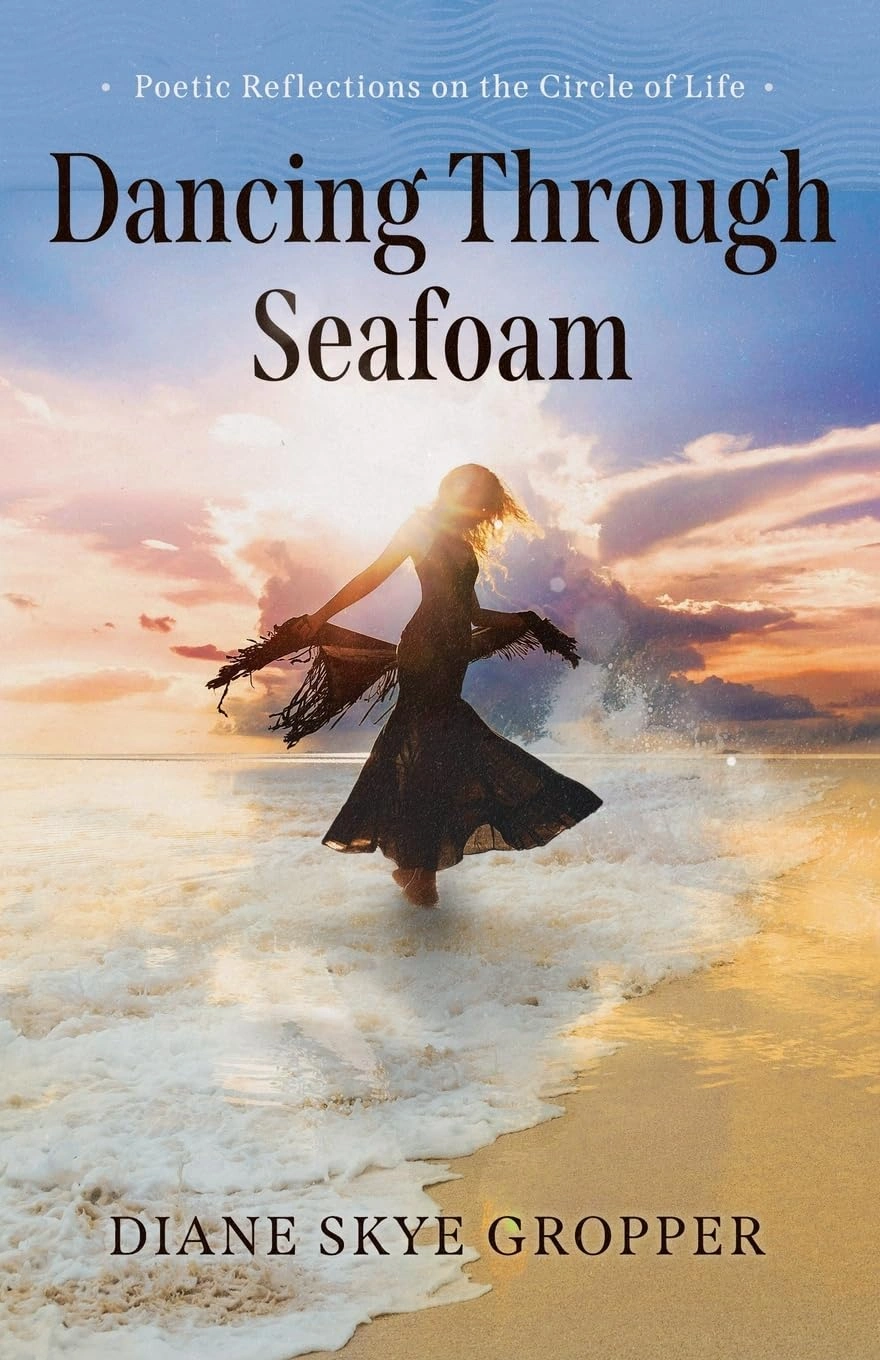
Dancing Through Seafoam: Poetic Reflections on the Circle of Life by Diane Skye Gropper
What if autobiography did not begin with birth or end with death? What if the story of a life included people we have loved before, lessons carried from one incarnation into another, unfinished relationships that find us again and glimpses of worlds beyond the one we can see?
Diane Skye Gropper’s Dancing Through Seafoam: Poetic Reflections on the Circle of Life is, in a sense, a poetic soulography: an intensely personal collection that follows the journey of the soul across lives. Drawing on more than 35 years of Buddhist and spiritual study, Gropper writes of past lives remembered, souls reunited, karmic consequences, mortality, enlightenment and a troubled planet shaped by the choices we make upon it.
The seafoam of the title captures the paradox at the heart of the book. Like waves on the shore of a vast sea, a single life is breathtakingly brief, here and then gone. Yet the soul continues on.
The collection moves through three sections that gradually widen its scope from the personal to the global. The first, “Love Goes On,” is populated with poems about lovers, parents, children and other souls whose ties survive separation and death. “Spiritual Truths” turns toward the larger forces shaping those relationships — karma, samsara, free will and the long climb toward enlightenment. “Darkening Firmament” looks outward at humanity itself, confronting dishonesty, violence, ecological destruction and our repeated misuse of the freedom we have been given.
Love That Outlives a Lifetime
“The Falconer” is one of the book’s most affecting pieces, playing a core role in the section “Love Goes On.” At fifteen, Gropper’s father mysteriously begins telling her, “Watch for the falcon,” repeating the phrase on postcards although neither father nor daughter understands why. Their relationship is difficult, marked by a connection neither can quite reach. Decades after his death, a past-life memory provides the missing piece: another life, another father figure … and those same words. “I now know those connections are never lost,” she writes. What follows is not simply comfort after loss. The discovery changes the meaning of the relationship itself. What had seemed painfully unfinished becomes part of something much older, with another chance for connection still ahead.
This theme of unfinished business bridging lifetimes shows up again in “Pax Romana” and “For Michael,” where the narrator recognizes a present-life person as a past-life lover, but the other person does not recognize her. These are balanced by the wonderful storytelling of “Casablanca,” where two souls actually do recognize each other and reconnect in the present life.
Poetry for Big Questions
Death appears throughout the collection in unexpected ways. In the section “Spiritual Truths,” we encounter “To An Old Friend,” where death is not an enemy but a familiar companion whose presence reminds us, “Time is short, tick tock.” “Memento Mori” goes further, recalling deaths as a Roman legionnaire, an Apache chief and a Buddhist monk before turning toward the death still to come. Its final question — “What’s your death song?” — is both challenge and invitation.
These are unapologetically philosophical poems, but Gropper rarely settles for simply stating an idea and breaking it into lines. She looks for metaphor, rhythm, wit, image or conceit to give the thought life on the page, tackling subjects like karma and other Buddhist teachings. The poem “Rinpoche” recounts a story about a would-be jewel thief’s encounter with an old Buddhist monk; it has a timeless quality and holds its own among classic stories of that tradition.
“Dimensions,” one of my favorites, takes on parallel realities, multiple planes of existence and time moving in more than one direction. The subject could easily become abstract, but Gropper imagines worlds “stacked and interwoven, / like strands in a fabric,” separated by veils that may sometimes open and allow life to touch life across dimensions.
She is also perfectly willing to let the sacred rub shoulders with the ordinary. Buddha appears beside a bed illuminated by a Target alarm clock. Spiritual seeking coexists with binge-watching, GPS and Seinfeld. Those contemporary references keep the collection grounded and sometimes inject a dose of humor, even when its questions are enormous. Gropper does not write as someone who has finished the spiritual journey, however. “Base Camp” turns spiritual growth into a long mountain climb filled with wrong turns, doubts, abandoned paths and repeated attempts to begin again. The summit remains somewhere above. The work is in striving toward it.
A World on Fire
By the time the collection reaches “Darkening Firmament,” the focus has shifted from individual souls to the consequences of collective human behavior. If choices matter, if actions carry forward and if life is interconnected, then cruelty, destruction and willful blindness matter on a spiritual level too.
“Nine-One-One” makes that idea frighteningly immediate. The narrator dreams she is trapped inside a burning building as flames close in and firefighters cannot hear her cries. She wakes and recognizes the nightmare as an expression of what it feels like to live amid hatred, war, deceit and destruction. She wants to believe humanity can still put out the fire. Then comes the final line: “But as I get up to make my coffee, I can feel the heat rising.” That one gave me goosebumps.
“Bombus” works with a much smaller image. A bumblebee becomes a “tiny goddess,” spending her short life pollinating the world until her wings are ragged. Humanity could learn from her industry and harmony, but “arrogance / closes our ears.” The bee’s brief life carries several of the collection’s largest concerns at once: impermanence, interdependence and the cost of failing to recognize either. This is a perfect gem of a poem, and could easily live on its own outside of the context of this collection.
One of Gropper’s gifts throughout this collection is that inspiration, no matter how small, opens up a whole world to explore. She can begin with a father’s odd refrain, a bee’s worn wings or a nightmare in the dark and find in it something much larger, much more significant.
Dancing Through Seafoam reminds us to see this life as fleeting, not final. We arrive, love, lose, learn, fail, begin again and keep moving. Gropper makes the golden strands connecting those passages briefly, beautifully visible.
About Diane Skye Gropper:
 Diane Skye Gropper has been a professional writer throughout most of her long career. She spent nearly two decades as a writer and editor at a major financial magazine, where she won several journalism awards, and as a freelance writer/editor. She later worked as a marketing strategist and writer at a financial firm and then formed her own marketing communications company
that served some of the leading names in investment management. Since then, she has continued to work and write in various capacities in the financial industry.
Skye graduated from the College of William & Mary in Virginia with a B.A. in Economics and did extensive graduate work in Economics at the City University of New York.
Skye has been reading and writing poetry for much of her life. Her study of Buddhism, Native American spirituality and other spiritual paths over the past 35 years has heavily influenced her poetic writing and is the primary source of inspiration for Dancing Through Seafoam, her first published collection of poems.