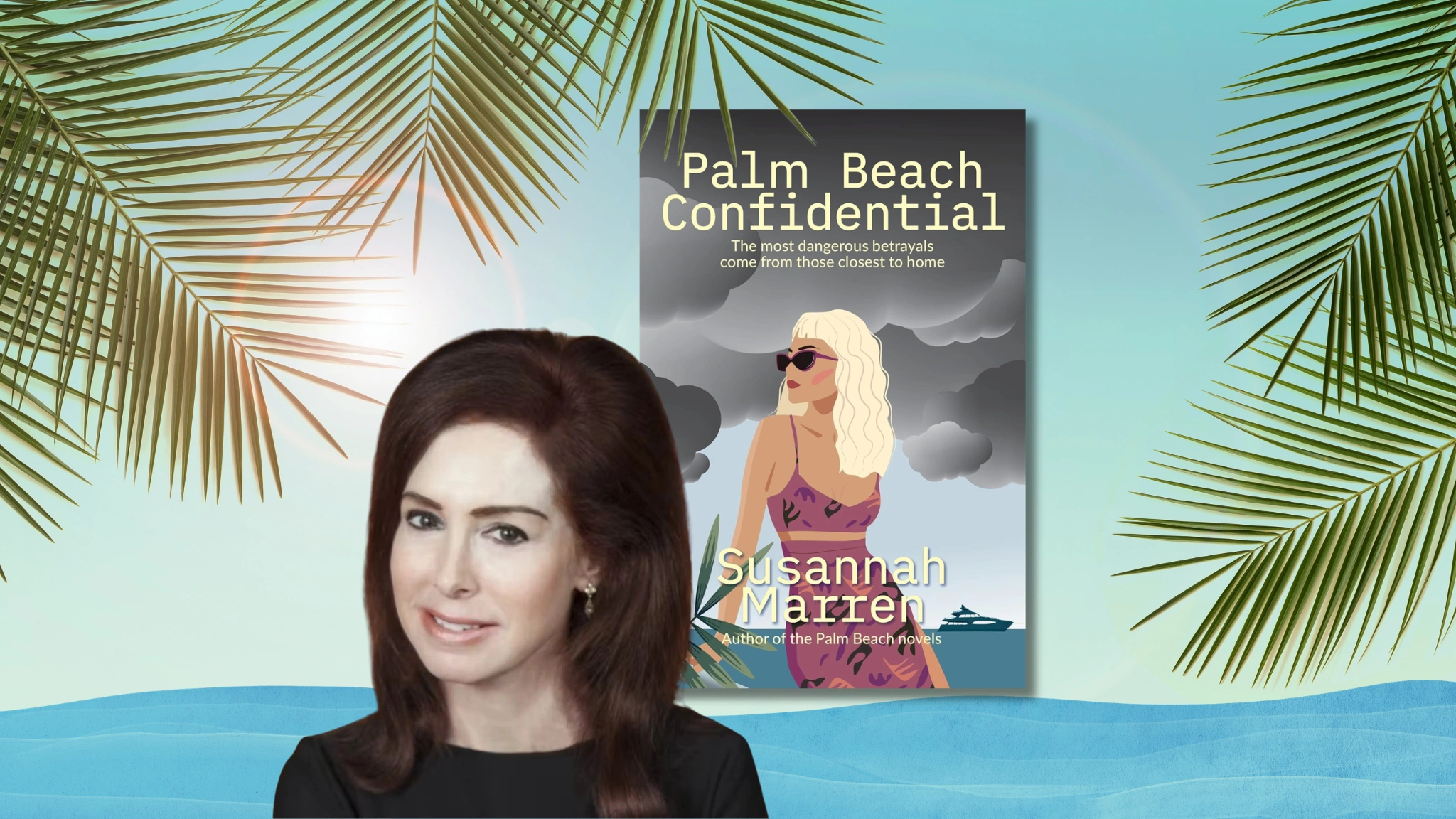
In Palm Beach Confidential, author Susannah Marren ventures behind the manicured hedges and glittering facade of one of America’s most exclusive enclaves to examine what happens when a carefully constructed life begins to crack. At the center is Lucinda Barrows, a Palm Beach matriarch whose hard-won place in society — and long-held secret — are suddenly at risk, with consequences for her three adult daughters. Drawing on years of nonfiction research into women’s relationships, Marren explores reinvention, ambition, family loyalty and the complicated bonds between mothers and daughters. Here, she talks about the social pressures of Palm Beach, the secrets women keep and what it takes to survive when a seemingly perfect world begins to unravel.
Lucinda Barrows has spent decades carefully constructing not only a life in Palm Beach, but an identity. What interested you about exploring the gap between the person a woman presents to the world and the person she knows herself to be?
I find it fascinating how women reinvent themselves. The faces we wear versus how we really feel, our stories, our secrets, the lies we tell to get through. In this novel, we have Lucinda, who is turning sixty and cares so much about her image. That includes her adult daughters with their own complex lives and a family company. Although Lucinda has established this rarified lifestyle, her backstory is suspect. At the opening of the novel, her fine job of infiltrating Palm Beach society and her long-held secret are both at risk. The stakes are very high because it is in a supposedly perfect place. Except friends and neighbors are waiting for her to fail and become an outcast. To this end, Lucinda is forced to face her past.
Palm Beach is almost a character as it is a place of extraordinary beauty, wealth and very specific social rules. What does that setting allow you to explore about ambition, power and belonging that another setting might not?
Palm Beach is such a specific place, an island with beauty, wealth and privilege. In Palm Beach Confidential, despite the setting, an unease lurks beneath. In this novel Palm Beach is emblematic of a supposedly pristine world. Female friendships matter, but trust is at a premium. Women are scrutinized, and every step is incredibly important. Of course there are friendship hierarchies and hope of being an inner sanctum anywhere we live — women strive for this. What matters in Palm Beach is how high the stakes are raised. While women strive to belong and to be part of a group in any arena, the tight social circles are unsettling. Women are concerned with being judged, included, or excluded while also fending off female competition and jealousy.
Your background includes extensive nonfiction work examining women’s relationships and roles—as mothers, daughters, sisters, wives, friends and rivals. How does that research influence the way you build fictional women and the conflicts between them?
For each of my nonfiction books, I interview a diverse group of women in terms of age, race, ethnicity, religion and level of earning power from all across the country. My nonfiction does inform my fiction. I consider what real women say in real time in anonymous interviews about how they feel as mothers and daughters, sisters, wives, rivals, mothers-in-law and daughters-in-law, friends and lovers. Their feelings inform how I build the female characters and their tensions and concerns in my novels. Both my fiction and nonfiction represent female strength, secrets, and how women survive — even in a luxurious spot such as Palm Beach.
The Barrows women each respond differently when the family’s carefully maintained world begins to unravel. Which of the women surprised you most as you were writing her story, and did any of them end up somewhere you hadn’t originally planned?
In my nonfiction research women have spoken about being supported versus being abandoned by those whom they rely on. I believe that in times of great happiness or times of great difficulty, we learn who is in our corner. This application of who is truly there during a dire period is a theme in the novel. I knew that despite Lucinda’s resilience and determination, when her entire narrative is endangered, it would be a very serious matter. For her three daughters, loyalty to their mother plays out along the lines of their own existence. In this way the mother/daughter/sister bond is looped in. Since I plot my characters’ actions and story lines before I begin to write the novel, I do know how each would respond, and yet the drama on the page was sometimes surprising and very intense.
Lucinda’s choices don’t affect only her own life — they become an inheritance of sorts for her daughters. What did you want to explore about the ways a mother’s decisions, compromises and ambitions can reverberate through the next generation?
Our mothers are our first mentors and guides. Their histories have enormous ramifications on our own path. As it applies to Lucinda and her daughters, I’d prefer not to say too much. It would prove a spoiler. What matters is how Lucinda, once uncovered, is understood and appreciated. Her ambitions—in terms of social standing, family, and success—are impressive and loaded.
A while back I wrote a non-fiction book about mothers and daughters, You’re Grounded Forever, but First Let’s Go Shopping. Among the interviewees were mothers who felt their compromises and ambitions haunted their daughters. As it applies to Palm Beach Confidential, the threat of Lucinda’s downfall could harm her family, and she and her three daughters could fall from grace.
Caroline, the middle daughter, has daughters of her own whom she is raising in Palm Beach. Since the Barrows family originally had no money, it is particularly significant that her daughters have a very luxurious life.
For Raleigh, a young, soon-to-be-divorced mother of a small son, life is precarious. Her divorce could shame the family unless she wins the custody battle. The result will be gossiped about no matter the outcome.
For Maribelle, the eldest, widowed unexpectedly, escape from Palm Beach is the only way to get through, and still her loyalty and commitment to the family factor in.
Without giving away the ending, what do you hope readers reconsider about the Barrows women by the time they finish the book?
I hope that my readers will consider what survival is for women. Even those who seem to have it all — the glittering prizes: beauty, success, lifestyle, children, if they so choose; husbands/partners, if they so choose. Females are raised with certain expectations in a patriarchal culture, and yet not everything goes as planned. It is how buoyant and strong we are that matters, how we come back from an abyss.