Dark times are ahead. It’s an infamous, ubiquitous message to be found in several sections of the Bible — the Book of Revelation among them. But those who read the Book of Revelation often come away with more questions than answers. But what is the truth behind the origins found in Leviticus? What is really in store for humanity on the Day of Atonement? And is there a possibility that, after the destruction, there’s reason to hope for humanity to recover and possibly even thrive?
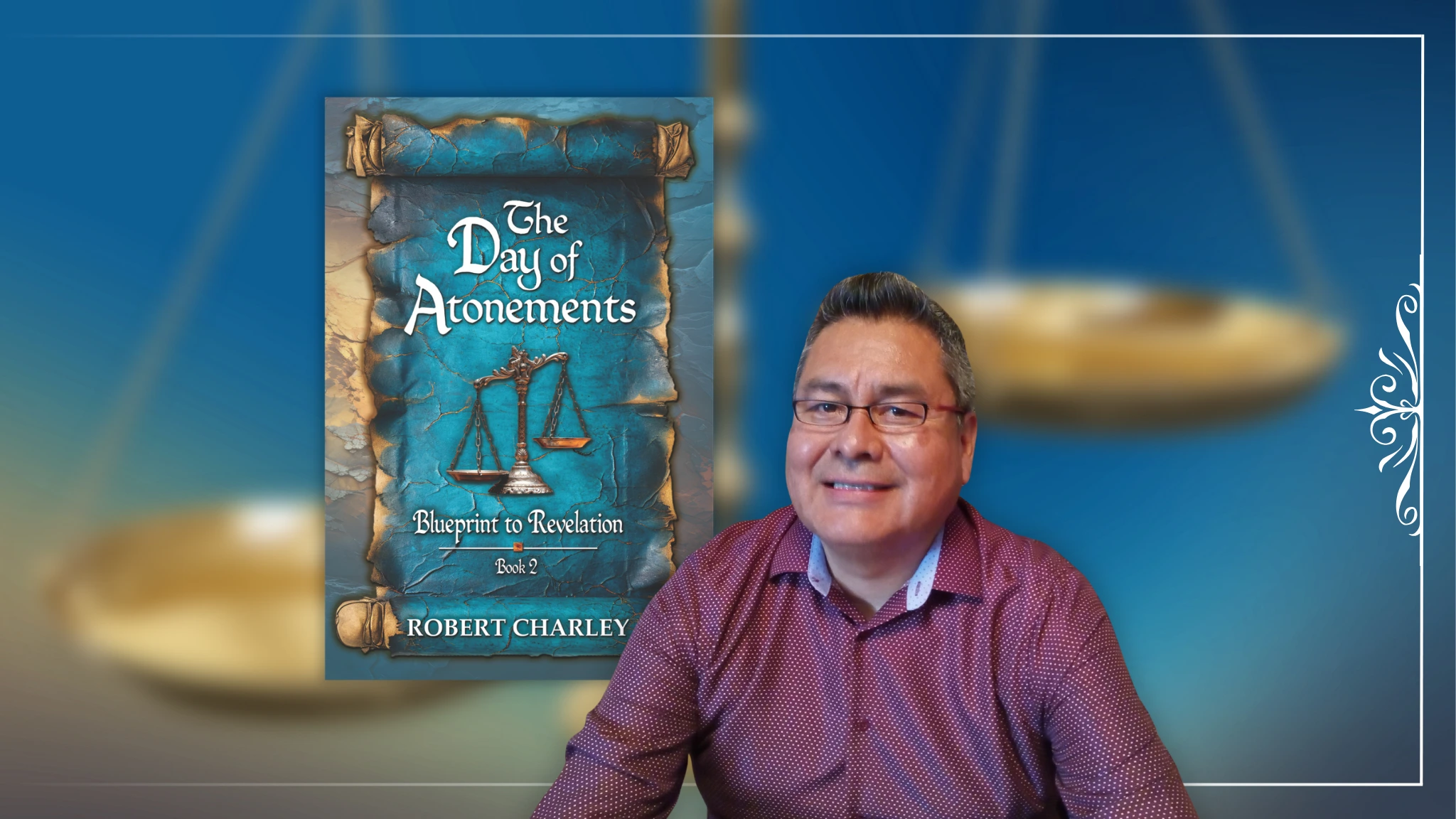
In his new book The Day of Atonements: Blueprint to Revelation, Robert Charley is here to provide those answers. Bringing his experience not only as a devout reader, but also as a teacher in the words of Scripture, he goes through the Book of Revelation with a fine-toothed comb, picking out the symbolism and significance that less informed readers would have missed. The result is an illuminating text that outlines his extensive scholarship without becoming dull, instead providing a rich narrative of the Bible’s message that helps readers enact real change in their lives.
You begin your book with a preface that strongly outlines the case for understanding the Day of Atonement both as a day for multiple atonements, and as a blueprint for God’s larger plan for humanity. How did you develop the understanding that the concept of “atonement” could extend beyond personal forgiveness to include the healing of the land and the purification of all creation?
In Leviticus chapter 23:27, the Day of Atonement is called Yom Hakippurim in Hebrew. Literally, “The Day of Atonements.” Plural. God summarizes it in Leviticus chapter 16:33. “He shall make atonement for the holy sanctuary, and he shall make atonement for the tent of meeting and for the altar, and he shall make atonement for the priests and for all the people.” The first three atonements are for the holy sanctuary, the tent of meeting and the altar; physical objects on the Temple grounds, the land.
In Numbers 35:33, God said, “…Bloodshed pollutes the land, and atonement cannot be made for the land on which blood has been shed, except by the blood of the one who shed it.” Here is an example of atonement made for the land. In ancient Jewish commentaries on the Feast of Trumpets and the Day of Atonements, cleansing, purification, renewal, re-creation, Creation and renewal of people and the land are common themes. They explain how on the Jubilee/Yovel year, on the Day of Atonements, time and the land reset. Using these themes as blueprints for healing the land and purification fits the narrative in Revelation.
What first inspired you to take a closer look at the events of the Book of Revelation, particularly when it comes to the ancient festivals and holidays mentioned within the Bible?
After reading the entire Bible for fifteen years straight, I asked, “What does the Bible really say in the Hebrew language?” Then I met Uri Harel, a teacher born in Israel, who spoke Hebrew as his first language. For several years, I attended his classes and learned to read the Bible in Hebrew. Around this time, I heard a rabbi mention how he read a Torah commentary set every year, so I incorporated that discipline of study. For the last 20 years, my goal has been to read one Torah commentary set every year. This is where the ancient literature came from.
One year after teaching a study on Genesis through Deuteronomy, I asked the group, “What do you want to study next?” By serendipity, everybody said, “The Book of Revelation.” I had no intention of studying that book. When I read Revelation again with my new Hebrew lens, the imagery, the symbolism and the idioms came alive. I put together the study so quickly! It made sense. I saw the Feast of Trumpets, The Day of Atonements and The Feast of Tabernacles. Since that decision in 2009, I have included the Book of Revelation in my regular Torah teaching. It fits like a puzzle.
Your manuscript touches on the spiritual uncertainty that may rise during times of intense societal upheaval. Do you think people today can find their own struggles reflected in the pages of Revelation? And what might they take away from that text?
Yes, I believe we can find our own struggles reflected in the pages of Revelation. As a matter of fact, Jesus points out specific areas in our lives where we may struggle and asks us to make corrections. Overall, Revelation is a book of prophecy. First, the prophet warns the people where the God of the Bible requires change in their lives and to return to God and His ways. Next, a prophet may give a vision of the future. In this book, the biggest warning and vision of the future is: do not take the mark of the beast. Receiving the mark will be so drastic that one will no longer be human.
Ecclesiastes/Kohelet 1:18 says, “For with much wisdom comes much sorrow; the more knowledge, the more grief.” I hear many ministers try to paint over the gory details of Revelation to make their congregations feel better. There is no easy way to say that distressing times for all humanity are coming to Earth. Birth pangs first, then the baby. “A woman has pain in childbirth because her time has come; but when she brings forth her child, she forgets her anguish because of her joy that a child has been born into the world” John 16:21.
From connecting the horn of the ram that saved Isaac to the Angels’ trumpets, you make compelling arguments for the significance of the rich imagery that permeates the Book of Revelation. What was your research process like for finding the symbolism these descriptions hold?
Over twenty years of studying volumes of Hebrew Bible commentaries. Although it was easy to find the symbolism, since every year, all observant Jews around the world commemorate Abraham, Isaac and the ram. It’s like Christmas and the story of the wise-men seeking the newborn king. Everybody knows the story. Since Christians are not familiar with the Feast of Trumpets or the Day of Atonement, they are not aware of the symbolism. During the Feast of Trumpets, Jewish observers read Genesis chapter 22, called the Binding of Isaac. In this ubiquitous reading, God tests Abraham to offer Isaac as an elevation offering. When Abraham is about to offer Isaac, the Angel of the Lord calls out to Abraham not to proceed, and Abraham sees a ram stuck in the thicket by its horns. This is the origin of the ram’s horn.
Christians identify the ram as a substitute sacrifice in place of Isaac. Like the ram, Jesus Christ is the Lamb of God; He is humanity’s substitute sacrifice for sin. Revelation chapter 5 portrays Jesus as a slain lamb with seven horns. A male lamb with horns is a ram. The ram in Genesis 22 has two horns; the “ram” of God in Revelation has seven horns. Jesus is a slain lamb in Revelation, as the ram in Genesis was slain. This is the connection.
Now, is it probable that the angels in Revelation chapter 8 are blowing the seven horns from the ram in Revelation? In the spiritual realm, all things are possible.
Your series is clearly driven by a desire to educate others on the meaning of these passages, and of the lessons to be learned from the entirety of the Bible itself. What is the message you want readers to take away from The Day of Atonements?
As I already mentioned, trying times are coming for everybody on Earth. When it is over, a new world is coming, but it is a slowww process. We live in a microwave generation and want things fast. This year in April, I planted Hopi blue corn in my grandfather’s field. It takes about two weeks to sprout. In June, they were about a foot tall but stressing for lack of rain. In July, about fifty percent survived the dry conditions to make it to the rainy season. In August, the ears of corn are forming, and now the crows and quail will begin their assault. When the growing season is over by the middle of September to October, I will finally harvest the corn after it dries. The non-GMO corn I grow does not develop in a week, a month, two or three months later. It takes four to six months; it’s a slow process.
Likewise, after these trying times of global calamity are over, Jesus says the birth pangs have just started. Nations have to form from the old world; ten kings have to rise. Then another war takes place. We have to have a lot of patient endurance.
What can readers expect from your next title in the series, The Feast of Tabernacles?
Like the Feast of Tabernacles, the last chapters of Revelation are times of simcha, times of joy. The birth pangs are over and the baby is born. All the imagery from the Feast of Tabernacles takes place here, and we will see a wedding supper of the Lamb, a picture of a chuppah, the wedding tent. It is a harvest festival. The harvest of the nations and the thousand-year reign of the Messiah. We will see God come down from heaven to tabernacle with man, the living water, the four species, and man restored to his original state at Creation.
Peter encourages us with these words. “Blessed be the God and Father of our Lord Yeshua the Messiah! In His great mercy He caused us to be born again to a living hope through the resurrection of Messiah Yeshua from the dead. An incorruptible, undefiled and unfading inheritance has been reserved in heaven for you. By trusting, you are being protected by God’s power for a salvation ready to be revealed in the last time. You rejoice in this greatly, even though now for a little while, if necessary, you have been distressed by various trials” 1 Peter 1:3-6.