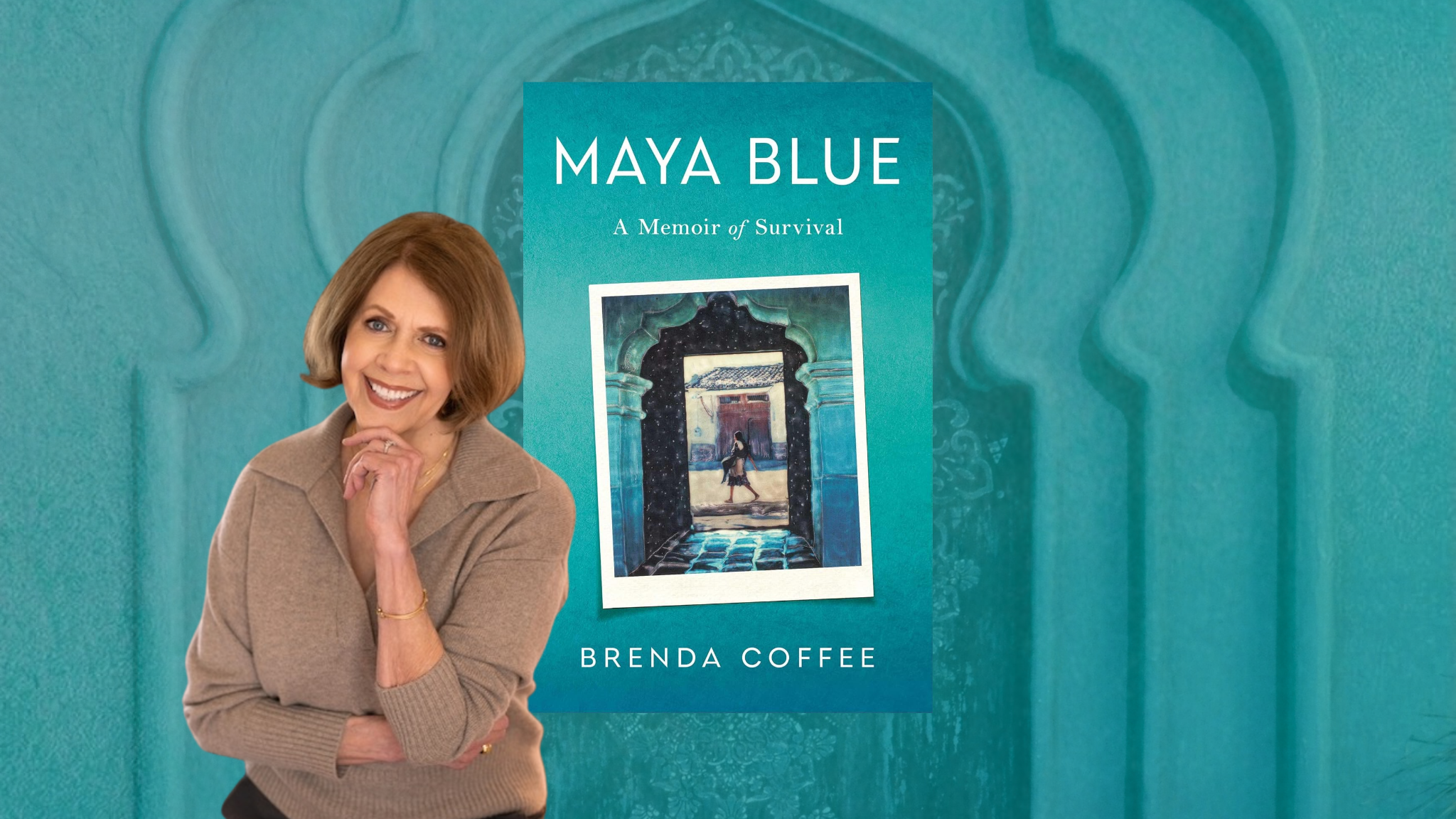
At first glance, Maya Blue reads like a fairytale. An ambitious journalist swept into the glittering world of invention, love, and promise. But as Brenda Coffee’s memoir unfolds, that sheen fractures into something far more harrowing and human. What begins as a story of brilliance and devotion transforms into a chronicle of addiction, danger, and ultimately, resilience.
In this Q&A, author Brenda Coffee traces her journey from silenced partner to survivor, revealing how reclaiming her voice became an act of both defiance and healing.
Your prologue begins with the striking line, “It was a fairytale until it wasn’t.” How did that shift from dream to danger shape the way you chose to structure Maya Blue?
It’s easy to write about a fairytale, but more challenging to paint a picture of how it unraveled. Since the book focuses on how and why I relinquished my voice and my ability to advocate for myself—and subsequently how I reclaimed it—I thought it was important to begin by bringing the reader into the middle of the action so they could understand the immediacy of the nightmare I was facing.
You write about Philip’s charisma, brilliance, and invention—but also his addiction and paranoia. How did you navigate portraying him with both nuance and honesty rather than reducing him to a villain?
Philip was an extraordinary, brilliant, kind, and larger than life individual. He was revered and admired by me, his peers, Wall Street, and our friends. But his addiction to cocaine and alcohol changed him into someone I didn’t recognize, and I felt it was important for the reader to understand how his addiction happened and to see the man, as well as the addict. He was a scientist, and in his mind, trying to make real cocaine from scratch was the equivalent of his other challenges: lead project engineer on the Titan and the Atlas rockets—which launched the astronauts into space—plus he invented the first personal computer and the microprocessor. Once he knew he’d made real cocaine, he wanted to try it and see why people were willing to do anything to possess it. He thought he was too smart to become addicted, but he was wrong.
In moments where the wrong word could spark a blaze, you describe measuring your voice carefully. Looking back, what role did silence and self-censorship play in keeping you tethered to dangerous circumstances?
That’s a great question. When I first realized he wasn’t behaving like the Philip I knew and loved, I didn’t know he was snorting the cocaine he was making and drinking vodka to bring himself down. I thought he was working on refining each step, something the scientist in him would do. I didn’t understand addiction, plus I was desperate to keep anyone else from knowing. I thought I could reason with him, and he’d stop, and life would go back to the way it was, but Dr. Jekyll had crept into my bed and turned into Mr. Hyde. And since I was afraid of that man, I wound up censoring my words to keep peace. Later, when I thought about leaving him, I was afraid everything would come crashing down on him, and I didn’t want that for him, so I stayed and my voice got smaller and smaller.
Your roadside abduction and survival in the jungle reads with the intensity of a thriller. What inner resources or small choices most surprised you about your own ability to endure?
During this horrific ordeal, the only thing that surprised me was that it was happening in the first place. The Guatemalan Army, barbarians with automatic weapons, had forced me out of the car and into the jungle. By then, all the big picture rules of thumb I’d learned from Philip had become ingrained in me like your decision rate is often more important than whether you make the wrong decision. In other words, you can’t sit by and do nothing, plus I’d already jumped out of a second story bathroom window to keep Philip from killing me. I didn’t hesitate then, and I didn’t hesitate in the jungle. When I saw a sliver of an opportunity to escape, I took it. They were going to gang rape and kill me. What did I have to lose? I would rather die trying to get away than to let that happen.
Readers have noted how you resist sensationalizing the Guatemala ordeal, focusing instead on the specifics of heat, calculation, and small choices. Why was it important to you to write that chapter with restraint rather than dramatization?
You must remember, I was a journalist, married to a scientist. Both deal in facts. It’s how I write and think. Life is complicated enough without sensationalizing a situation. You give up your power and make matters worse when you do that. I don’t panic or give way to my emotions. I carry on until the crisis is behind me or I find a good resolution. It’s one of the survival tools I learned from Philip. Sometimes, I think about the old black and white movies I watched as a kid. The ones where the monster is lumbering toward the heroine, but she just stands there and screams like her feet are super glued to the floor. Her lack of action insures he’s going to get her. But if she’d kept her cool, she could have outrun him and saved herself.
You reflect that early caretaking and people-pleasing primed you to accept compromises in adulthood. How did writing this memoir help you recognize and break those patterns?
Writing Maya Blue helped me better understand how the patterns of silencing my voice influenced my life, but by the time I wrote the book, I had already left those unhealthy behaviors behind me. After Guatemala—and the boyfriend from Hell—I started seeing a therapist for what I now know is PTSD. There wasn’t a name for it then. I went to her Monday night meetings for abused women. At the time, I didn’t identify with any of them. One was a meth addict who was missing two of her teeth. Another had a perpetual black eye, but one woman gave me an ah-ha moment: I’d moved from a relationship with an addict to one with an abusive narcissist. I’d traded free will and common sense in return for feeling loved, but I realized I didn’t have to find my balance in someone else’s out-of-kilter world. The choice was mine.
The final act of your book emphasizes therapy, boundaries, and new beginnings. What was the most difficult boundary you had to set in your process of healing, and how did it transform your sense of self?
In my last answer, I spoke to some of these things, but also, I learned to prioritize myself. Some people may think that’s selfish, but it’s making our needs and well-being more than an afterthought. I also saw a doctor who specialized in hypnosis, and over the course of several years, I learned to use tools like guided imagery and breathwork. They came at a good time because when I was diagnosed with breast cancer, focusing on my breathing helped me stop focusing on any fears associated with eight rounds of chemotherapy and 10 breast cancer surgeries. They’re tools I still use every day. Reclaiming my voice and knowing how to care for myself have made me stronger than I’ve ever been. I’ve also learned that because we’re more than our body, we must nourish our mind and our soul as well.
About Brenda Coffee:
 Brenda Coffee is a businesswoman, public speaker, and former board member and managing consultant to a public company she sold to Big Pharma. She is also the creator of two Top 10 websites, including 1010ParkPlace.com, home to her popular BRENDA’S BLOG, which has repeatedly been voted a Top 10 Blog/Site for Women Over 50 by FeedSpot. Brenda is also the author of The Breast Cancer Sisterhood and Husbands and Heroes: The Breast Cancer Caregiver, and was formerly a writer for Spirit, Southwest Airlines’ magazine. A graduate of Trinity University with a degree in journalism, she lives in San Antonio, Texas.