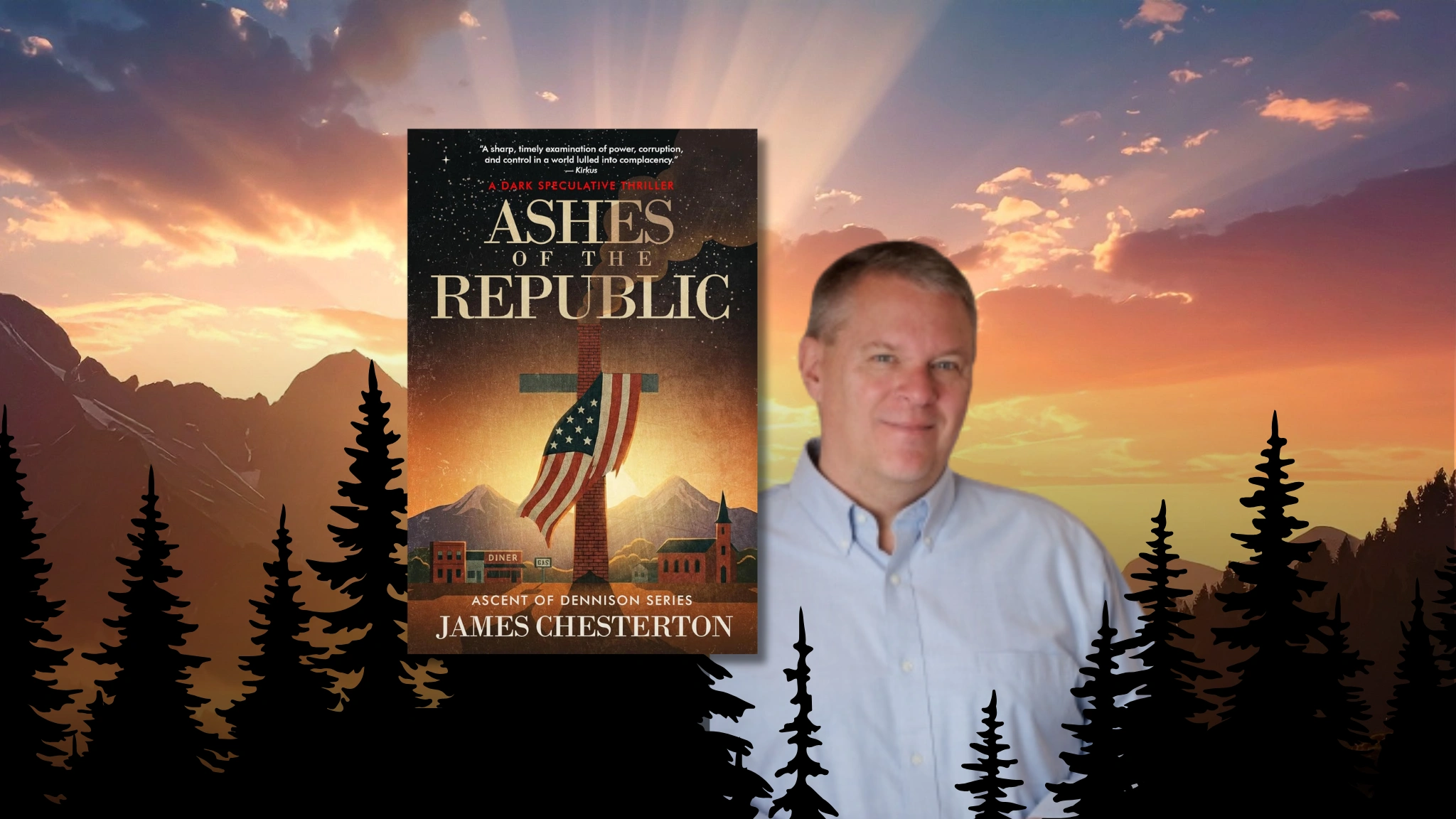
James Chesterton’s Ashes of the Republic is a chilling political thriller that fuses technological dystopia with spiritual symbolism, exploring how power reshapes democracy, morality and personal identity in an age of corporate surveillance and authoritarian drift. Set against the beauty of Sedona’s red deserts, the novel follows characters trapped between conscience and complicity as advanced “bee” drones, media manipulation and religious spectacle become tools of social control. In this interview, Chesterton discusses the real-world inspirations behind the novel, from his experience working at Purdue Pharma to his fascination with Roman history, and reflects on the ethical failures, political anxieties and human compromises that informed one of the book’s central questions: how ordinary societies gradually surrender themselves to extraordinary systems of power.
The novel blends technological horror with spiritual and ecological symbolism—what inspired you to set this story in Sedona’s red deserts and to frame Iwanna’s control through “bee” drones and religious imagery?
My wife and I have been visiting Sedona for years and are very familiar with the many forms of spiritualism found there. When it came time to start the opening scenes between Iwanna and Charity, it was an easy choice as the location: there are many secluded areas in the city, and the rocks provide the sense of awe that is manipulated by people in power through religion. It is also a center of meditative practice, which is also featured throughout the story.
Charity (and other engineers in the book) face the moral consequences of their creations. How did you approach portraying the ethical conflict between innovation and accountability, and were there real-world technologies or debates that informed Charity’s dilemma?
The ability for those in power, in particular heads of companies who make decisions about their products that often fail an ethics assessment, is central to Ashes. The way to get people to develop things of questionable integrity is simply to deceive them about their purpose. I worked for the now defunct pharmaceutical company Purdue, maker of OxyContin. We had no idea about the sales practices of our ownership or reps and thought we were doing wonderful work that helped cancer patients: not starting an opioid epidemic. Charity thinks she is protecting her country with her development of the bees and had no idea they would be weaponized by Iwanna, which is why the story is much more about the intent of humans than the technologies themselves. The people who created Twitter and Facebook thought they were connecting the world, not starting an epidemic that profits from the capture of the world’s consciousness.
Iwanna Dennison is a charismatic, ruthless leader whose methods combine corporate power, surveillance and spiritual manipulation. How did you conceive her character arc?
I’m a fan of Roman history because it is frightening how little we have learned as a species, and it teaches us that lust for power and wealth is a human condition that, no matter how much we cover it up, will pervert every human endeavor. Iwanna is just a modern Caesar using all of the same tricks and the technology at her disposal to achieve the same end. The Roman satirist Juvenal called the practice “panem et circenses”: bread and circuses. We’ve certainly got plenty of the circus now.
The novel depicts structural changes to democracy (voter certificates tied to employment, elimination of term limits, media control). How much of Ashes of the Republic is extrapolated from current political trends?
This is fully happening today, right in front of us. You’ve got multiple media sources spreading lies and paranoid conspiracy theories, whitewashing January 6. The CIA director was on site in Georgia to collect ballots, and the president has repeatedly floated staying in the oval office beyond 2028. With complete control of the government, including the most necessary check of the Supreme Court, he is just following the game plan of Putin, Orban, and every dictator that preceded them: change the rules to retain power. Minimum requirements to vote have already been a part of our history and would just simply need to be reinstituted.
There are multiple scenes showing everyday people adapting or acquiescing to the regime—teachers, pilots, service workers. What did you want readers to understand about complicity and survival under authoritarian systems, and how do those small personal choices add up in your view?
In the novel, I wanted to show that authoritarianism does not depend only on true believers. It also depends on ordinary people making small accommodations to survive. Teachers adjust what they say in the classroom. Pilots follow new rules. Service workers learn what not to question. Most of them are not evil. They are frightened and exhausted, trying to keep their jobs, protect their families, and get through the day.
That is what makes complicity so difficult. Under an authoritarian system, survival itself can start to look like cooperation. People tell themselves, “This one thing doesn’t matter,” or “I can’t afford to fight this,” or “Someone else will stop it.” But when millions of people make those same small compromises, the regime becomes normal. The abnormal becomes routine.
That is also why I think the personal and political are inseparable in the book. Public collapse is built out of private decisions. A society does not usually surrender all at once. It gives way inch by inch, often through silence, fear, careerism, or the hope that things will somehow correct themselves.
In our own time, I think the lesson is that institutions matter, elections matter, and public accountability matters. We have chances to correct course, but only if people are willing to call out corruption, pressure their representatives, protest, vote, and refuse to let the unacceptable become ordinary. For me, writing the book was part of that refusal.
The book blends family drama with a broader political collapse and the rise of far‑right authoritarianism. What message or questions did you want readers to take away about the interplay between private power (wealthy families, corporations) and public institutions (law enforcement, government), and how do you see fiction best engaging readers on such political moralities?
I wanted readers to see what happens when private power becomes large enough to bend public institutions to its will. In the world of Ashes of the Republic, authoritarianism does not arrive only through soldiers in the streets. It grows through money, influence, family dynasties, corporate loyalty, data, policing, and the slow corruption of institutions that are supposed to protect ordinary people.
The same forces reshaping the country are also reshaping homes, marriages, friendships, and the choices people make to survive. Wealthy families and corporations can present themselves as respectable, even patriotic, while quietly becoming more powerful than the government itself. And once law enforcement or government agencies begin serving those private interests instead of the public, the people wind up being manipulated by them.
I think fiction is especially good at engaging these moral questions because it does not ask readers to begin with an argument. It asks them to begin with people. You follow characters you care about, and through their fear, compromise, courage, or silence, you feel the political reality before you analyze it. That makes the questions harder to dismiss. The reader is not just asking, “Is this system wrong?” They are asking, “What would I do inside it?” What would I ignore? What would I risk? And at what point would I finally say no?”