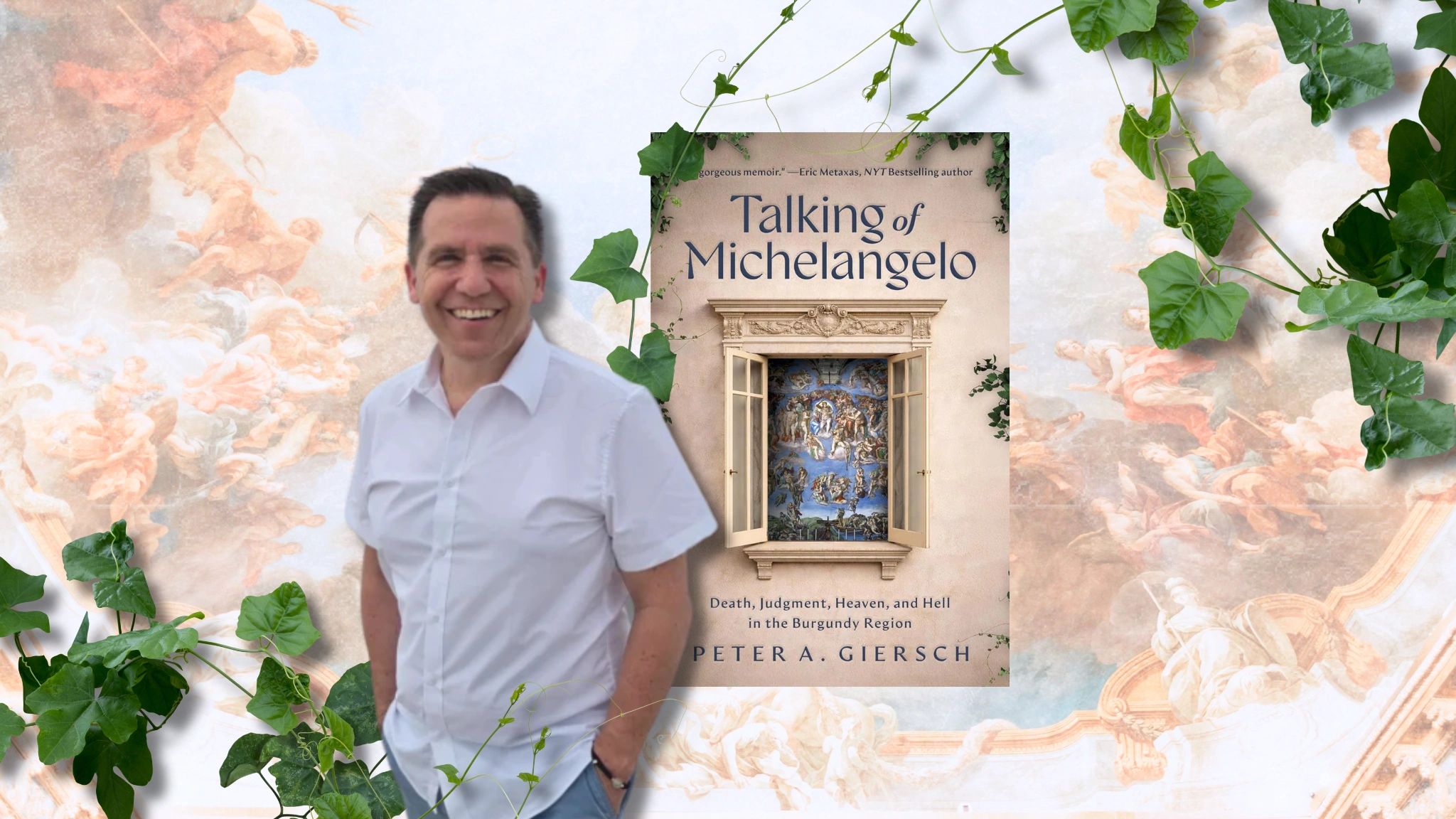
In Talking of Michelangelo: Death, Judgment, Heaven, and Hell in the Burgundy Region, author Peter A. Giersch blends memoir, literary criticism, theology and travel writing into a personal exploration of faith and meaning. Drawing on an Ignatian retreat in France, the poetry of T.S. Eliot, the art of Michelangelo and the enduring wisdom of great literature, Giersch reflects on the moments that reshaped his understanding of God, providence and the human condition. In this interview, he discusses the surprising role The Love Song of J. Alfred Prufrock plays in his memoir, the influence of his years as an English teacher, the spiritual lessons that emerged from his retreat and why he hopes every reader will be inspired to tell their own story.
Why did you choose T. S. Eliot’s The Love Song of J. Alfred Prufrock as a recurring lens through which to interpret your spiritual journey?
That came about quite by accident. In the book, I was trying to explain what a hermeneutic key is and how to apply it, so I gave the example of how, in my opinion, most literary criticism gets Prufrock wrong because it uses the wrong key. When Prufrock says, “I am Lazarus come back from the dead,” they all refer to the wrong Lazarus. So I laid out how to read the poem using the right Lazarus, and suddenly I realized, to my surprise, that this interpretation of Prufrock was really the hermeneutic key to the entire memoir I was writing — the quote from Dante’s Inferno, the prophet, the eternal footman, all the poem’s talk of death and judgment, and, of course, Michelangelo. It’s all there. Prufrock is so essential to the book that we reproduced the entire poem in the appendix.
Your mother is one of the most vivid characters in the book — spiritually attuned, unhurried, utterly unimpressed by your anxiety. What does she think of how she’s portrayed here?
The book is a memoir of an experience I had 20 years ago. My mother is 84 now. She just recently lost her husband of 62 years, right before the book came out, and I don’t know if she’ll get to read the book anytime soon. I did show her the book and the chapter where she’s driving me to the airport. She remembered it like it was yesterday, and she said all the darling, spiritually attuned things you would expect her to say. But I’ve noticed with my mom and with everyone who is in the book, like my wife (who figures prominently) or Laurent (the friend I meet up with in Paris) or my son (whose final words close the book), they all have that mixture of repulsion and attraction to the idea that their person, their personality, is published in a book that has sold thousands of copies. I get it! It was hard to write a memoir, but this is another Prufrock moment. He didn’t want to share his true self with the world. I had to fight hard to overcome that, to not be a coward, like Prufrock.
Throughout the book, you describe “coincidences” as signs of the Holy Spirit at work. How do you distinguish between divine providence and ordinary chance in your own life?
You know, I don’t. I don’t distinguish between divine providence and ordinary chance. Thomas Aquinas says that because God created the universe and placed us here without our permission, he is ultimately responsible for the final outcome of everything. And perhaps the ultimate genius of God is that he can give us radical free will (with complete personal responsibility) while at the same time driving all of human history to his own intended outcome. It’s like that parent who is able to let her toddlers explore freely but still keeps them safe from a distance. So, for me, everything is Divine Providence. But we could never comprehend that, so God gives us these “coincidences” to let us know that he’s there. Those are the moments when the child looks up and sees his mother smiling at him from across the playground.
Your reflections move easily between literature, philosophy, art, travel and theology. How have your experiences as an English teacher shaped the way you approach faith and storytelling?
I didn’t know it at the time, but getting an English major was the best thing I ever did. Of course, everyone tried to talk me out of it. I can’t tell you how many times I had to answer the question, “What are you going to do with an English major?” I finally came up with the answer, “I guess I’m more concerned with what my major is going to do with me.” And what it did was it taught me what human nature is like. That’s a pretty important thing to understand. It helps you deal with people. And that’s all life is, right, dealing with people? I’ll never forget the semester I read Faulkner’s A Light In August, or Milton’s Paradise Lost, or the poems of Emily Dickinson. The insights into the human condition that literature gave me have not only shaped my writing, but they’ve also helped me in business, marriage, parenthood, friendship — basically every aspect of my life.
The Ignatian retreat challenged many of your deepest assumptions about sin, judgment, heaven and hell. Was there a particular moment during the retreat that permanently changed your understanding of God?
No specific moment, really, but the whole retreat experience kind of brought me back to the idea that God is like a brick wall. Ultimately, he will have his way; it’s just a question of how long you want to bang your head against that wall before you realize it. I’m not the first person to use that metaphor. There’s an old gospel song called “So High,” for example:
So high, you can’t get over it
So wide, you can’t get around it
So low, you can’t get under it
You might as well come in at the door.
There’s a recurring image in the book of “a door in the wall.” It comes up several times, and it’s the title of one of the final chapters. After I’ve passed through my dark night, I am walking along this wall the monks have built around their vineyard, and I find this little door, and it reminds me of that advice I read somewhere: if you come to a wall, walk along it. Eventually, there will be a door in the wall. If you stick with God long enough, you’ll find a way in.
You argue that modern culture is often driven by the desires to possess, consume and control. What practical advice would you give readers who recognize these tendencies in their own lives?
We’ve heard the answer to that many times. Let go. Hold on loosely. Less is more. What you own owns you, etc. You see it in so many stories, from St. Francis of Assisi to Henry David Thoreau to Mother Theresa; as soon as they gave up trying to have their own way, they were supremely happy. Having to have everything the way we want it is a trap, because no one, not even a billionaire, has everything he wants. So count your blessings. Be happy with what you have. I know it’s hackneyed, but it’s true. That same message is in a lot of “pop philosophy” these days. We constantly hear people say, “It’s all good.” What if we truly believed that? It would mean that whatever you have, wherever you live, it’s okay. You can be happy there. Or, “Everything happens for a reason.” Again, if we truly believe that, we’re basically saying that life has a purpose. It’s back to that idea of Divine Providence. Someone is ultimately in control. Trust the process. Enjoy it while it lasts.
If readers finish Talking of Michelangelo remembering only one idea or one question, what do you hope stays with them long after they close the book?
I’m always careful not to assume that people want me to sign their book, because, like, what am I, Hemingway? Besides, they might want to re-gift it. But whenever people do ask me to sign my book, I write, “Tell your story!” Everyone’s got a memoir in them. Everyone’s life is worthy of a book. And it doesn’t even matter if you publish it. I wrote this book 20 years ago and almost forgot about it. But I only wrote it because when I was in high school, I read Catcher in the Rye, and I thought, “This guy is just walking around talking. I could do that.” Then in college I read Mere Christianity and I thought, “This guy is just explaining what he believes; I could do that.” Those two experiences are why I wrote this book. So if someone read my book and said, “This guy is just telling his story; I could do that” — and then did it, that would be the best outcome I can imagine.