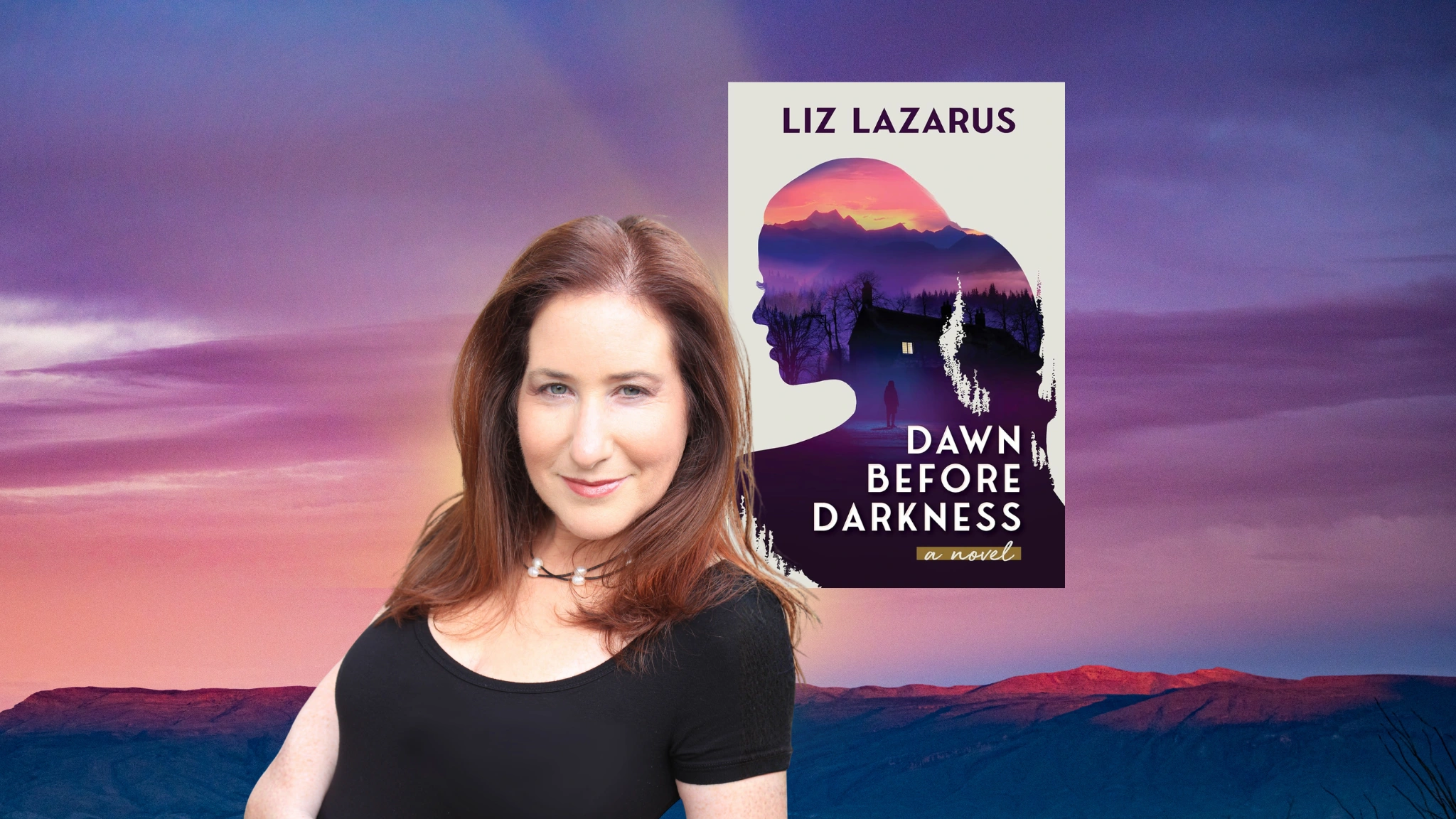
In her thriller Dawn Before Darkness, Liz Lazarus explores what happens when the systems meant to protect us become tools of manipulation and control. Drawing on years of personal experience battling for guardianship of her mother, as well as extensive research into stalking and victim advocacy, Lazarus crafts a story that feels both terrifyingly plausible and emotionally authentic. In this conversation, she discusses the real-life experiences behind the novel, the challenge of creating a charming yet dangerous villain, her meticulous plotting process and why writing this book proved even more difficult than revisiting the trauma that inspired her debut.
Your protagonist, Dawn, is introduced as someone who instinctively does the right thing —reporting an accident when her boyfriend won’t and capturing the license plate of the offender. How much of her moral compass reflects your own values, and did you always know she’d be the kind of heroine who fights back?
Dawn’s moral compass reflects some of my own values, particularly living by the Golden Rule. Moreover, the novel has an underlying theme of karma as a wheel, catching up to the bad characters and rewarding the good ones.
I knew Dawn would be strong but a little naïve, so she was blindsided when her ex used the legal system to ensnare her and her mom. I’ve been told that the book is “relentless” and “breathtakingly frustrating.” I purposely wrote it that way because my own legal battle was equally maddening. It took me ten years and thousands of dollars to gain guardianship of my mom in a legal battle that should never have happened.
The novel deals with stalking and the legal system’s failure to protect victims, and you’ve included a resource page for SPARC. How much research went into depicting those systemic failures, and was there a particular case or story that shaped the way you portrayed the bad guy’s behavior?
I knew that I wanted to tell a stalker story for my fourth novel because one of my friends dealt with a relentless stalker. I wanted to fictionalize her story, keeping the parts that showed how helpless she felt and how little could be done to really protect her. I also posted on social media asking to talk to women who had stalkers and were willing to share their experiences. Dozens of volunteers came forward. I ended up interviewing ten women and combined their accounts to create my super villain.
Your bad guy is written as deeply charming — generous, attentive, perceptive — right up until the red flags start appearing. How did you balance making readers fall for him alongside Dawn, so that the danger feels genuinely shocking rather than obvious in hindsight?
That twist was tricky, and readers will have to tell me if I pulled it off. The prologue foreshadows a relationship ending badly. Who Dawn is speaking with isn’t clear, and there is more than one person it could be. Without revealing spoilers, I invite readers to let me know at what point they figure it out.
The veterinary clinic scenes are specific — the pyometra diagnosis, the euthanasia protocol, the emotional toll of “compassion fatigue.” Did you draw on personal experience or someone close to you, and what did you want those scenes to reveal about Dawn beyond her job?
My amazing vet tech friend, Becky, shared “day in the life” stories, which I found to be heartwarming and heart-wrenching, particularly the behaviors of callous pet owners. Becky told me that her fellow vet techs were literally cheering when they read the animal stories because they felt heard and understood. And each story has a reason for being in the book, meaning sometimes Dawn’s kindness comes back to bite her (no pun intended).
You have a degree in engineering. Do you think that analytical, problem-solving background shapes how you construct a thriller or do you try to leave that mindset at the door when you write?
I’m definitely a plotter, outlining my chapters in elaborate detail. This process helps me stay organized and ensures I circle back and resolve the clues I’ve planted. If I showed you one of my Excel outlines, with the many rows, columns and color coding, you would quickly spot my engineering background.
This is your fourth novel, and you’ve said your first book “wouldn’t leave you alone” until you wrote it. How has your writing process evolved?
I think (and hope) that I’ve gotten better. With every book, I hear my editors’ voices correcting some of my habits, so I fix them in real time.
It’s true, my first book, Free of Malice, wouldn’t leave me alone. That novel was based on an actual event when I was attacked in college. The book started as my journal, a way of processing the trauma, as no one talked about PTSD at the time.
Dawn Before Darkness was also cathartic in a similar way. I’d been in a prolonged legal battle for guardianship of my mom and fictionalized the ordeal. My goal was to show how easily a loved one can be taken away by the courts, and although some early reviewers have said that the legal part doesn’t seem plausible, I can assure you it is because I lived it.
Marie, Dawn’s mother, is a pivotal character — the duplex next door, the wine-and-medication fall, the Alexa. Was her presence always central to the story, or did she grow into that role as you drafted?
Dawn’s mother, Marie, always had a pivotal role. Dawn is fiercely protective of her mom, just like me. When we watch our parents age and become more vulnerable, it’s natural to take on a protective role. I’ve been asked which of the two novels, both based on my real-life experiences, was more difficult to write. It was the latest, Dawn Before Darkness, because worse than fighting for my own life against an assailant was having to battle the court system for the inalienable right to care for my own mother.