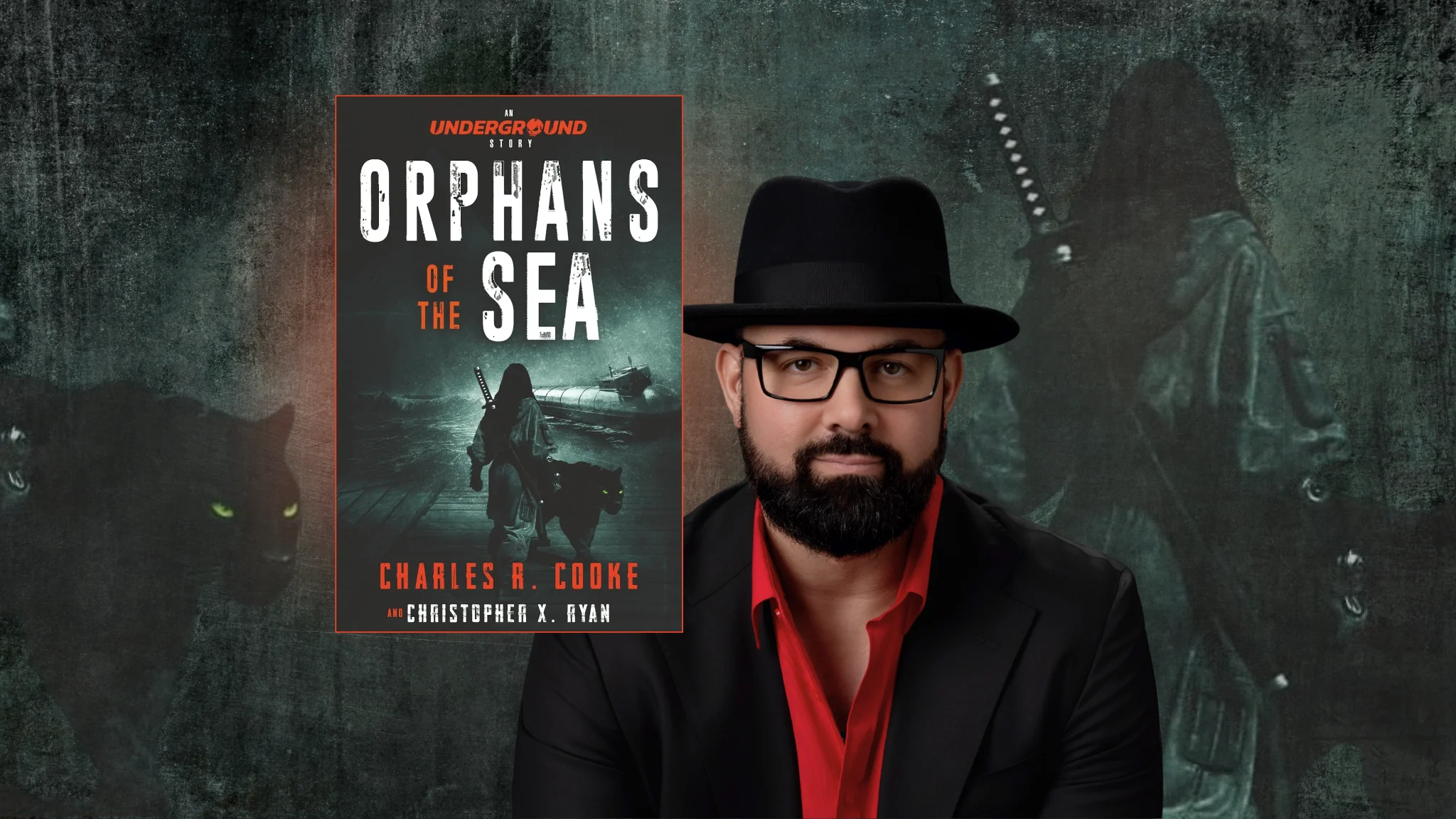
In Orphans of the Sea, Charles R. Cooke introduces readers to Sook Joo, a fifteen-year-old girl whose sheltered life at an orphanage is shattered by loss, violence and betrayal. Forced to navigate a dangerous world where powerful forces prey on the vulnerable, Sook Joo relies on the martial arts training, discipline and wisdom passed down by her grandfather Ryu. Blending futuristic technology, ancient traditions, organized crime and questions of family and survival, the novel explores what it means to grow up before you’re ready — and how to hold on to your humanity when survival demands that you change. In this Q&A, Cooke discusses Sook Joo’s journey, the creation of Orikido, the importance of chosen family and the world behind Orphans of the Sea.
Sook Joo is forced to grow up quickly as she faces loss, violence and betrayal. What did you most want to explore through her journey from a sheltered orphanage upbringing into a brutal world?
What I most wanted to explore was the difference between growing up and being forced to grow up. Sook Joo is only fifteen. At the orphanage, she has people who love her, a place where she belongs and a future she can still imagine. Then all of that is ripped away, and she has to make decisions no kid should face.
I didn’t want her to respond by suddenly becoming fearless or impossibly capable. She’s angry, frightened, and grieving, and sometimes those feelings help her while other times they get in her way. Her grandfather Ryu has given her skills and a sense of who she is, but she has to figure out how to use both when he’s no longer there to guide her.
The question I kept coming back to was: how much can Sook Joo change in order to survive without losing the part of herself that still cares about other people? She can’t return to the sheltered life she knew, but she can decide what kind of person comes out the other side. And Sook Joo’s story doesn’t end when she gets off that ship. She’s seen what happens to people who can’t defend themselves, and she isn’t done standing up for them.
Ryu teaches Sook Joo that controlling her emotions and remaining focused in the face of adversity are just as important as physical skill. How do his lessons continue to shape her long after he is gone?
Grandfather Ryu gives Sook Joo something more useful than instructions for winning a fight. He teaches her to pause, pay attention, and keep her emotions from making the decision for her. She doesn’t always manage it; she’s fifteen, she’s grieving, and people keep giving her excellent reasons to lose her temper. But his voice stays with her. When everything around her turns chaotic, his lessons help her steady herself and decide what to do next.
What I love is that Ryu isn’t the only voice in her head. Her adopted brother Futotta is in there too, practically screaming at her to do the impulsive thing she already wants to do. That tug-of-war feels true to Sook Joo. Ryu taught her restraint, but he didn’t make her any less fifteen.
The orphanage gives Sook Joo a strong sense of family even though many of the children are not related to her by blood. What did you want the novel to say about the difference between biological family and the families we create for ourselves?
I absolutely love this question, because I don’t think family is defined by blood alone. The children at the orphanage grow up together, look out for one another, and share a home. They’re family. Grandfather Ryu is Sook Joo’s biological grandfather, but what makes their relationship so important is that he’s there for her. He raises her, teaches her, and loves her. When that world is torn apart, those bonds don’t disappear.
The epigraph to my upcoming novel says, “To my family, whether we share blood or simply have chosen each other. I love you all more than I ever remember to tell you.” That’s how I feel about it. Blood ties can be powerful, but so can the people who choose to stand beside you (and the people you choose to fight for). I wanted readers to feel both kinds of love in Sook Joo’s story.
The world of Orphans of the Sea blends futuristic technology with martial arts, ancient traditions, organized crime and cultural beliefs. How did you approach building a world that feels both futuristic and connected to the past?
I’ve always liked the idea that progress doesn’t erase what came before it. People can have advanced technology and weaponry on their arms and still be guided by old traditions, beliefs, and family expectations. We built those things side by side in Orphans of the Sea. Technology changes what people can do, but it doesn’t change the very human reasons they do it: loyalty, greed, fear, love, and the need to belong. That mix makes Terrus feel lived in to me.
I also don’t think every part of the world would develop at the same pace. Different regions have different resources, histories, and priorities, and I wanted that to show in the Underground series. Some places embrace new technology; others hold more closely to older ways of life. Those traditions shape what people build and how they use it. In upcoming novels, we’ll spend more time with older tribes and see just how different life can be across this world.
Sook Joo’s Orikido training becomes much more than a fighting skill as it influences the way she thinks, reacts and survives. What inspired Orikido, and how did you develop its philosophy and traditions?
I had an absolute blast studying martial arts and taking bits and pieces from different disciplines to create Orikido. I looked at Hapkido and other techniques, then thought about the philosophy behind the fighting. I’m a diehard Mr. Miyagi fan, but I’ll admit that Johnny and Cobra Kai might be onto something with “strike first.” There’s a time to hold back, and there’s a time when hesitation can get you hurt.
I wanted Orikido to be more than a convenient way for Sook Joo to win fights. Grandfather Ryu is teaching her to control herself as much as to defend herself, so the discipline had to reach beyond physical technique. Its philosophy grew from their relationship: focus, restraint, awareness, and the ability to keep thinking when fear or anger takes over. Those lessons become part of how Sook Joo sees the world. The fighting matters, of course, but if all she learned was how to throw a punch, Ryu would have failed her.
The story places vulnerable young people at the mercy of powerful individuals and institutions. What drew you to exploring themes of exploitation, power and survival through the experiences of Sook Joo and the other orphans?
I wanted to tell a fast, gripping story, but the danger we had them face had to mean something. Sook Joo and the other orphans are vulnerable because powerful people see them as useful rather than human. That’s frightening precisely because the imbalance is so real. What interested me was how the kids respond to it: the ways they protect one another, the choices they make under pressure, and the determination it takes to survive without simply becoming like the people who hurt them. I never wanted their suffering to be the point of the story. Their humanity is.