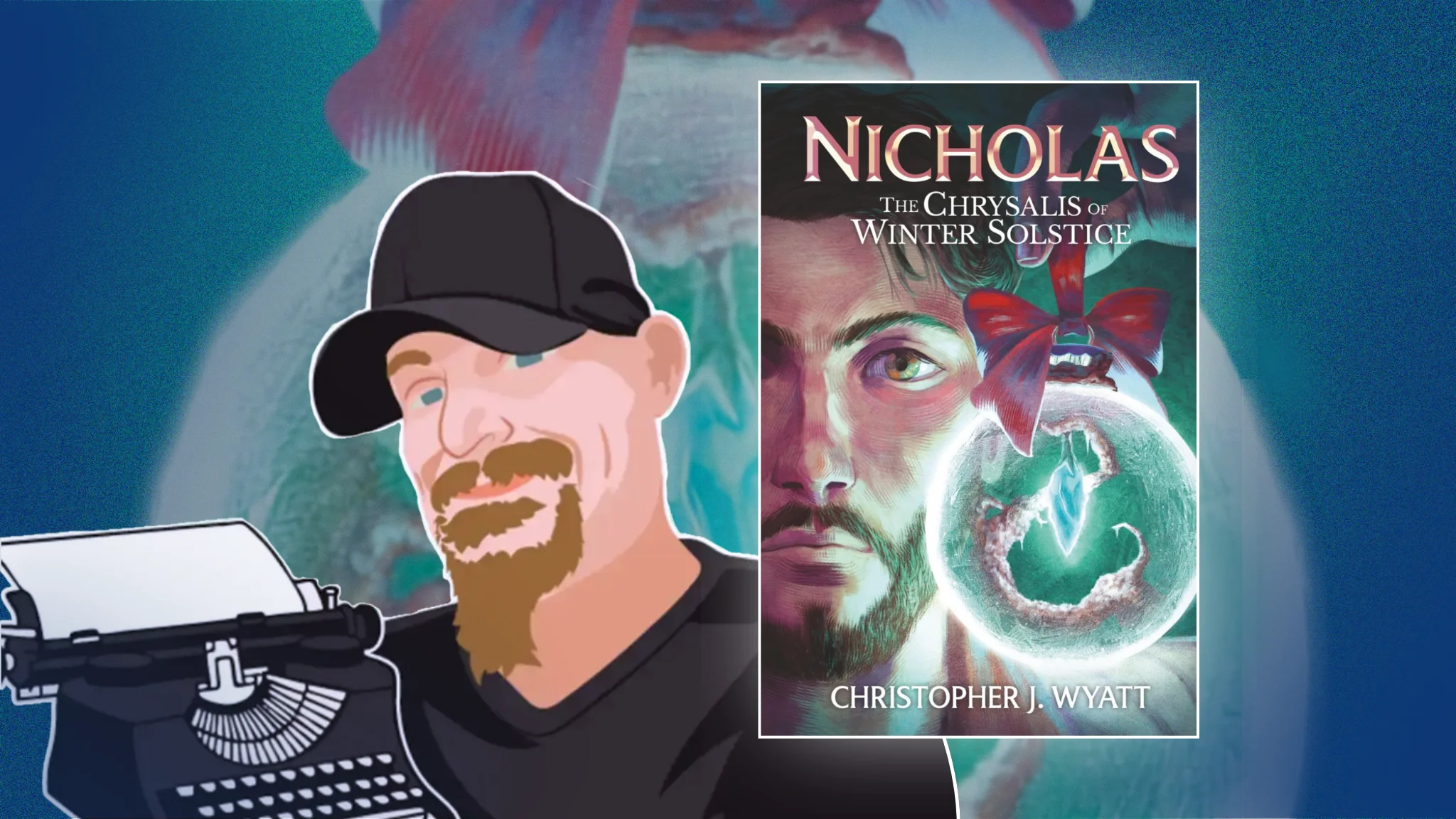
What if the legend of Saint Nicholas began not just with generosity, but with the making of a superhero? In Nicholas: The Chrysalis of Winter Solstice, Christopher J. Wyatt reimagines the familiar historical figure through a blend of fantasy, mythology and adventure. As Nicholas confronts grief, self-doubt and an extraordinary destiny as the “Restorer of Goodness,” Wyatt explores the qualities that define true heroism — compassion, courage, trust and the determination to persevere through adversity. In this Q&A, Wyatt discusses his fascination with the origins of Saint Nicholas, the imaginative world of Degomble and the deeper messages of goodness and purpose at the heart of the story.
Your novel reimagines Nicholas as both a historical-inspired figure and the “Restorer of Goodness.” What inspired you to blend the familiar legend of Saint Nicholas with fantasy, mythology and superhero-like elements?
I’ve always had an extreme fascination with Santa Clause: his different mythologies, his roles, his abilities, and his kindness and “goodness” to others, which I feel fits the bill of a superhero. What intrigues me the most is Santa’s historical origin. I guess you could say that my fascination inspired me to write a story that shows an alternate in mythology and history but also forms an epic connection that makes Santa who he is — a superhero — and it all begins with Nicholas.
Nicholas’ mother teaches him to “pull the sea,” a lesson that begins with swimming but becomes a philosophy for facing adversity. What does that phrase mean to you?
I believe when many of us face challenges or hardships, we often recollect on something that we were told — maybe by a mentor, a parent, or even a grandparent — and that inspirational nudge “pulls” us through. For Nicholas, he uses the fond memory of his mother telling him to “pull the sea” as a metaphorical tool to battle the hardships as a “Restorer of Goodness”.
After losing his parents, Nicholas begins searching for a greater purpose beyond the acts of generosity they taught him. How did you approach transforming his grief into the driving force behind his larger destiny?
Grief is a very powerful emotion. It can create sadness, emptiness, loneliness… even revenge in some instances. But I also believe it can spark motivation and ambition. I guess it’s how we move forth after losing someone. For Nicholas, re-enacting the historical tragedy of his parents was a way to emotionally ignite that spark and to fuel his ambition to seek his true purpose and meaning.
The world of Degomble introduces readers to an elaborate mythology of magical creatures, unusual customs and the battle between goodness and the “embedded evil.” What was the process of building this world, and which elements were the most enjoyable to create?
It all falls back on trying to create that epic connection between realism and imagination. Fulfilling that connection is what engages me the most, but it requires an elaborate mythology of characters, creatures, places, and “unusual customs,” as you say. It also contains a harsh nemesis of unforeseen nature.
Nicholas initially doubts that he can become the Restorer of Goodness, insisting that he is simply someone from a small town who knows “small deeds.” Why was it important to show that hesitation before he accepts his larger responsibility?
I wanted to maintain a realistic point of view of Nicholas’ struggles and doubts to draw emotions that my readers could relate to. I think we all face times in our lives where we are offered or given an important role, and we feel doubtful or unable to pass beyond a certain comfort zone. In Nicholas’ eyes, his comfort zone was living in a small town and performing “small deeds.” I also believe emphasizing doubt and hesitation enriches Nicholas’ “larger responsibility” but also the storyline itself.
Animals have meaningful roles throughout the story, from the Foredoomed Fallow to Hooley, Kiffy’s arctic fox. What drew you to using animals as both companions and important forces in the novel’s struggle between goodness and evil?
Whenever I go hiking or for a stroll, I often see dogs “walking their humans.” When my wife and I sit on our front porch, we receive free entertainment from our retired neighbor as he sings to his cat while grooming her. To many of us, animals are just as much people as humans are — I call them “furry humans.” I figured, why not have animals help play the part by giving them unique roles and abilities?
The Chrysalis of Winter Solstice ultimately gives Nicholas the ability to restore rather than simply destroy, and his encounter with the Foredoomed Fallow centers on compassion and trust. What do you hope that moment reveals about your larger message of what it means to be a hero?
I believe this scene shows that true heroism is built on defining moments, building confidence, acquiring the right heroic tools or instruments, and obtaining support from others by compassion and earning trust. When all that is smelted together, a hero is forged.