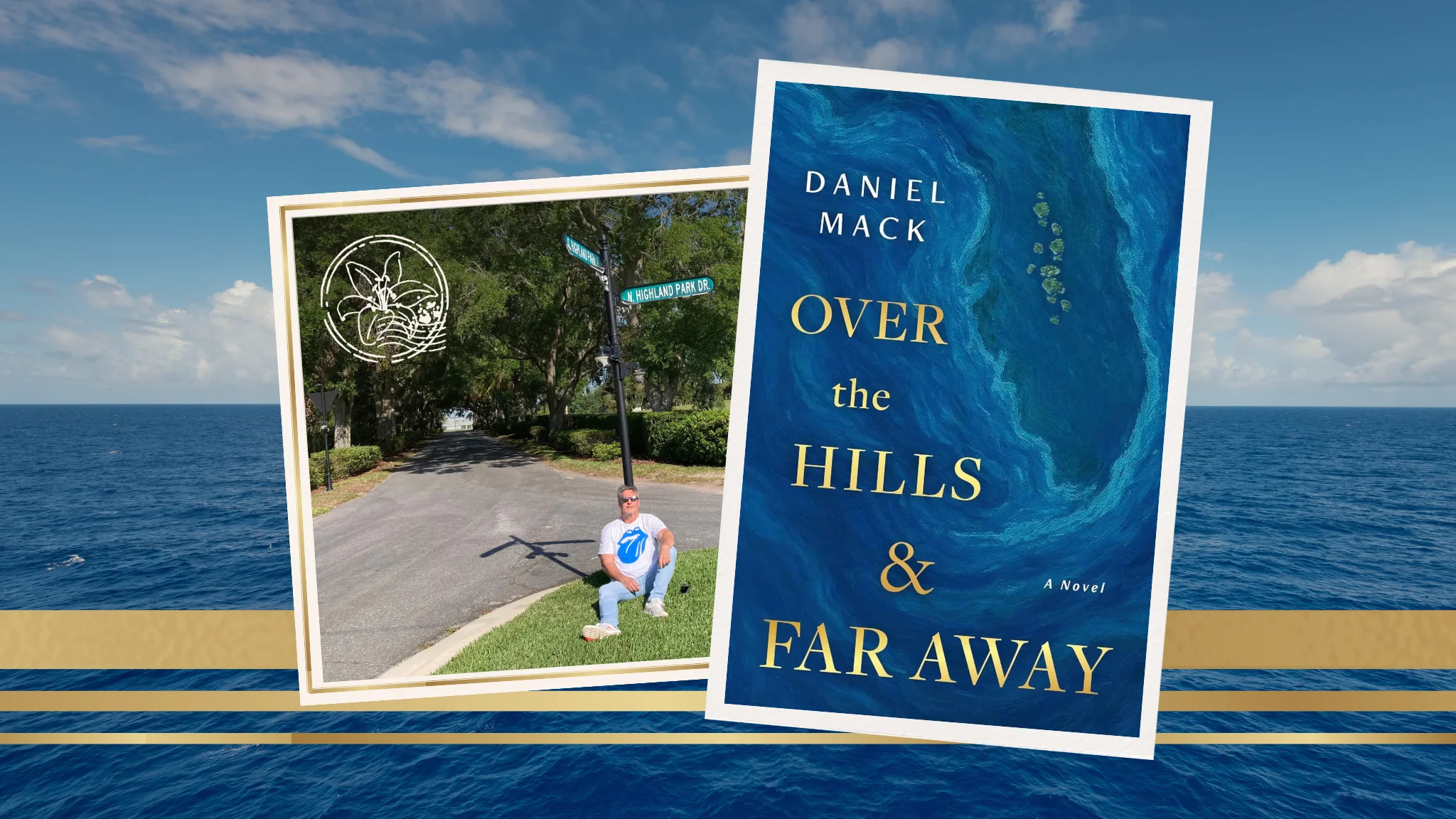
In Over the Hills and Far Away, author Daniel Mack takes readers on a thought-provoking journey through some of life’s biggest and most enduring questions. Through behavioral therapist John Merlan’s observations of an increasingly complicated and often absurd world, the novel explores free will, control, identity, human connection, spirituality and the search for meaning — all while leaving plenty of room for humor. In this conversation, Mack discusses the ideas and experiences that shaped the novel, the memorable characters who bring those themes to life, and why he ultimately wants readers to draw their own conclusions about what the story means.
The struggle between control and freedom is established from the very beginning of the novel. What made you want to explore free will as one of the book’s central themes, and how did that idea shape the story?
Excellent first question. Yes, in the novel’s very first sentence, the theme of ‘control’ is initially proposed in a near-accusatory tone. The book’s last line intentionally echoes the same theme. But there, I leave it for the reader to decide whether I am tossing the line out in a sarcastic sneer or offering mankind a last hope that some type of benevolent force is guiding their fate.
To respond to the rest of that question, I really must go back to the initial stages in the creation of my novel. It basically came down to my wanting to offer readers Dan Mack’s very best effort—my honest, comprehensive take on just what lies at the core of this human experience. Do you think readers demand enough of modern literary fiction? Do authors challenge themselves enough by daring to ask eternal questions about what life on planet Earth is really all about? There are fiction genres for everyone. Most of them bore me. Why can’t a novel be highly entertaining while pushing the reader to more deeply examine their own life? Why can’t a nice piece of modern writing employ good-old-fashioned symbolism and metaphors and be cleverly layered to tell two or three stories at the same time?
So, while an army of Orcs or DC Universe bad guys certainly serves a purpose in the sphere of entertainment—as much as I challenge the reader—I challenged myself to write about the most important topics I could discuss and present those topics by using a highly entertaining piece of prose.
And how does the idea of ‘control’ shape the story? I hope it becomes either an overt or implied component in nearly all the characters I have created to move us through the story. El Roy, Mind F Guy, and The Jehovahs are scrutinized for their individual takes on ‘control.’ The main character, a behavioral therapist, takes us into counseling sessions where his patients (Health Guy, Relationship Guy, Regrets Lady, Modern Times Guy, and Gas Station Lady) reveal their own struggles to maintain control of their own lives in this modern world.
John Merlan spends much of the novel observing the absurdities of modern life while also questioning his own purpose and identity. What inspired John as a character, and what did you hope readers would take away from his way of looking at the world?
Taking a long look at the myriad ways the complexities of this world challenge us all to maintain a feeling of sanity—that was always going to be a main theme in the novel. This is where choosing a behavioral therapist to lead us through the story became a key component. Who better to point out the insanity in nature and how we are all trying to cope with it? John Merlan gave me all the latitude I ever needed to introduce every major bizarre component within this experience of being a human on planet Earth.
With John, I am hoping to connect with the readers. I hope they see facets of their own struggles in the numerous incidents of ‘madness in daily life,’ which he catalogues throughout the entire novel.
I think questioning our own purpose and identity strikes us all at some point—sometimes it comes like a punch in the forehead—sometimes, it comes as a whispering curiosity that builds over the years and must finally be addressed. In fact, perhaps we should be continually course-correcting as we age. ‘A second chance’ is another core theme in the book.
The brings novel brings together science, spirituality and speculation about the human soul, including the idea that Earth might be a place souls come to experience freedom, imperfection and physical life. How did you develop this intersection of scientific and spiritual ideas?
About time you asked me an easy one. After a lifetime of listening to so many voices telling me their version of spirituality and insisting their version was superior to all other products competing in the marketplace of souls—after studying theories on human evolution and living long enough to see the ‘scientific facts’ updated and changed on a regular basis—after all that, I’ve come to the conclusion that this intersection of ideas is the only possible basis for a believable theory that might explain how we have come to be what we are.
Thanks for asking that. I do not pretend to solve any eternal questions in my book. But maybe I can stimulate the ‘looking deeper for answers’ in the minds of my readers.
John repeatedly notices patterns, coincidences and moments that make him wonder whether his life is part of a larger script. How important is the tension between coincidence and some greater guiding presence to the novel?
I’m not sure that I would call it ‘tension.’ But I most definitely wrote a few scenes featuring coincidence. First, I wanted to present coincidence as a very real thing in daily existence. I think it’s just a matter of adjusting our human antennae to notice how prevalent it is. Second, I still can’t exactly explain it, but I wanted to use coincidence to make my case, that, “Hey, there’s something going on here. I see it. Do you see it?” I wanted to present the phenomena as being clues that there is more happening, that a deeper understanding of our existence is available and occurring all of the time right before our eyes.
Some of these scenes appear within the natural flow of the story. I hope they don’t seem too obvious or corny, but many of those examples come from my own lived experience. In other scenes (at the doctor’s office in Bartow, in the final showdown with Mind F Guy) John Merlan checks box after box on his personal list of coincidental happenings.
Perhaps what you describe as a tension between coincidence and some greater guiding presence is the eerie, intimidating thought that this is communication with and proof of a greater presence.
John wrestles with whether maintaining his freedom and individuality has cost him some of the relationships, belonging and sense of purpose that come with being part of “The Tribe.” What interested you about exploring that conflict between independence and human connection?
Yes, ‘The Tribe,’ our wonderful, all-knowing, all-powerful, freedom-usurping tribe. Finding balance in all aspects of our lives is a theory that I regularly put forth in the book. In Chapter 12, John wrestles mightily with finding balance in his interactions with ‘The Tribe.’
John even finds ‘Tribes’ within the ‘Tribes.’ Factions will force the individual to sign up for a side—to join a fight that isn’t his—to hate without even thinking about it. But he doesn’t really condemn anyone for ‘Tribal’ membership. He merely seems to be pointing out these quirks in the natural order of being human. It is just one more instance where he asks us to pause and think about it.
Look, I like people—they’re one of my favorite things. But at some point, they do begin to suck. An organized population of human beings does offer many benefits for the individual. But it seems at some point comes an overreach, a need for greater and greater control over the individual. That tightrope balancing act of maintaining one’s liberty becomes fair game for the powers-that-be to obliterate. To them, it is no longer enough for us to become their good citizens. We are turned into frogs in a pot of boiling water.
At some point, you are no longer able to choose which of their policies you deem beneficial. At some point, they always cross the line. Next thing you know, some dummy from the local township board is telling you how tall your front lawn flag pole can be. This, after you went along with their previous brainwashing and started flying their damn ‘Tribal” flag.
A clue to the ‘Tribe’ thing might be found in a conversation with Relationship Guy. That client describes never having felt fully hypnotized at birth. Maybe John Merlan wasn’t either. Is John stepping back—self-aware enough to know he is occupying a human form—and saying, “Good Lord, just look at these silly humans, taking themselves so damn seriously”? Maybe the folly of man disgusts him to such a degree that he has never felt any desire to join in and play their games.
It’s a societal insanity, and I just had to let John Merlan point it out.
The book examines the ways advertising, institutions and society can influence people while allowing them to believe they are still exercising free will. What did you want the novel to say about how much control individuals really have over their own choices?
This question ties in well with the previous. In this madhouse existence, one must be ever-vigilant and push back at all the bastards who are trying to control us. But unless you can identify the enemy, you stand zero chance of prevailing.
I really enjoyed my marketing classes in college. Advertising became a personal fascination after I read a book called Media Sexploitation. My roommate and I spent hours scouring the colorful ads in Time magazine for subliminal messages hidden within their brilliantly airbrushed.
Throughout the novel, and especially in Chapter 16, I try to identify our worst and most common enemies. Unfortunately, pointing out the bad guys doesn’t seem to be enough. ‘We didn’t start the fire,’ but I really don’t think there is much we can do to extinguish it.
In Chapter 8, John discusses the origin of the ‘fire’ with El Roy, who offers a sympathetic ear but no real answers. Only, “Here we are, and how do we proceed?”
Our main character has chosen to just keep his head down, try to have a nice day every day, and not partake or contribute to the mess that has been left for us all to muddle through. While he begins, hopeful that a solution is discoverable, the futility of our Earthly reality eventually sinks in. He sees the trap—because to have a normal human life, with hormones and emotion driving us to do all the human things—to merrily join ‘The Tribe’—even the most vigilant among us will just naturally find themselves in a position of furthering the madness, totally unaware that they have become part of the problem, all the while feeling they are an innocent part of the solution.
When John is asked what he does, he ultimately answers, “I just be John Merlan,” rejecting the idea that his occupation should define him. Why was this question of who we are versus what we do important to John’s journey and to the larger meaning of the novel?
Yes, he ‘just be John Merlan.’ And that seemingly simple act is enough for him. He realizes the complexities and depth of just becoming the human he came here to be. He is satisfied with himself. He doesn’t need a badge or a name tag. He doesn’t need a constant companion. He doesn’t need the smothering embrace of a community who welcomes him with one hand and reaches for his wallet with the other.
Listen, Dan Mack and John Merlan don’t care what costume or disguise anyone adopts to feel they are enjoying their time as a human. But like everything, maintain a balance. Take time to examine your every move. Examine your own motivations and personal flaws. If you first learn to enjoy the ‘you’ inside your own head, aren’t you then more likely to enjoy performing in the costume or disguise you chose from Life’s wardrobe department? A lot of cops lose that message of service to the community and crave the power they wield to control others. A lot of young medical assistants lose that message of compassionate healing and fall in love with a feeling of superiority they gain from wearing a simple set of scrubs to work.
Balance. Just being. Self-examination. Costumes are not only for Halloween—just make sure you’re wearing one for the right reasons.
Explain Water-skier Chick.
Ah, yes, the water-skier chick. At first, she may appear as being a bit of a toss-off character. A reader asked me if I was just trying to have a bit of fun and add color to the story. Absolutely. I’m always trying to have fun in my writing. And the first time she appears, that may have been all she was. But I quickly saw how she could be used to show greater depth to my character, John Merlan.
John is aging in a rapidly changing world. We are all aging. We lose hair, we lose teeth, and we lose friends and familiar landmarks. Maybe worst of all, we lose our connection with the natural things that made us human in the first place. Our very emotions seem to grow numb. It takes a lot to make John laugh, and we may never know what could make him cry. A distance seems to develop between all of us. The gap between acknowledging someone else’s presence in the world and actually connecting grows wider—or at least becomes redefined.
This theme is explored more deeply in John’s sessions with Relationship Guy. I use Water-skier Chick to show how this distance in connecting is becoming more pronounced in the main character’s life as well. Look, maybe it’s a ‘guy thing.’ Nothing stings like that first time a young, desirable woman calls you ‘sir.’ John Merlan is quite intrigued by The Chick. He knows that those days are gone, but he seems to enjoy teasing himself with the fading echoes of emotions he used to have. And in the end, he is just as satisfied with the result of the limited exchange they do have.
Yeah, Water-skier Chick was pure fun to write.
One final question, Dan. In an earlier answer, you listed many of the characters you created for the story. But you made no mention of two of my favorite characters. Would you tell us a little bit about where Kelly and Shannon came from, and how did you hope these characters would help shape your story?
I could probably talk about those two all day. Writing a novel can be a lot of work. I do not like work. I was very determined to write something of substance that gave the reader value for their purchase. But the process had to be fun—not work. And writing this novel was some of the biggest fun I’ve ever had. The Kelly chapter and Shannon’s frequent (often unannounced) appearances were as fun as they get, while still delivering on the substance.
John Merlan might be described as a loner. There is no wife or girlfriend, though he often refers to previous relationships. Despite his age and seeming disinterest, he seems a little torn on his own feelings about female companionship. The story features 3 women who perpetually intrigue him. Kelly appears late in the story but quickly becomes a driving force to its conclusion. Is she another red herring? Is she the basis for the story’s ironic ending?
In Chapter 8, El Roy encourages John to write about life. While the Kelly character performs many tasks in moving my story along. But the most important job I gave her was to give John another nudge toward writing about his experiences. Here was my own little inside joke about human behavior—that while we often shrug off the advice of a wise elder, let a pretty face offer the very same advice, and we will turn our lives upside down to perform the request. I enjoyed revealing our hero to be more than a deep-thinking philosophical type but at the same time just another mongrel human at heart.
Shannon. Oh, boy. That dude pretty much kicked my door in and demanded more print time in the novel. Originally, there was his brief intro in Chapter 1 and a wild conversation during the car ride to Bartow. Once I had finished my first draft, I knew there was an important element missing in the story. A lot of my book deals with very heavy issues that plague all our lives. And while Merlan regularly tinges his opinions with a good deal of sarcasm, I knew the story needed more humor—because that’s a component of my own personality, and it’s my book, and dammit, I wanted it to be fun and funnier. Shannon was the easy solution. I wound up extending his scenes and writing him a couple of new ones. I even introduce the reader to his nut-job girlfriend.
All my life, I’ve heard interviews with movie directors or novelists in which they describe a character simply taking control of the camera or the pen. There is NO negotiation; you are going to take me from cameo bit-player actor to big-time Hollywood icon. Well, that was Shannon.
I knew I needed more laughs, but there was something else I needed. There is a lot of dialogue in this book, but it’s mainly coming from straight men therapy patients, with Merlan’s sarcastic thought bubbles providing the only comic relief. The buttoned-down, serious topics of those clients needed to be addressed, certainly. But there is so much absurdity and off-color lunacy in everyday existence. This too needed to be talked about. The Shannon character allowed me to address those topics with his off-the-wall observances and irreverent commentary. He made my novel complete. He gave me a hilarious lunatic who broached the untouchable, politically incorrect topics of our times.
Shannon gave me so much that I didn’t mind making him a star. But now his agent isn’t taking my calls.
Thank you very much for the wonderful questions. I struggle a bit when a prospective reader asks me, “What’s your book about?” Oh, I could go on and on telling them about my book, but there is a struggle. Writing this novel was such a wonderful experience, and I am amazed at how much fun it is to listen to readers’ feedback after finishing the story. I love to listen to THEM tell ME what it’s about. Because it will always be what I think it is about, in my mind. But now it has evolved. Now it is about what hundreds of people say it is about. Now it is open to interpretation. Now it is about the filter of their own attitudes, opinions, and lived experiences creating a personal movie in their own minds. I think that is the wonder of a written story. I give you a new coloring book and a big box of crayons—go create. I don’t even care if you stay inside the lines. So, when someone asks me, “What’s your book about?” I struggle. My job is to give them a template for a wonderful movie in their mind. Isn’t that the joy of reading a good book—making it personal—making it your own? I keep trying to keep my answers to their question short and somewhat opaque. I do not want to rob them of the pleasure their own brain and imagination will create for them.
I honestly think that just about anyone will be able to find something to connect with in Over the Hills and Far Away. Enjoy.