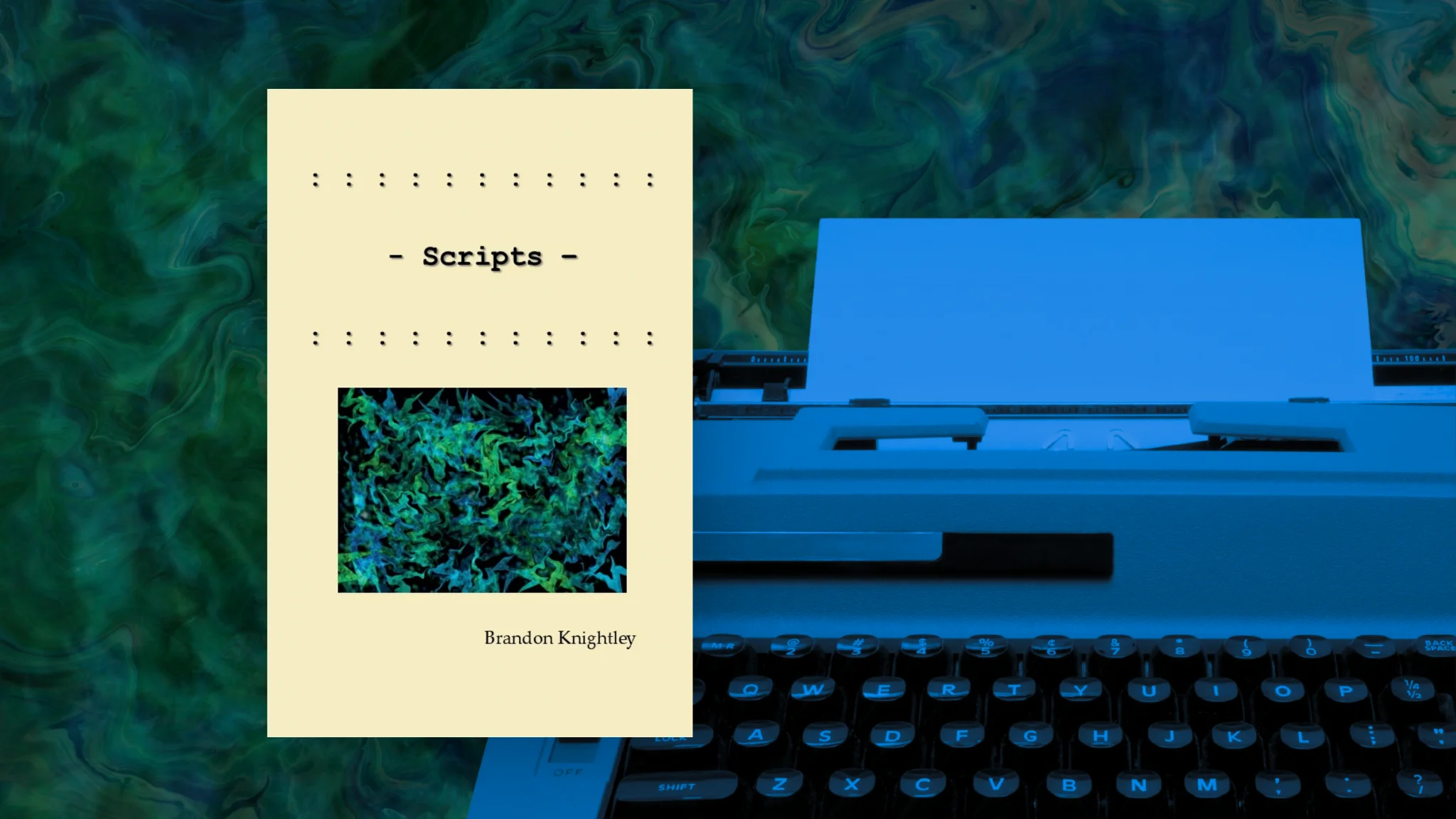
In Scripts, Brandon Knightley explores the complicated relationship between the stories we inherit, the stories we tell and the lives we ultimately choose for ourselves. At the center of the novel is Arlene, a woman trapped in an emotionally empty and increasingly frightening marriage who discovers an unexpected path toward self-expression through writing. As her fictional scripts begin to reflect truths she has yet to recognize in her own life, storytelling becomes a means of connection, transformation and liberation. In this conversation, Knightley discusses Arlene’s journey from invisibility to independence, the symbolism behind her writing, the importance of friendship and the power of fiction to help us see ourselves more clearly.
Arlene lives in an emotionally empty and increasingly frightening marriage to Charlie. What did you want her journey to reveal about the difference between enduring a life and choosing one for yourself?
Two things, perhaps. First, to highlight how much the formal framework of our lives is determined by the abstract philosophies we are given. So, Arlene was taught by her mother that survival, while remaining moral, was enough, and that invisibility was an advantage in surviving; she married Charlie with no expectation of anything more. Second, to acknowledge the astonishing role that chance—or contingency—plays in our personal histories. If Arlene had not been at the park watching the children play that morning, her story might have been different. Life and art both manifest this barely credible, wonderful tension between the abstract and the contingent.
The “readings” are woven throughout the novel and echo the emotional experiences of the characters reading them. What inspired you to build the story around this interplay between fictional scripts and the characters’ real lives?
Arlene speaks for the author when she describes the scripts metaphorically as sheet music, which is not music itself but something we acquire to allow us—even those of us of very limited talent—to get inside the music. (I still hope that some readers will try these readings as Arlene intended!) Once that device was established, the relationship between the scripts and Arlene’s story, with their ultimate convergence, was natural insofar as these were Arlene’s scripts, and this was Arlene’s life. But more to the point of your question, the fictional characters in the codas that follow each of those tiny plays both reflect on the meaning of each and show the direct relevance of Arlene’s constructions to real life.
Arlene’s decision to buy the blue typewriter becomes much more than a practical purchase. Why was the typewriter such an important symbol of commitment and transformation for her?
Arlene went big on the typewriter so that she could not go back. The typewriter was hard to hide and hard to disobey. All that was soft and timid in her was overruled by an iron machine that commanded that she write her stories, and with those, her own story, in a voice that she, by choice, no longer directly controlled. We see this liberated Arlene without the typewriter perhaps once in the book: the confrontation with Charlie over the puppy that he has brought home with such nefarious intent.
Arlene possesses a sensitivity to other people’s emotions, yet she initially has difficulty examining her own circumstances. What interested you about creating a character who can understand others more easily than she understands herself?
Of course, this has precedent in fiction, and Jane Austen’s Emma immediately comes to mind. More germane to your question, Arlene has confused origins and a clear and continuing lesson from her mother that makes self-reflection almost beside the point. She eventually learns that she has some talent for transporting herself into others, a gift to which she wants to give voice. The final step—of transporting herself into herself—is much more elusive because it has been so obscured by her family culture. The American cultural hero in this is her sister-in-law Mary, who brings about the final step. We’ll get back to her later, I think, but for now I’d have to say that it is the role of culture in self-reflection—and therefore in self-definition and self-determination—that made Arlene so fascinating for me.
Arlene writes under the name Marla Kraft, allowing her work to reach people while she herself remains largely invisible. What did you want to explore through the separation between Arlene’s private identity and her identity as a writer?
Again, there are two compelling elements at play here, one drawn from contingency, the other from abstraction. The first is the practical matter of shielding her writing from Charlie. Arlene knows intuitively that Charlie will smash this self-expressive lark with the force of a falling boulder. She does not understand him, but she knows perfectly well what to expect from him. She cannot permit this, and the only vestige of her true person in her name is the unvoiced Lena linked with a German word meaning strength. (But Arlene herself is not fully aware of how she chose this name, as she makes clear late in the story.)
The second factor in her decision not to write under her own name is the moral tenet her mother has immersed her in: do good and disappear. This abstract principle affects both what we choose to do and how we choose to do it. In Arlene’s case, she writes, for the most part, about ordinary people with no flashiness, and she rejects any direct notice of her writing. We imagine that the typewriter keys make as little noise as possible as she frowns over them behind her embroidered curtain.
Something else comes to mind. The use of a pseudonym does not shield you from whatever comes with attaching your name to your work. You are still putting yourself out there as much as if you were singing lead in a big musical under a stage name. Nonetheless, there is still something intensely liberating in the charade.
Mary becomes much more than Charlie’s sister to Arlene, developing into her first true friend and an important supporter of her writing. How does their relationship change Arlene’s understanding of connection, independence and what she wants from her life?
Mary is fully engaged in life, even in an enormously common one, as a 1950s housewife and mother. When Arlene asks her to be her agent, there begins a reciprocity between the two, each acting as a catalyst for the other’s growth. Arlene gains confidence in her new-found self-expression, and Mary learns of capabilities that she has never suspected in herself, even though her life has been a happy one. I have never thought about this, but I cannot separate Arlene’s transformation from Mary’s. By the end of the story, they are as much in love with each other as is perhaps possible in a non-romantic sense. When Arlene writes to Mary in that final letter that she has had to re-image “do good and disappear” to accommodate personal love, it is Mary who has brought that about.
I cannot help adding, as the author, that I had never planned for any of this. Mary would just not stop growing, and I miss her almost as much as I miss Arlene.
Throughout the novel, characters use stories and performance to experience emotions that may be missing, suppressed or unresolved in their own lives. What do you hope Scripts says about the power of fiction to help people recognize truths about themselves?
The other questions are so simple compared to this that I need to confess first that I can only answer narrowly. Karl Marx once wrote, “Every emancipation is a restoration of the human world and of human relationships to man himself.” The fictional readers of the little plays in Scripts, as well as Arlene herself, are reflecting precisely on this insofar as they see emancipation in self-expression, freedom, and love. Perhaps these stories within Arlene’s own story can reinforce Marx’s profound assertion to make it visible to the real-world readers of the book. Art certainly can do this, and that is my hope for Scripts.