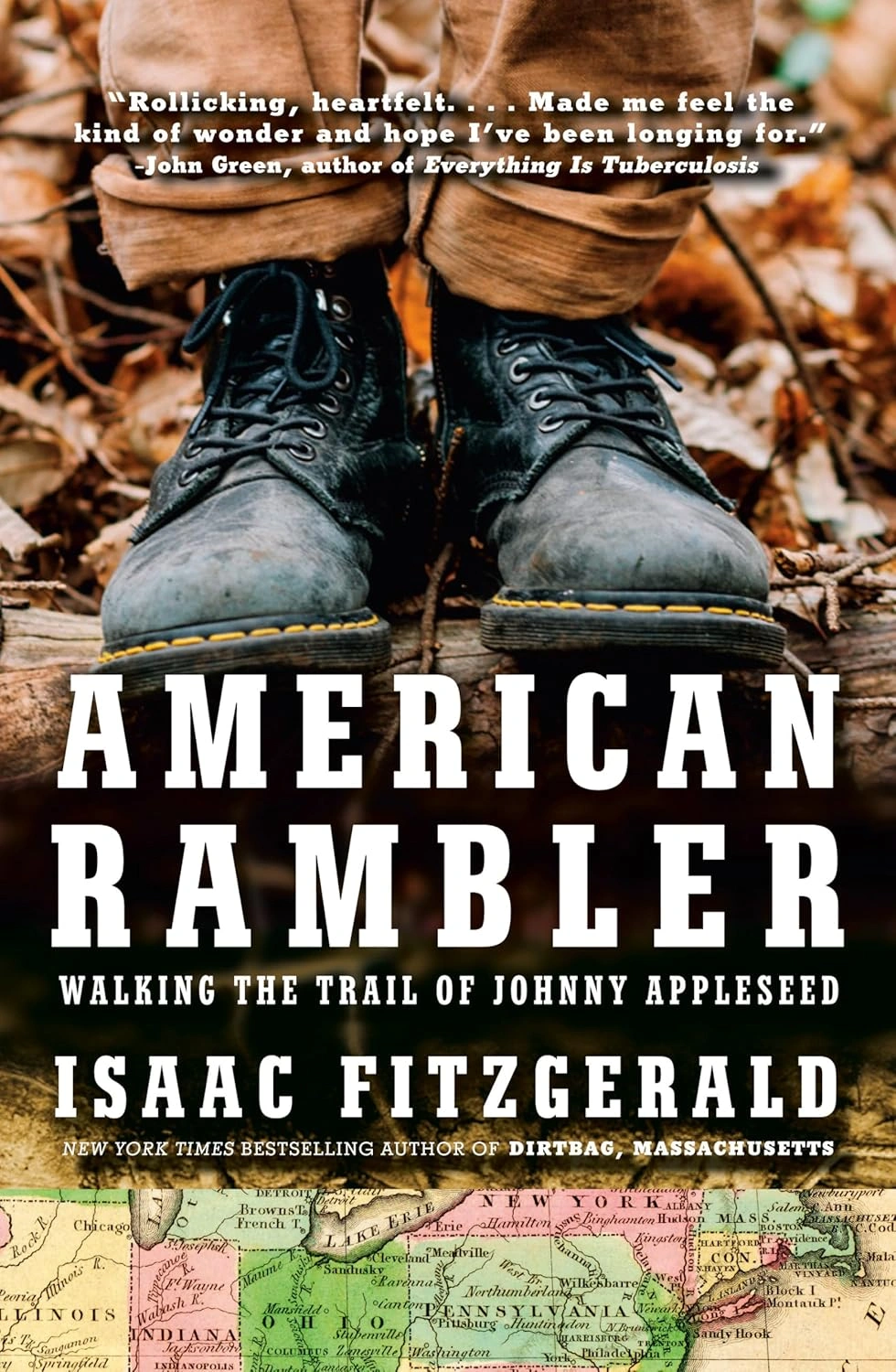
American Rambler: Walking the Trail of Johnny Appleseed by Isaac Fitzgerald
Isaac Fitzgerald is a New York Times bestselling author of Dirtbag, Massachusetts; recipient of the New Atlantic Independent Booksellers Association Book of the Year Award; and frequent Today Show guest. His current work of nonfiction, American Rambler, subtitled Walking the Trail of Johnny Appleseed, documents his insightful adventures following the legend and facts of the ghostly and mythologized American folk hero John Chapman. It’s a riveting amalgam of humorous memoir and travel guide of a yearlong journey along his subject’s known paths. Beginning with spring, the book is divided into four seasons, during which time Fitzgerald walked or drove from the Leominster, Massachusetts, birthplace of John Chapman to his gravesite in Fort Wayne, Indiana. The author had recently left a well-compensated but demanding job to pursue a childhood fascination born of his father’s embellished tales of this early nurseryman who propagated orchards throughout the frontier. It’s the transcendent and uplifting introspection of an ingenuous writer who endured a fraught childhood and has lived itinerantly since his late teens. Along the way, he confronts nagging fears of the possibility of inheriting the mental illness that plagues his mother and the contemplation of a calmer, more joyful future with his soon-to-be wife while walking, meditating and observing nature.
The Making of an American Rambler
The author is a former altar boy and lapsed Catholic whose early childhood in Boston was stigmatized by illegitimacy; his parents were married to other people when he was born, with each already raising a child. After divorcing their respective spouses, they married, but a sense of shame lingered, as evidenced by his grandparents, who shunned Isaac but proudly displayed photos of their other grandchildren. The impoverished blended family lived in a Catholic homeless shelter and halfway house for several years before achieving greater stability. Walking was their primary mode of transportation, and after they acquired a car, camping became their recreation. His restless father frequently took Isaac on long hikes, and when his young son became fatigued, he encouraged him to push on with the allure of episodic storytelling as a promised reward. There were tales of knights of old, pirates, mythology and partially remembered plots of novels along with historical events and heroic figures embellished with his dad’s inventive and imaginative flair when memory failed him.
Stories of Massachusetts native Johnny Appleseed tramping the countryside carrying sacks of seeds, planting and selling apple tree seedlings all across the land to the far reaches of the early to mid-19th century frontier were captivating. What could surpass following in his footsteps as a way to separate fact from fiction?
The Legend of Johnny Appleseed, a popular segment of the 1948 Melody Time animated anthology of musical short subjects from the Disney studios, was frequently shown on television. The cheerful and fantastical segment featured a perpetually smiling, childlike man clad in vaguely colonial attire topped with a tin pot hat who talks to the animals as he plants an abundance of apple trees. Along with striking images of a wobbly wheelbarrow brimming with large, delicious red apples is a simple Christian message with the song “The Lord is Good to Me.” Little wonder the short, stocky, and reportedly quite eccentric real person was easily confused with mythical characters like Paul Bunyan in a child’s mind.
The Man Behind the Myth of Johnny Appleseed
John Chapman, born in 1774, was the son of a Son of Liberty member who grew up in Massachusetts near Lexington and Concord during the American Revolution before relocating to Pennsylvania, but beyond this, little is known of his formative years. As the country expanded westward in the early 1800s, homesteaders were required to plant 50 fruit trees within 3 years to secure ownership of 100-acre land claims. Chapman seized upon this opportunity by acquiring vast quantities of free seeds leftover in the apple pomace after being pressed for juice and selling or trading them from his large sacks while wandering on foot from Pennsylvania to Ohio, Indiana, and as far as Illinois. He also planted many acres of land with these seeds to establish nurseries to sell seedlings to settlers. Despite false assumptions of poverty based on his lack of permanent address, worn clothing, beard, long shaggy hair and characteristic bare feet, he was in reality a financially adept businessman. The twelve hundred acres of land he had acquired by the time of his death in 1845 were bequeathed to his sister Persis, while other known properties were lost due to failure to file the deeds. John Chapman never married nor had children, although he retained good familial relationships, including with his younger brother Nathaniel, who as a boy accompanied him on his rounds.
Chapman was a devout follower of Emanuel Swedenborg, whose tradition “values freedom of thought in matters of belief.” “Any precepts of faith that we accept should make sense to our minds and our hearts,” according to the Swedenborgian Church of North America. All of the orchards he planted were from seeds due to his abhorrence of grafting (cloning), which he believed caused them suffering, and not in accord with these beliefs. As a consequence, all fruit produced was hard, intensely sour, and generally inedible, although ideal for making apple brandy or, more often, hard apple cider, which was 18th and 19th century America’s customary beverage for adults and children. Beer, wine, coffee and tea were costlier than apple cider and whiskey, and the prevalence of contaminated water made these alternatives preferable in an era when alcohol was consumed at all times. Author Michael Pollan in The Botany of Desire describes John Chapman as “our American Dionysus bringing the gift of alcohol to the frontier.”
During Prohibition, the vast majority of apple trees used to make hard cider were chopped down, bulldozed, or burned. Purportedly, the sole surviving tree planted in 1837 by John Chapman exists on a farm owned by the Algeo Family near the tiny town of Nova, Ohio which Isaac Fitzgerald visited to view that tree on his year-long pilgrimage in homage to his patron saint Johnny Appleseed. The proliferation of highways, barriers, an abundance of housing developments and otherwise commercial and private property made it impossible to literally trace John Chapman’s footsteps. The Johnny Appleseed Trail of North Central Massachusetts is a misnomer, for there is no actual trailhead; it is simply a stretch of highway attractively named for motorists.
A Journey Through History and America
Driving and hiking solo encourages Zen-like meditation: a sense of wakefulness and awareness of the natural world as well as serving as a time for reflection. Isaac Fitzgerald researched his subject and stopped at each marker, plaque, monument or museum in every hamlet John Chapman was rumored to have sown seeds or planted seedlings in. Johnny Appleseed was celebrated in verse, books and music, with many festivals held in his name, the largest in Ohio and Fort Wayne, Indiana. “You’re not from around here” was the common refrain heard by the author as he matched shots with a one-eyed bartender in Warren, Ohio, and at other taverns along the way. Isaac Fitzgerald made it clear at the outset that he is a drinker, and from his own account, on his journey alcohol flowed as copiously as in John Chapman’s pre-temperance era.
As a self-described burly, bearded, heavily tattooed man customarily clad in Hawaiian shirts, shorts or jeans and flip-flops or boots depending on the weather, the author would be noticed in any crowd. Previous books reflect some of his interests. How to Be a Pirate is a best-selling children’s book along with two books published on tattoo art: Pen & Ink: Tattoos and the Stories Behind Them and the award-winning Knives & Ink: Chefs and the Stories Behind Their Tattoos.
American Rambler: Walking the Trail of Johnny Appleseed has less in common with Bill Bryson’s rambles or John Steinbeck’s ode to America Travels with Charlie than with the road trips and observations of Jack Kerouac or Robert M. Pirsig’s philosophical Zen and the Art of Motorcycle Maintenance. As Paul Simon wrote in his iconic song America from the album Bookends, “I’ve gone to look for America.”
Isaac Fitzgerald has charmingly included us in his search as he sifts seeds of truth from mythology about John Chapman/Johnny Appleseed and introduces us to authentic individuals for appreciation along the byways of the American heartland. Ramble along, good reader, with an essential book for our times.
About Isaac Fitzgerald:
 Isaac Fitzgerald is the New York Times bestselling author of Dirtbag, Massachusetts (winner of the New England Book Award). He is also the author of the bestselling children’s book How to Be a Pirate as well as the co-author of Pen & Ink: Tattoos and the Stories Behind Them and Knives & Ink: Chefs and the Stories Behind Their Tattoos (winner of an IACP Award). He appears frequently on The Today Show, and his writing has appeared in The New York Times, The Atlantic, Esquire, GQ, The Guardian, The Best American Nonrequired Reading, and numerous other publications. He lives with his wife and their two dogs on the North Fork of Long Island.