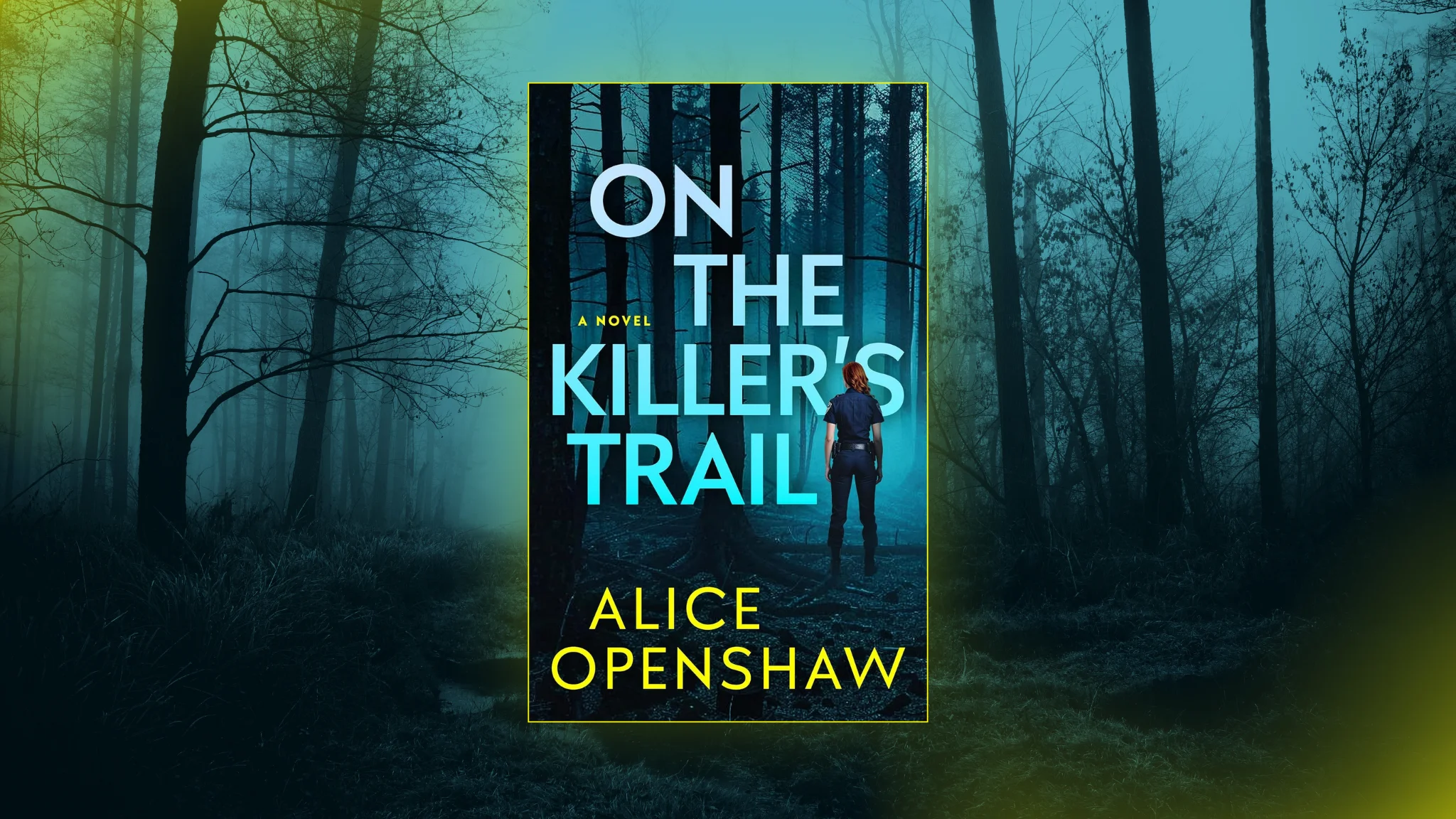
On the Killer's Trail by Alice Openshaw
“Ten years ago, fresh out of college, she expected to be a veterinarian with a life partner and her own home by now. Instead, here she was, pushing thirty-two, alone in a small town in northern Maine, and she didn’t even have her own dog.”
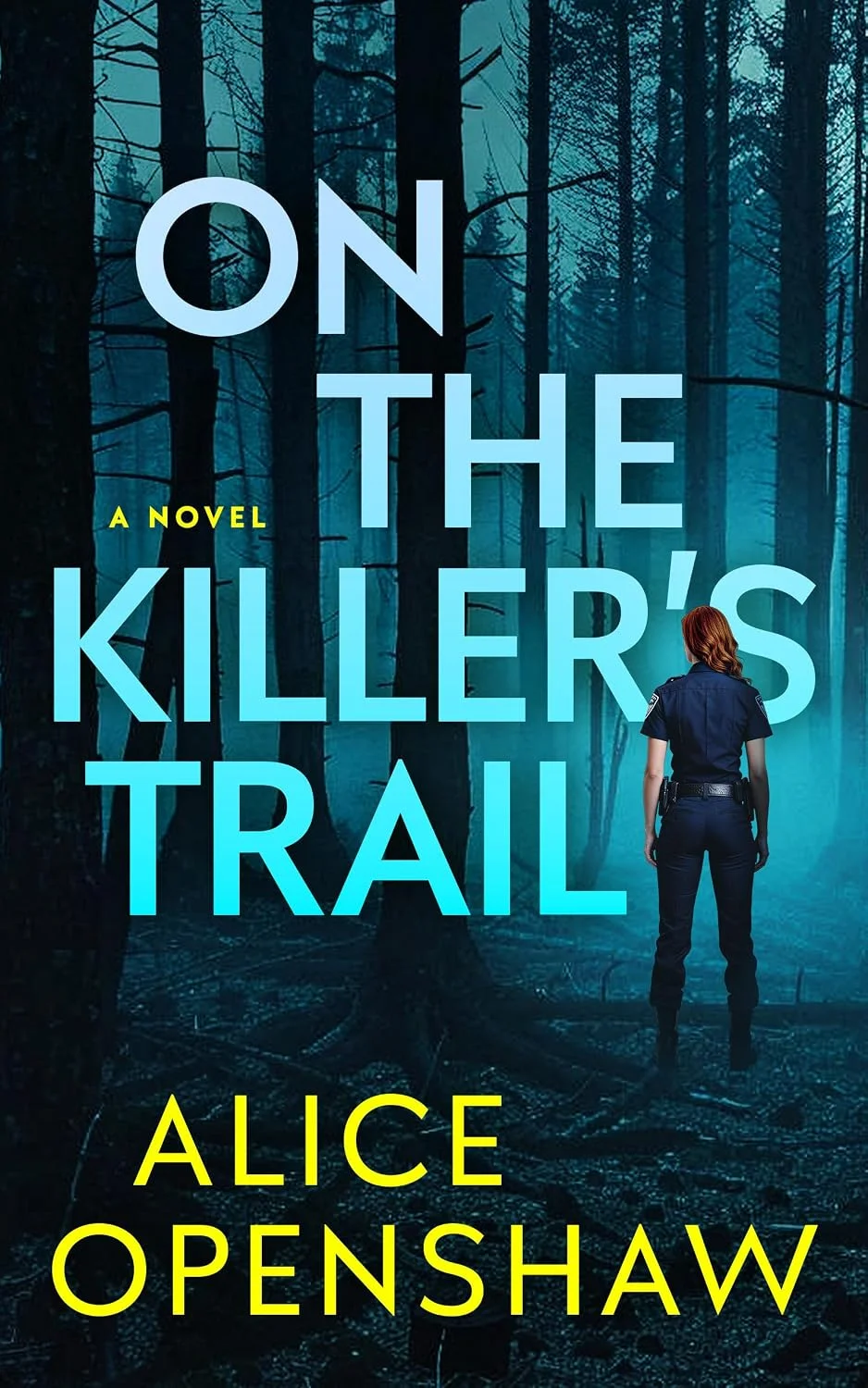
Things haven’t worked out the way she’d planned for Sergeant Penny Maclean. In Alice Openshaw’s On the Killer’s Trail, she’s stuck on a tiny police force, consigned to days of stray dogs and school presentations, distress calls from the elderly and returning lost wallets. And then the 10-61 call comes in, the code for a hunting accident. Penny’s temporarily in charge – her boss is away for the weekend – and when she arrives at the scene, it doesn’t look like a hunting accident. The wound on the dead woman is all wrong.
Even when the state police arrive, and agree with her – pegging it as a domestic shooting, most likely her husband – something still feels off to her. The more she digs, the more she’s convinced that the woman had secret, but nobody wants to talk and nobody wants to listen. Worse, she’s reprimanded for her side investigations, accused of immaturity and unprofessionalism, and soon she’s walking on very thin ice, her own job on the line.
What aren’t you telling me?
The question is for everyone in the victim’s family, and all the people circling their wagons, but especially it is for the victim herself. But the answers, when they come, are like nothing Penny could have expected:
“Abuse, neglect, loss, fear, suspicion, death. So many lives that would never be the same.”
Hers, among them.
A Small-Town Murder With Secrets Buried Deep
Where did the book come from? “I lived for thirty years in Maine,” says Openshaw. “For several of them, I commuted fifty miles each way to work, and listened to hundreds of audio books, many of them mysteries, so mysteries were on my mind. We lived on a small farm at the edge of the woods, and at one time or another, we had horses, goats, and even a llama. It can be a very Zen-like experience in the barn with the scents and sounds of the farm mingling with those of the surrounding evergreen forest. Each season has its own atmosphere and rhythm. At night, though, it is pitch dark out there, and you feel a frisson with the wildness of the woods close at hand. I felt safe, but that juxtaposition of the light and the dark, the domestic and the wild, led me to conjure up the opening scene of the novel in which Andrea, an ‘ordinary’ woman, is killed while tending her animals at night.
“That scenario was the starting point. I’m a country mouse. I grew up on a dairy farm in a town of four hundred people and I’ve lived in several small towns throughout New England, including those years in Maine, so the day-to-day experiences and vibe of rural life are close to my heart. I mention some specific places in the novel for authenticity, but I tried to distill the essence of rural Maine into the book’s characters and setting. For example, Penny, the young police sergeant, had been to the crime scene several years earlier, when she inquired about buying some of Andrea’s used farm equipment. The assistant medical examiner and the victim were members of the same knitting group. Small towns are like that. As a murder mystery, the fictitious version of life in rural Maine had to be darker than the real version, but I tried to stay true to the character of the state, as I knew it.”
The same was true for the characters themselves:
“I had a vision of Penny in my mind before I knew much else about her. She was a generation younger than me, exceptionally tall, with long read hair, and wearing riding boots: a woman both attractive and physically imposing. I don’t know where that image came from. But, though superficially we are very different, as Penny’s character developed, she came to share some of my traits as well. Penny is an introvert but chose a career helping others. Her style, like mine, is direct and analytical. She attended my alma mater. We both like animals, though she is better at hands-on work than I am, and I am more squeamish. Andrea shares many of those same traits, as well, and as Penny investigates the murder, it’s those similarities that help her form a bond with the victim.”
There was one detail, though, that veered from reality. Openshaw did a lot of research, but “despite living in a small town in Maine for decades, I never realized that the state police handle major crimes in all but the two largest cities in the state, Portland and Bangor. So, right from the start, I had to create a situation in which Penny, a small-town cop, could be more involved in the investigation than would typically be the case.”
It’s a circumstance about which the exasperated state police never tire of reminding her. It makes for a very bumpy ride. Was Openshaw’s path to publication any smoother? Not very.
From Inspiration to Publication: Alice Openshaw’s Writing Journey
“I carried the basic plot in my head for years before I wrote a word, then in November 2021, I heard a news story about National Novel Writing Month. The idea was that, in one month, you wrote a first draft of 50,000 words, with no editing or revision, just getting the story on the page. I did it in six weeks – and then over the next eighteen months, I worked on revising. I used online resources, virtual critique partners, beta readers – I still hadn’t told anyone around me what I was doing, because I didn’t want the pressure of people asking about my progress.
“Finally, though, I knew it was time to start querying literary agents. I needed feedback. I still had no idea if the manuscript was any good. And on my first query, I got a full request overnight! It was very exciting, but ultimately unhelpful. The book was rejected, but because I had had that early encouragement, I didn’t realize that the manuscript wasn’t ready for prime time. More queries, more requests, no takers.
“Time went by. I hired a developmental editor, who was very helpful. I continued working with my critique groups for another year or so. Finally, I had used up most of the agents whom I wanted to query, so I looked at publishers who took direct submissions. I remembered my developmental editor mentioned Crooked Lane Books in that regard, so I made them my first choice – and I was thrilled when they said yes. I still needed an agent, though, so, contract in hand, I approached Gina Panettieri at the Talcott Notch Literary Agency, whom I had met at a conference earlier that year – and got the same yes from her. I feel very fortunate to be working with all of them.”
The next book finds Penny Maclean deep in another murder investigation in her tiny town of Horton, Maine. No doubt the state police will continue to be exasperated with her – but we’ll be very happy.
About Alice Openshaw:
 Alice Openshaw has been a fan of mysteries since the age of ten, when she discovered Perry Mason books at her tiny town’s public library. She holds a BA in psychology from Middlebury College in Vermont and an MLS from Vanderbilt University. She lived in rural Maine for thirty years, where she worked as a librarian and adult literacy teacher and raised three children and an assortment of animals on a small farm. She now lives near Cape Cod, Massachusetts, with her husband and her tuxedo cat, Frankie. On the Killer’s Trail is her debut novel.