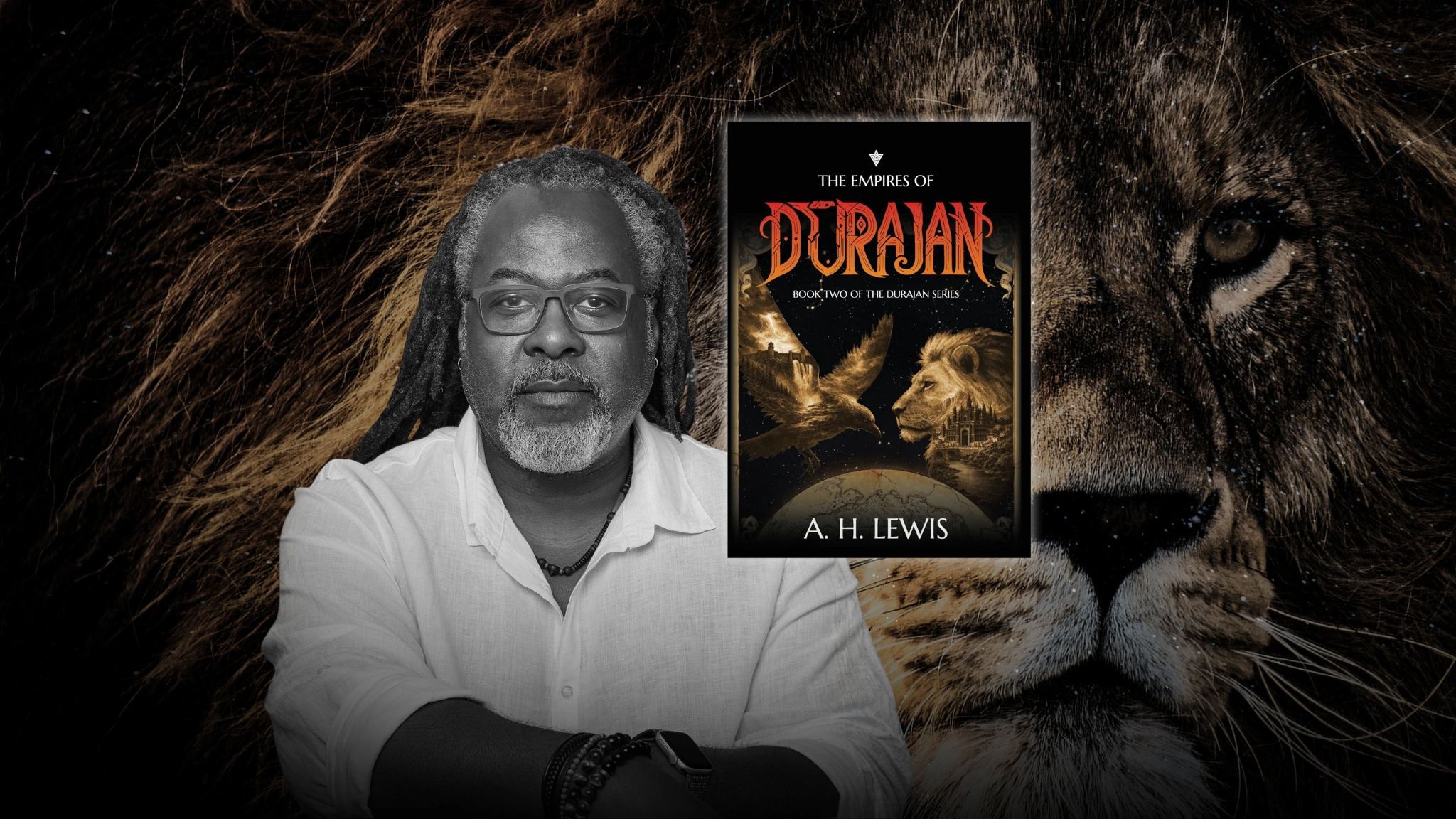
A. H. Lewis doesn’t speak about fantasy as escapism. In this conversation, the author of The Empires of Durajan reflects on the questions that shaped his life long before they shaped his fiction: questions about belief, surrender, identity, power and the people history forgets. Drawing from decades of quiet reflection, creative partnership with his wife Anne, and a lifelong fascination with what makes ordinary people endure impossible circumstances, Lewis discusses the origins of the Hollow, the emotional architecture behind Dothemia and why he believes true heroism begins long before the sword is ever drawn.
Where did the concept of the Hollow come from, and how did you avoid making the Creed feel like a simple villain
Many prevailing belief systems, political, communal, and doctrinal, rise to power. Their paths to power vary but are often based on conversion, absorption, adoption, or high-stakes surrender. Surrender of what a person is in order to become what the system wishes you to be. Surrender and forgetting.
It’s a bit of a blanket truth, flowing from youthful peer pressure that a child can either resist or yield to, to sweeping movements that have changed the course of history. These systems grow and spread, consume and erase. New wholes are formed from the fragments of shattered ones. Consuming powers are often larger, stronger, and more complex. They can be charismatic or manipulative, or benevolent or malevolent. Some begin with good intentions, but often change until the intention is no longer the objective. Holding on, maintaining order, hierarchy, and control, becomes the objective.
Sadly, power often loses sight of the people and focuses only on the purpose.
Since childhood, I have looked at what I have been taught as true and tried to weigh those truths against others I have experienced and felt to be true as well. True to those who believed them to be true before they were defeated, convinced, conditioned, molded, and forged into something new.
I was in a community of people I loved, and in many ways, though now distant, I still very much do, but I just felt very apart from them because of the questions I asked in silence about the things I observed. They had and still have their beliefs. It was and remains their way of life.
Still, I had questions. Questions that I was told never to ask. Questions that were reflected back as possessing doubt, which in this community was the enemy. But it wasn’t and never has been doubt. It was always just honesty.
So I had no one I could really ask. As a child, I just wasn’t brave enough. I was honestly afraid to. So I asked that source that people look to when answers to their questions are not answered by those around them.
What about the others?
What about people who came before us?
What about the countless beliefs that have vanished?
Who is to say we are right?
I was about maybe 5 years old when I began asking those questions, and I thought they were as honest and true as you could be. So I asked and continue to ask, and the questions have only deepened. And I ask them not just for me and not just for today, but for those from the time before us. Those who didn’t surrender.
To surrender wholeheartedly, truthfully, you need, in many ways, to forget what you were to become what you believe you must now be. You have to become empty to become filled. The shape of that emptiness defines the shape of what occupies it. That is where the Hollow came from. We have to become hollow to become filled.
Dothemia is explicitly a city built by the banished, the condemned, and the forgotten. How much of that theme was personal to you, and did your wife Anne’s co-creative partnership shape that vision in ways you can point to
Dothemia, The Durajan, and the Awakened World are all very personal. Fantasy, distant worlds, heroism, and courage in the face of adversity—those themes have always fascinated me. Not just the spectacle. That was only a small part of the fascination. Not nearly as important to me as what was often not written of with equal depth or pushed to the forefront in those stories.
I wondered about where that courage came from. Would I have it? What conditions does it take to have it? How far would someone go to stand for what they believed in? And if a person isn’t willing to go the ultimate length, do they believe at all? Where is the line of belief drawn?
The stories that shaped me often showed two kinds of courage. One arrived with power and spectacle: the drawn sword, the final stand, and the heroic charge. The other lived more quietly, inside the person, before the act ever became visible. That was where my mind lingered most: what a person carries before the act, what they endure within it, and what remains afterward.
Dothemides knew what would happen if he helped the beaten merchant in the streets of Tharios, and he helped anyway. He was already a man of forty when his life was saved by Samike. Innocent in every way but banished anyway.
Two people from very different paths, sharing the same fate, who together built something for others like them. People from different paths who shared the same fate. Forgotten and cast out by their own. Each unwritten. They saw beauty in and held hope for each person they encountered. Each in their own ways.
I am not Dothemides, and Anne is not Samike, but we have been by one another’s side for over 30 years. I’ve always held questions about cultures, beliefs, and traditions. Questions about their growth, spread, and those absorbed, forgotten, people who were lost to beliefs, powers, new and stronger. More militant and influential.
People whose choices were defined in conditions where resistance meant death and adoption meant survival. Survival that truly meant surrender, forgetting what came before to survive what exists now. The ever-changing, ever-evolving, constant redefining of lines once considered etched in stone that are erased and redrawn.
Anne has heard me talk about them for years and thinks much along the same lines. It’s one of the many things that we’ve always connected on.
We began creating together when we were 19 back in college. One idea became over a thousand unpublished pages of ideas and notes that we both had to table as we grew together, and the responsibilities of young adulthood took over. Flash forward to after our children had grown, and those ideas and questions still lingered. We began what would become the Durajan together as a second project. Smaller in scope—at the time.
But this time it pulled me in completely. I’d wake up at 3 AM and write, build, research, and this went on. Anne would see what I was doing and, in time, decided to step back and let me continue on. I was reluctant, but she believed I had an author in me. That all the questions I had were finding their way to the surface in what she saw me writing. Things that emerged before and after the heroism in our initial story were connected to all my questions.
She wanted me to just run with it and see where it took me. But she didn’t step away. She knew me more than anyone and pushed me to really let the storyteller out, to not worry about length or word counts. As a lifelong reader, she told me that it didn’t matter how long a story was. That a good story is a thing people don’t want to leave. As she read what I’d written, she felt the Durajan and the Awakened World formed a world she didn’t want to leave.
It became a bit of a joke between us. Anne comes to sit in the living room at 6 AM. Me having been writing for the last three hours. She called it story time with morning tea. I began marking my manuscript not just with notes but with indications noting where the story would pick up for her again. That was how both books were written, and it’s how book three is beginning. She’s my partner in this and my biggest supporter.
Dothemides is a warrior-king who prays, journals and tends to old wounds with healing oils before dawn. He’s not the typical fantasy hero. What were you reaching for with him, and how did your own understanding of leadership find its way into Him?
First and foremost, Russom Balewa—Dothemides is a person. Flawed. Filled with hope, pain, loss, and weight. He is first introduced as He Who Endures. We are all people who, above all, endure. It’s something we are defined by. What do we do with our experiences? How do we make sense of a world where the ability to endure is our defining characteristic?
Dothemides is my version of the hero that I have never seen, and I write him from a place where I believe heroism is truly born.
Before David’s sling, Thor’s hammer, Arthur’s sword, Luke’s saber, William’s claymore, Maximus’ sword and shield, and Frodo slipped the One Ring onto his finger—before any of these weapons were drawn, a decision needed to be made. A choice that would carry consequences.
And after the battle, a hero must sit with that decision and reflect on the consequences of their actions. Exploring that is at the heart of the character and the story.
I don’t think taking on the mantle of leadership or accomplishing acts of heroism follows a path that is faultless, pure, or untarnished. They are almost always the complete opposite, and they come with a high cost. The best stories show this, so I wanted Dothemides’ journey to reveal the complexities of leadership and heroism with intimacy, reflection, and patience—so his quiet strength, resilience, doubt, fear, faith, and conviction could all be shown in him across every decision.
Bianzhi carries an unrequited love for Dothemides across years, yet the relationship between them is rich with tenderness and humor. How do you write emotional complexity like that without it tipping into either tragedy or sentimentality?
Love is very complex. Probably the most complex emotion we can experience or express. Marukh, in my story, has its distinct culture. The Durajan and its dangers complicate that even more. Add to that the beliefs surrounding The Mother, and you have quite a recipe for a relationship that runs very deep.
Between them, there is a deep friendship, loyalty, and respect that results in love. He saved her life in the jungles in year four, and from that first meeting, there was something between them. It blossomed in The Mother’s temple rituals and was fully revealed when they were captured by Clan Rolki in The Chronicles of Durajan.
By the time The Empires of Durajan begins, they have become the closest of friends, bound by one of the oldest lingering relationships in Dothemides’ life. Bianzhi offers him strength, counsel, humor, lightheartedness, and courage, always saying, “Mother and Mountain,” to remind him of where it all began, and to ground him. She knows him in ways that no one else does, and I try to communicate that in their dialogue and interactions. I won’t speak of other characters because they aren’t part of this question, but I think it’s all of those things that keep them from being tragic or sentimental.
Tragedy would require a sense of loss, defeat, or ruin. Sentimentality would require a sort of overly dramatic or excessively emotional state that would override logic and reason. Bianzhi’s humor and her approach to the world, gods, relationships, and her place within the chaos of it all run counter to both tragedy and sentimentality. She faces the world with a bit of a grin, understanding that she ultimately has no control, so she allows herself to remain by his side and to stand for the dream of Dothemia without abandoning what she feels.
So I wouldn’t say that Bianzhi’s love is necessarily unrequited. It may be in our earthly sense of what love is, but in the Durajan, a world that is as savage as it is serene and brutal as it is beautiful, something about it fits. I would say Dothemides loves Bianzhi, and loves her very deeply, in a way that incorporates all of the above. His history, culture, the Durajan, and the Mother.
He wouldn’t be what he is without her.
The dedication reads “For the forgotten and for the silenced” Who were you thinking of when you wrote those words?
Loaded. But I’ll try.
All we need to do is look back at the path any power has walked to achieve its prosperity or greatness. Look deeply, not through the eyes of the victors but through the eyes of those left in the wake of the victorious.
The weak become strong. The new strong creates a new weak, treating it as it was once treated. This isn’t always the case, but it is often. I don’t want to seem as if I am standing on a soapbox or trying to finger-wag. Every part of human history is based on this phenomenon.
No one is innocent of it.
All I am trying to do is be conscious of it. Listen to it. To them. Place myself out of where and when I was born into another where and when, and wonder what they might be saying or feeling if they could be heard.
Not only people who have come and gone, but also people today, on either side of the political aisle, on any of the many sides of belief. People in differing places in their spiritual or non-spiritual journeys in life. One side tends to forget the other by choice or by time.
I can’t seem to, and I have never been able to. I don’t ever want to. Something about being rendered silent and forgotten is deeply tragic.
As for specifically “who” I was thinking of, I think anyone who, right now, feels forgotten or silenced just for trying to be who they are. Wanting to be accepted and loved for who they are, and being shunned for possessing the courage to live and speak their truth.
Again, this is not about left or right, dogma or doctrine; it’s about feeling and being held down, silenced, forgotten by others. By power. By majority. By the confines of conformity.
I feel it. I know many feel it. In their own ways. So I hope that people will find a way to be heard. Even if it is in the quiet of a journal or the vulnerability found in writing a book. I’m thinking of them.
As a writer, how do you balance the joy of what your characters have built against the dread of what’s coming for them?
Whether you are in the camp of seeing it as unfortunate or fortunate, life has an inevitable end, but it doesn’t mean it can’t be filled with joy, love, purpose, and meaning. I have this personal mantra that I developed when I was going through some challenging times. Career stuff that everyone faces—burnout and other stresses. I was waking up in the middle of the night not to write but to stop my heart from racing or my mind from spiraling. The stress was real.
To get through it, I began to say four things: I am grateful, I am mindful, I am hopeful, and I am determined.
Grateful for the road behind me and everyone who has been on it with me and even against me. Mindful of where I am on my journey now.
Hopeful for what lies ahead on that journey.
Determined to stay the course. To better myself, not just for myself but for those I love and those who love me.
Even though I know this life will not last forever, I owe it to the life I have been given and to the people I love and who love me in return to be some kind of force for positivity. Not in some heroic sense, just small decisions to do right by others, not for recognition but because it is what I feel we all inherently want and need. It’s how we flourish, grow, and thrive.
The Durajani, be they of Dothemia or Stormraven, the Woadican Highlands or the Thanelands, the Sands of Sifur’s Breath, Skarnvald Steppes, or Carnothi Highlands, all know that threats loom. Storms are on the horizon. Death may come at any time, but they live their lives with passion and hope for their future. Joy in their bonds and friendships, and the driving need and understanding that their lives are worth remembering, no matter what the world tells them.