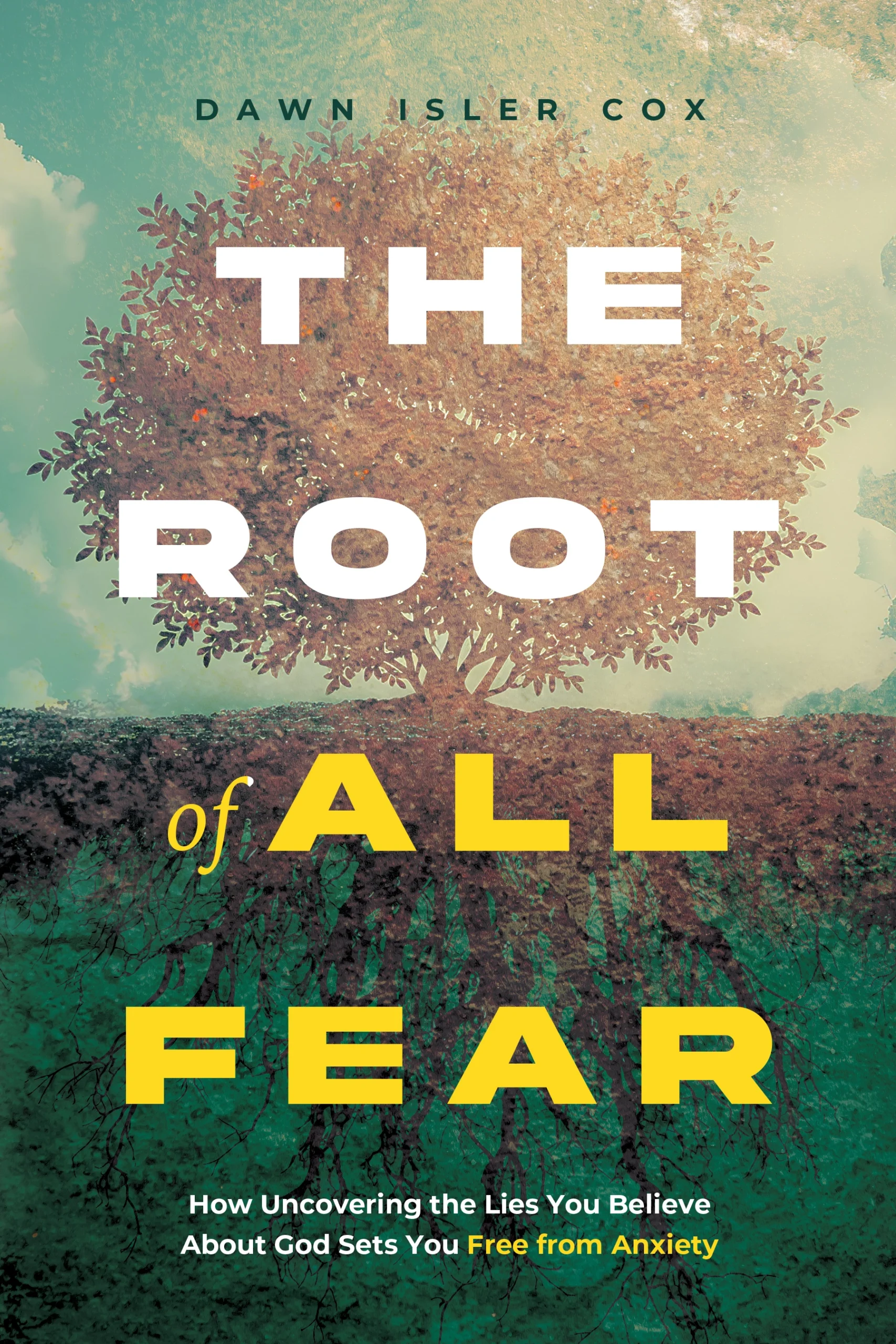
The Root of All Fear by Dawn Isler Cox
Dawn Isler Cox’s The Root of All Fear takes a familiar therapeutic idea — that thoughts shape feelings and behavior — and asks what happens when the thought beneath anxiety is not only “I’m not enough,” but something much deeper: our beliefs about the nature of God. That shift gives the book its purpose. Cox is not positioning the book as a clinical cure-all for anxiety or a general guide to positive thinking. She is writing for Christians who know the verses, believe the doctrines, and still find themselves spiraling into fear, worry, shame or the need to control.
The book’s central image is the Berry Bush, a metaphor Cox uses to describe the way anxious thoughts grow. The visible fears are poisonous berries: worries about money, parenting, failure, health, approval, safety or the future. Beneath them are feeder roots, the smaller lies that keep the fear alive: “I’m a terrible parent,” “I’m a failure.” But Cox argues that the deepest root is always theological. The fear may appear to say, “I can’t handle this,” or “I’m not good enough,” but underneath, she believes, is a more serious accusation: God is not good. God is not trustworthy. God doesn’t love me. God doesn’t approve of me. God is not in control.
A Framework for Naming Fear
That framework is the book’s most useful and distinctive contribution. Cox borrows some of the logic of cognitive reframing, but she relocates it inside Christian belief. The aim is not self-affirmation for its own sake. In fact, she repeatedly pushes readers past the “I lie” to the “God lie.” A thought such as “I am unlovable” is not solved simply by saying, “I am lovable.” Cox wants the reader to ask what that thought implies about our beliefs about God — the God who created, loves, accepts and sustains His people. She sees our struggles as spiritual warfare — one of the many ways that Satan deceives us, sowing doubts not just about ourselves, but about God’s nature.
She develops this argument through a steady blend of Scripture and personal story. Genesis becomes the starting point, with Eve’s temptation presented as the first attack on God’s character: Is God really good? Is He holding something back? Can He be trusted? From there, Cox moves through the armor of God, Jesus in Gethsemane, the disciples in the storm, Job’s suffering, Paul’s weakness, Peter’s restoration and other biblical scenes where fear, temptation and trust collide.
What keeps the book from becoming abstract is Cox’s willingness to translate these ideas into ordinary life. A vague text from a ministry partner sends her and her husband into financial panic. Jury duty exposes her fear of unfamiliar situations. Her daughter’s health problems reveal how quickly uncertainty can become dread. These stories are sometimes homely in the best sense. They make the theology tangible because Cox catches herself in the very moments many readers will recognize — mid-worry, mid-self-rebuke, mid-parenting regret, mid-need for control.
From Insight to Practice
Each chapter ends with “Listening for Truth” questions, and the later chapters guide readers through the Berry Bush exercise itself: name the fear, ask “Why?” repeatedly, trace the feeder roots, identify the root lie about God, and then replace that lie with a Truth Tree grounded in Scripture. The process is simple, but not shallow. It gives readers something to do with anxiety besides scolding themselves for having it.
Stylistically, Cox writes with warmth and directness. She is not trying to impress with scholarly distance; she writes like someone handing the reader a tool she has used herself. By looping back time and again to the concept of the Berry Bush, she mirrors the discipline she is teaching: notice the thought, name the lie, return to the truth. Over the course of the book, that repetition becomes part of the practice.
The Root of All Fear is a practical, compassionate and deeply faith-centered guide for Christians who want to stop merely managing anxiety and start excavating its deeply rooted source — lies we believe about God that keep fear alive.
About Dawn Isler Cox
 For more than 25 years, Dawn Isler Cox has worked in full-time Christian ministry, focusing on equipping and encouraging families. She currently serves on staff with a global marriage and family ministry. As a passionate communicator, Dawn delights in bringing God’s word to life in a personal and practical way. Drawing from her experience and hard-won insights, Dawn offers a thoughtful approach to confronting negative thoughts and fears.
In The Root of All Fear, she shares the story of the Berry Bush — a simple but powerful picture that has equipped many to recognize lies and step into freedom. Dawn lives in Orlando, Florida, with her husband, Paul, their five children, and their dog, Lil’ Bill.