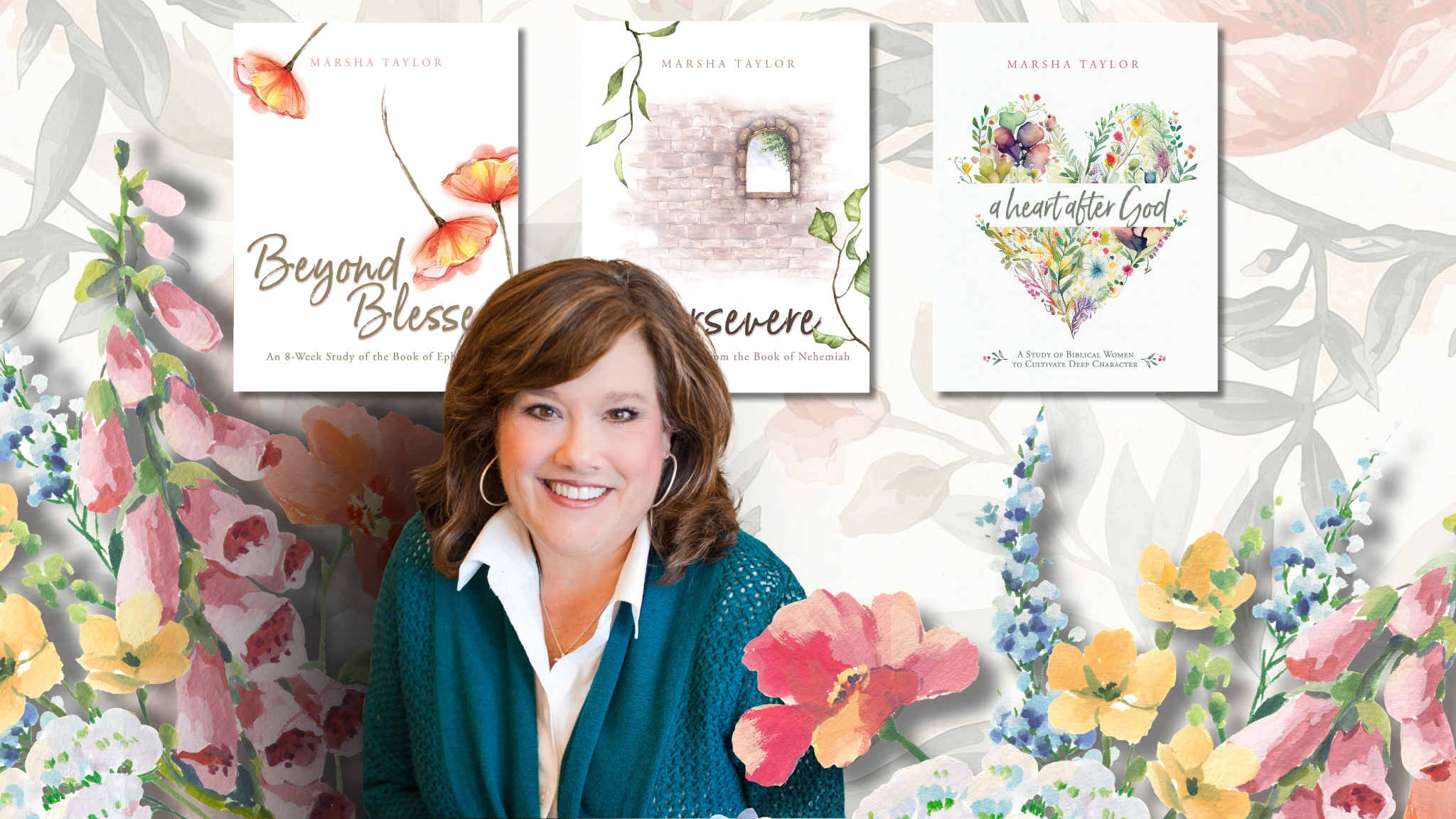
Author and Bible teacher Marsha Taylor has built her ministry around a message that resonates deeply with readers navigating insecurity, hardship and spiritual growth: true freedom is found not in striving for approval, but in surrendering fully to God. In her books Beyond Blessed, Persevere and A Heart After God, Taylor combines personal vulnerability with rich biblical teaching, inviting readers to discover their identity in Christ, endure difficult seasons with faith and cultivate a heart shaped by humility and worship. In this conversation, she reflects on the painful experiences that shaped her writing, the deeply personal process behind each study and the hope she wants readers to carry with them long after they turn the final page.
Across all three of your books, there’s a strong theme of identity and surrender — in Beyond Blessed you explore who we are in Christ, and in A Heart After Godyou highlight humility and teachability. What personal experience or turning point in your own faith journey inspired you to make these themes so central to your writing?
As a child, my home life was challenging, and I often felt rejected and unloved. In response, I fell into patterns of perfectionism and performance, believing the only way I could be accepted was to be perfect, trying to prove I was worthy of love. Those insecurities and wrong thinking followed me well into adulthood and sometimes even worm their way into my thinking now, if I am not careful.
The transformation began for me in college, as a godly roommate gently helped me identify my insecurities and need for approval. Through prayer, searching God’s Word and godly counselors, I began to see that God’s acceptance of me was not based on my performance but solely on the work of Christ through His death on the cross. It was through His grace and my acceptance of Jesus’ work on my behalf to pay for my sin that I began to see my worth in God’s eyes and His love for me.
Embracing the true freedom found in my identity in Christ has changed my life. I’m no longer trying to prove myself to God and earn His approval, which has freed me to live my life looking to Him alone, rather than seeking the approval of others. This theme runs throughout my writing because I want for others to know their worth and value in Jesus. It is where I found peace and healing, and I want others to experience the freedom found in surrender as well.
Your studies span very different books of the Bible — Ephesians, Nehemiah and stories of women throughout Scripture. How do you choose which biblical text to study next, and what does your research and writing process look like as you develop a verse-by-verse or character-based study?
Because I deeply value personal application of God’s Word and His Truth, I write about what I am currently going through — what God is teaching ME right now! Each study has come from a personal need in my own life. When I was desperate to understand my identity in Christ, I wrote Beyond Blessed (Ephesians). As I was walking through a very difficult struggle in my life and needed reassurance from God, I wrote Persevere (Nehemiah). And, because I longed for God to cultivate a deeper, godly character in me to serve Him and others better, I wrote A Heart After God.
As for the process, I definitely begin with a lot of prayer, asking God to direct and guide every word I write. Then, I throw myself into the scriptures and write down everything that comes to my mind — especially my own questions about the passage. I research the Greek and Hebrew meaning for many of the words to better understand the original text, and I read lots of commentaries. As I write the study questions, I want readers to feel they learned something new and choose lots of supporting verses from both the New and Old Testaments. In fact, I counted how many different references were used in A Heart After God and found 34 different books in the Bible were used to make up the questions in the study!
In Persevere, you tackle some of life’s hardest seasons — grief, difficulty and hardship. That’s vulnerable territory for both a writer and a reader. How do you approach writing about suffering in a way that feels honest and encouraging rather than dismissive of real pain?
Persevere was a really hard study for me to write. I was walking through one of the most painful periods in my life. I felt completely rejected, not only by people around me, but also by God. I knew in my head that wasn’t true, but my heart was completely ripped apart. And, in my despair, I remembered Nehemiah — called by God to build a wall, and yet he met trials, hardships, insults and persecution, and in the face of it, he carried on and built the wall.
God walked with me to write Persevere. Each lesson was written from my own experience and through many tears. Through my writing, God began to heal my heart, and I wanted others to experience God’s healing, too. We all will go through times when life is hard. I wanted others to know they are not alone, that they are seen and that God really does hear their prayers. This study offers practical ways to carry on, even in the face of great hardship. Personally, I never look at myself as an expert on what I write, but more like a fellow sojourner and student. I definitely journeyed through each page that I wrote. I wrote Persevere from my heart and left pieces of it behind on every page. I’m a pretty transparent person, so I write what I know in a way I hope others can relate to.
The women profiled in A Heart After God each represent a distinct character trait. Without giving too much away, was there one woman whose story surprised you, challenged you personally or reshaped something in your own walk with God as you studied her more deeply?
While I loved the stories of every woman I studied, I definitely resonated with the story of Mary and Martha, representing a heart of worship. In the story, Mary is praised for sitting at Jesus’ feet, while Martha is chastised for being busy in the kitchen while Jesus was visiting their home. I am so much like Martha — I get so busy with things that I forget to rest and spend time with God. (Plus, I really like cooking, entertaining and hanging out in my own kitchen!)
I think in many sermons, Martha often gets a bad rap for her actions, but as I studied her further, I think that it wasn’t her actions that displeased Jesus — after all, she was created with gifts and talents that should be used to minister to others. Rather, her heart was focused on herself and not on Jesus, and that is what Jesus wanted to correct. As we read scripture recounting other moments in Martha’s life, we see her continue to use her gifts to serve other people, but rather than just being busy, she is described as ministering to them and meeting their needs. She is truly using her gifts to serve God. For a busy girl like me, it was so refreshing to see that my work is a way I can also worship God, if my focus is on Him and not on me. Plus, it was a great reminder to keep my eyes on Jesus in everything I do and to remember to take time to rest and reflect on Christ.
As Bible study culture continues to evolve as more people study alone, online and through video, how do you think about designing content that creates community and accountability? What role does the video teaching series for A Heart After God play in that vision?
I believe that there are different seasons for everyone and that Bible studies should work for any season you are in. For instance, there are some seasons where we desire to be in community, discussing questions and concepts in-depth with other people. Other times, we are short on time or in a season where we need to be alone, so working through a study at your own pace is preferred. That’s why I created the video content. It is available anytime and can be used by groups to watch together or for individuals to view on their own.
The videos are actually available for all three studies and add more in-depth teaching and personal stories that are not included in the books. My hope for the videos is that people will be drawn into a deeper relationship with God and they will give a personal feel to the studies. For an individual watching, I hope that even if someone is studying by themselves, they still feel a part of a group, as I think finding connection is very important. I don’t want anyone to feel alone. (If anyone is interested, the video teaching is offered at a very affordable price through Fresh Surrender Ministries at freshsurrender.org.)