
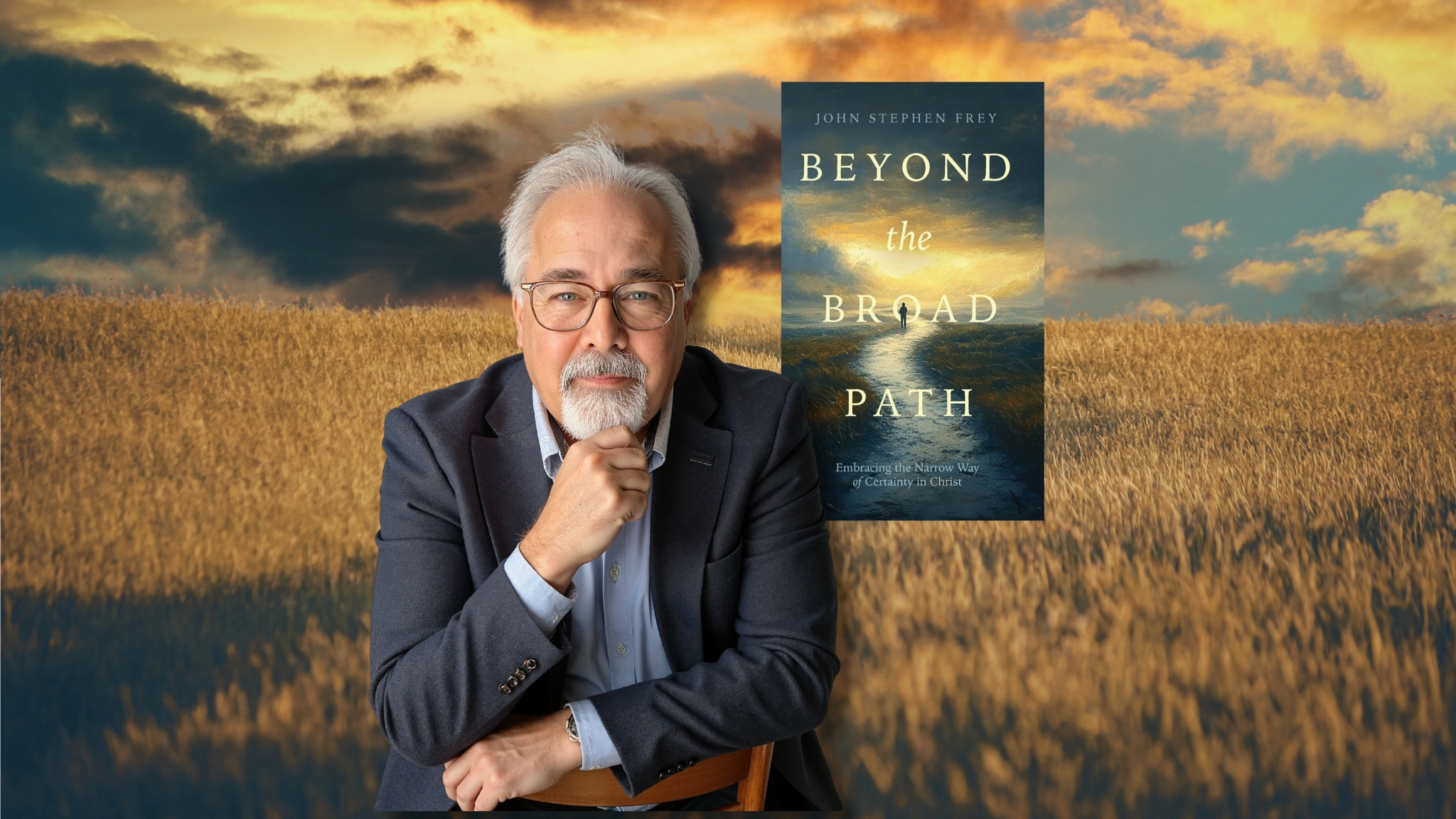
In an age dominated by political outrage, digital overload and growing spiritual uncertainty, author John Stephen Frey believes many people are searching for peace in all the wrong places. In his book, Beyond the Broad Path, Frey explores how cultural confusion, ideological division and what he calls “autocratic gaslighting” have left countless people anxious, distracted and spiritually unmoored. In this conversation, he discusses the dangers of comfort-driven faith, the importance of gospel-centered discipleship and why he believes true peace can only be found through a relationship with Jesus Christ.
Your book argues that modern cultural “noise” leaves people anxious and adrift. What first led you to connect cultural confusion with a spiritual deficit, and how did that shape the book’s opening chapters?
This is a vital starting point because the book was born out of direct observation. I began noticing a stark divergence in how the people in my life — friends, colleagues and loved ones — were processing the relentless information overload of our modern world. As a writer, I’m wired to observe human behavior, and I couldn’t ignore a recurring pattern: those without a relationship with Christ often reacted to global chaos with deep-seated anger, frustration or a sense of total mental exhaustion. They were adrift in the “noise.” In contrast, I saw that those standing on a foundation of faith tend to possess a unique ability to reason through the chaos without losing their peace. This became the catalyst for the book. I wanted to explore that specific intersection — how a spiritual deficit leaves a person vulnerable to cultural confusion. In the opening chapters, I chose to lean into this comparison, framing the ‘noise’ not just as a social problem, but as a spiritual test that reveals whether we are standing on sand or a solid foundation.
You describe contemporary tactics of deception as “autocratic gaslighting.” Can you explain that concept more — how it operates in public life and why you see it as spiritually dangerous?
Most people understand gaslighting as a personal form of manipulation — one person making another doubt their own reality. But in the book, I expand this to what I call “autocratic gaslighting” which operates on a societal level. This occurs when those in power utilize institutional assets and media to systematically distort the truth, creating a sense of confusion that makes the public easier to control. What makes this truly insidious, however, is that it isn’t confined to politics or secular institutions. We are seeing these same tactics creep into the Church. This is where it becomes spiritually dangerous: it begins to blur the lines between eternal Biblical truth and temporary worldly ambition.
I view this not just as a political strategy, but as a destructive tool of the adversary designed to “divide and conquer” the Body of Christ. When the Church is gaslit into prioritizing cultural trends over the Gospel, it loses its ability to be light in this dark world. My goal is to help believers recognize these tactics so they can stop being moved by the “noise” and instead stand firm in the unwavering truth of God’s Word.
The book places great emphasis on the peace “that surpasses all understanding.” How do you recommend believers cultivate and sustain that peace amid political turmoil, cancel culture and digital narcissism?
I always tell people that finding peace is not about burying our heads in the sand. Life is a “participation sport,” and believers are called to be a light in the world, not apart from it. However, to engage with the world without being consumed by it, we must be intentional about our spiritual defenses. We cannot manufacture peace within ourselves; true peace is a fruit of the Spirit, not a result of our own willpower. To cultivate it, we must put on the full armor of God — as the Apostle Paul urges in Ephesians 6 — and make a daily habit of abiding in His Word and in prayer. This is our anchor. Practically speaking, this also requires setting boundaries. We have to be disciplined enough to step away from the 24-hour news cycle and resist the pull of digital narcissism. By silencing the “noise” of the world, we create the space necessary to hear the voice of God. Sustaining peace amid turmoil isn’t about ignoring the storm; it’s about knowing the One who has authority over it.
You critique the prosperity message and comfort-driven faith as a “false gospel.” How can local churches reclaim sacrificial discipleship without alienating people who are seeking hope and practical help?
In God’s Kingdom, Love and Truth are not opposites; they are two sides of the same coin. True love requires us to have the courage to speak the truth — even when it might offend — because we know that a path of comfort-driven faith ultimately leads people away from God’s purposes. The prosperity message and self-help doctrines that have permeated the Church over the last several decades simply do not hold up when measured against the life and teachings of Jesus. Reclaiming sacrificial discipleship means acknowledging a difficult reality: some may be driven away by the Narrow Path. However, the alternative is to abdicate the Truth for the sake of attendance, effectively leading people down a “broad path” that offers temporary comfort but leads to spiritual destruction. Local churches can reclaim this without losing heart by reframing sacrifice as the gateway to genuine hope. Jesus tells us in no uncertain terms, to follow Him, we must deny ourselves and take up our cross daily. We aren’t asking people to give up their lives for nothing; we are inviting them to lose their lives for Christ’s sake to find something infinitely better. Practical help is vital, but the greatest help we can offer anyone is an honest encounter with the Gospel — one that transforms us rather than just validates us.
For skeptics or seekers reading your book who ask, “Why Jesus?” what single piece of evidence or personal testimony do you most often share to invite them toward investigating the claims of Christ?
When speaking with skeptics, I find they are often distracted by the failings of “religion” — denominational disputes, hypocrisies or the mistakes of leaders. My response is usually to agree that we are all flawed participants in a fallen world, for as Romans 3:23 says, “all have sinned and fall short of the glory of God.” I invite them to look past the human institutions and start with the Person of Jesus. His message is radically counter-cultural. In a world obsessed with power and self-advancement, Jesus taught — and demonstrated — that it is better to serve than to be served. Consider the sheer humility of the Last Supper: on the night He knew He would be betrayed and ultimately crucified; Jesus knelt and washed His disciples’ feet. That level of servant leadership is unheard of in any other worldview. But the ultimate evidence is the Cross. He didn’t just teach love; He became love by taking the sins of the world upon Himself and paying a debt we could never settle. I share this because it isn’t about joining a club; it’s about a God who loved us enough to lay down His life so that we could find ours.
The book urges readers to move beyond political fixes and cultural reform toward transforming hearts. How do you envision a practical balance between cultural engagement (justice, policy, service) and the priority of gospel-centered discipleship?
We have to begin by acknowledging our primary mandate: Jesus’ command to “go and make disciples of all nations.” When we lose sight of that, we begin to mistakenly believe we can “fix” the world through man-made institutions alone. The reality is that policies and reforms are only as good as the hearts of the people who create and inhabit them. The practical balance is found when we view cultural engagement as an outflow of our discipleship, rather than the source of our hope. We participate in justice, policy and service not because we believe they are the ultimate solution, but because they are the arenas where we manifest the character of Christ. To achieve this balance, we must daily put on the armor of God through prayer and Scripture, ensuring our strength comes from Him and not our own political fervor. When we lead with the servant heart that Christ demonstrated — placing the needs of others above our own and acting as living examples of the mercy and grace we’ve received — we stop just “fighting” for a culture and start “ministering” to it. True cultural reform begins when we stop trying to fix the systems and start inviting the Savior to transform the person.