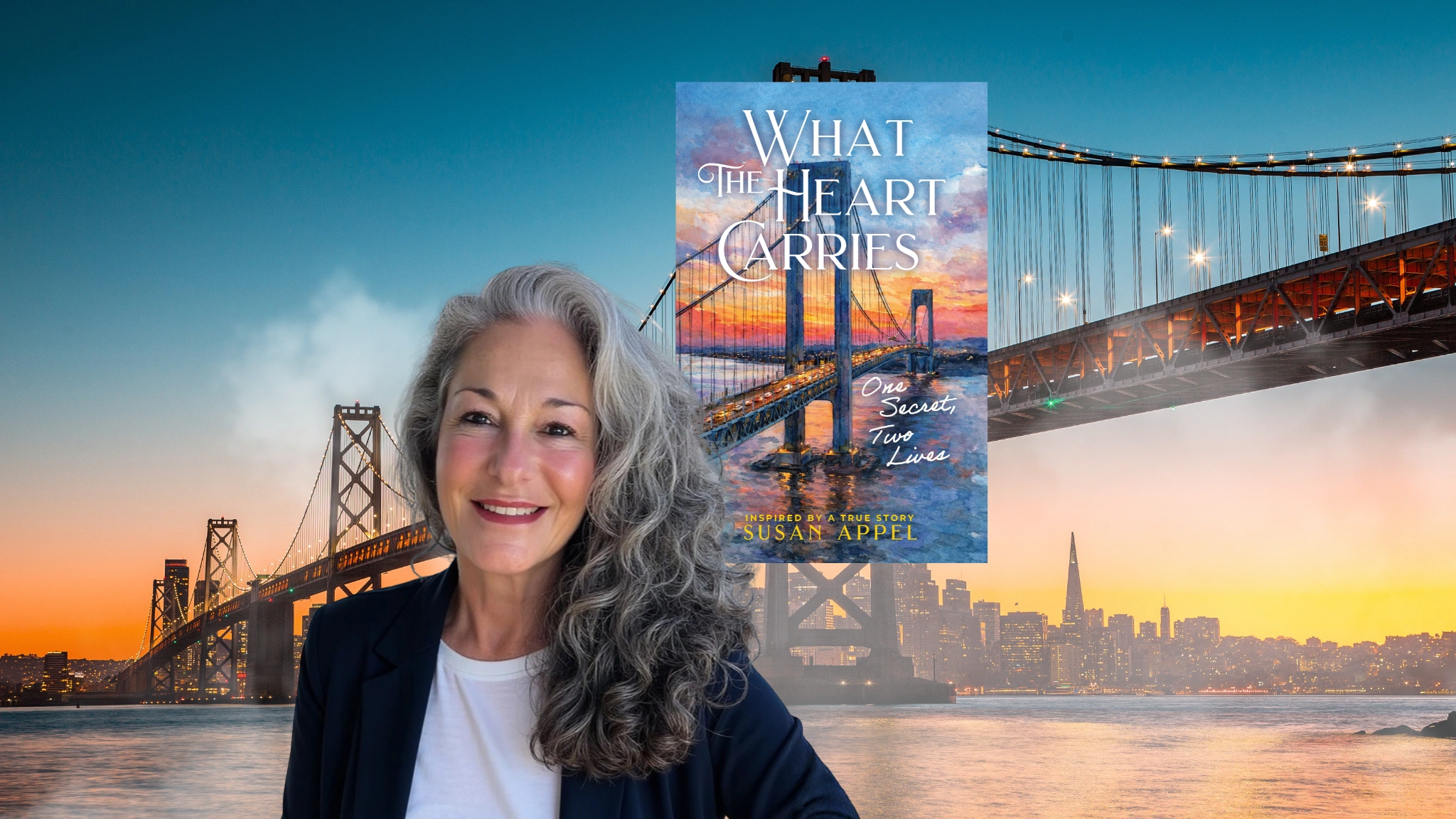
In her deeply personal novel What the Heart Carries, Susan Appel transforms lived experience into a moving story of family, faith and long-buried truths. Inspired by real events yet shaped through the lens of fiction, the book explores how a single secret can ripple across generations — leaving behind both wounds and unexpected paths to healing. In this conversation, Appel reflects on the emotional journey behind the novel, from reimagining moments to giving voice to those she never had the chance to know. She shares how themes of forgiveness, identity and resilience guided her writing and how telling this story became part of her own healing.
Your disclaimer notes the novel is “inspired by a true story” with names and events changed for storytelling purposes. How did you decide which real-life details to keep and which to alter?
It was very much part of the creative process. Because I personally lived the people, places, and moments that inspired this story, deciding what to keep and what to reshape became a winding but deeply meaningful road. Some names came from first or last names of people who matter to me, and others were created from their initials — a quiet way of honoring them. Many of the places remain true to life, but some situations were reimagined. They’re moments I wish had happened, or versions of events that came straight from the heart.
Cecilia’s secret and its ripple effects drive the novel. What drew you to explore the long-term consequences of a family secret across decades?
The heart of this novel is rooted in the hope of inspiring anyone who has lived through deep hurt or long‑standing trauma. I carried this story with me for many years before I could write it, partly because of the emotional weight attached to my own experiences. One person’s choices created an entire web of consequences — shaping my life and the lives connected to mine — and it took time, distance, and a lot of healing before I could revisit it with clarity.
Exploring the ripple effects of a family secret allowed me to show how a single moment can echo across generations but also how strength, restoration, and self‑discovery can rise from those echoes. Writing this book became part of my own healing process, and my hope is that readers feel encouraged, seen, and reminded that their stories can lead to resilience too.
The story spans many years and perspectives (from 1966 through the 2000s). How did you structure the timeline and decide whose viewpoint to follow in each chapter?
I drew from the natural rhythm of my own life’s timeline, so the structure came together in a way that felt both organic and honest. Stephanie’s viewpoint mirrors my own, which made her chapters feel instinctive to write. When it came to my biological mother, I never had the chance to meet her, but through the pieces of information shared with me over the years, I imagined the voice she might have had. Even without knowing her personally, I’ve always felt a deep, almost spiritual connection to her, and writing her chapters felt like giving her the space to finally speak.
The remaining characters were all inspired by people I’ve known intimately — their personalities, their choices, their presence in my life. Their perspectives emerged naturally because they were already woven into the fabric of the story. In many ways, the timeline and viewpoints chose themselves; I simply followed the emotional truth of each moment and let the characters guide me.
Faith, guilt and redemption are prominent in Stephanie’s arc (her therapy, church memories and eventual testimony). How did your own spiritual reflections shape her journey?
I gave Stephanie the same tumultuous but ultimately beautiful spiritual journey that shaped my own life. Her path mirrors the long, winding road of wrestling with betrayal, searching for meaning, and eventually finding her way back to faith. For me, returning to my faith was what opened the door to forgiveness — especially toward the people who caused the deepest wounds. That kind of forgiveness isn’t simple or quick, but it is powerful. It’s born from love, and it’s born from God.
Like I say in the book, forgiveness is the most beautiful gift you can give — to yourself or to someone else. Stephanie’s arc reflects that truth. Her healing, her testimony, and her redemption all come from a place of spiritual surrender and renewal, just as mine did.
Carmine’s search for his sister is a major emotional thread. What research or personal experiences informed your depiction of adoption reunions and the complexities of searching for family?
This emotional thread was incredibly raw because I lived a version of it myself. My brother searched for me for four years, not knowing my name, my story, or even whether I truly existed — only that something in his spirit told him the pieces of our childhood didn’t add up. I felt that same intuition growing up, that quiet sense that I wasn’t being told something.
When he finally found me, everything shifted at once. Long‑buried truths surfaced, emotions rose to the surface, and our lives changed in ways that were both overwhelming and deeply healing. That experience — the uncertainty, the longing, the shock of discovery, and the profound relief of connection — shaped how I wrote Carmine’s journey. It allowed me to portray the complexity of adoption reunions with honesty, tenderness, and the emotional weight they deserve.
The novel emphasizes Italian-American family life and mid-century Catholic values. What aspects of that cultural background were most important for you to capture, and why?
Growing up in Brooklyn in an Italian‑American family meant being surrounded by faith, loyalty and a strong sense of community from the very beginning. Those values weren’t just taught — they were lived. The neighborhood itself felt like an extension of our family, a place where everyone knew each other, looked out for each other, and shared in the rhythms of daily life. It was a very special time and place, one that shaped who I am.
Capturing that era felt essential because it was truly one of a kind. The traditions, the closeness, the unspoken rules of respect and devotion — all of it created a foundation that stayed with me throughout my life. I love sharing what that world felt like with people I meet and now with readers of this story. It was a once‑in‑a‑lifetime era, and I’m incredibly proud and grateful to have lived through it.
And of course… the food. You can’t tell an Italian‑American story without honoring the food — it’s practically its own character.
In your Author’s Note you write about breaking silence and naming the absence that once defined you. What was the most difficult part of transforming that silence into fiction, and what did you hope readers would take away?
Yes — the absence was my brother. I carried a hole in my heart for decades without fully understanding why it was there. Turning that silence into fiction wasn’t so much difficult as it was deeply emotional. Writing from a place where real life and imagination meet required care, honesty, and a willingness to revisit moments I had tucked away for years.
The greatest challenge was making sure I honored my brother and my family while still allowing the story to breathe as its own work of fiction. I wanted the truth of our connection — and the ache of our separation — to be felt without overwhelming the narrative.
More than anything, I hope readers walk away recognizing their own strength. I hope they see that even in the darkest or most confusing chapters of life, there is always the possibility of healing, hope, and unexpected beauty. If my story helps someone feel less alone or more resilient, then I’ve done what I set out to do.