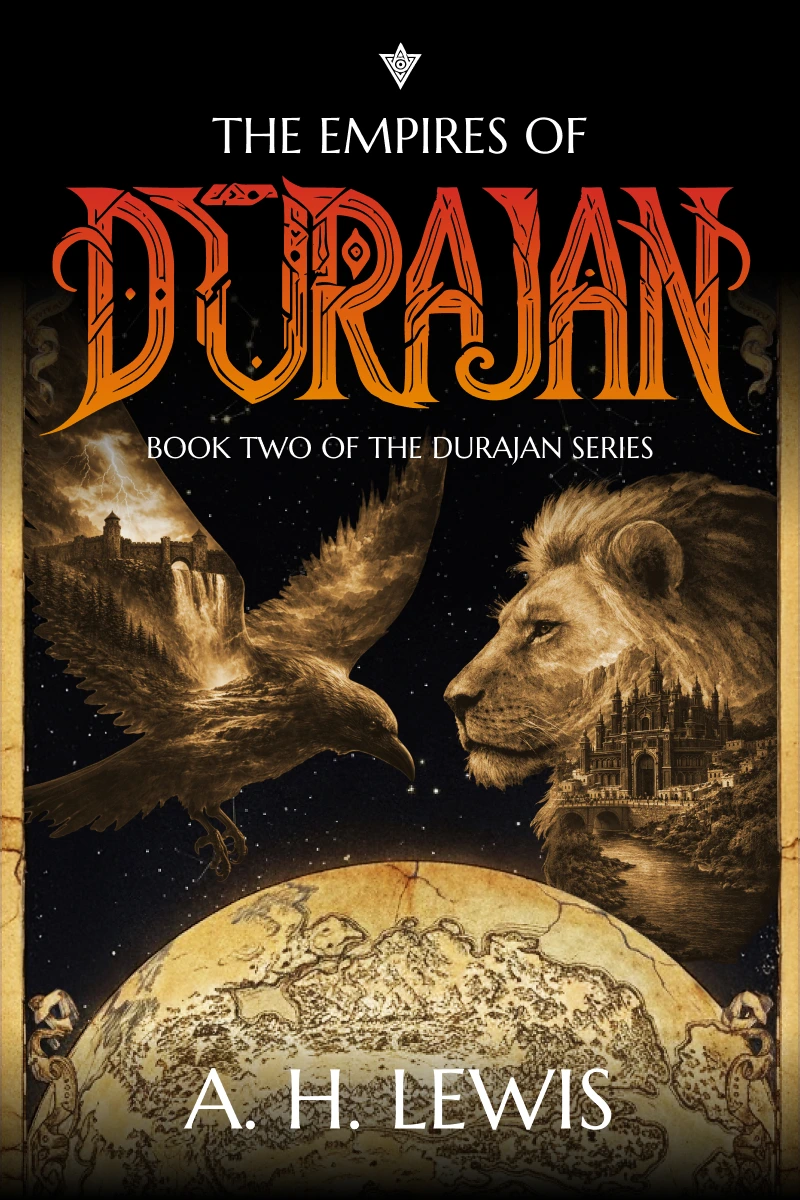
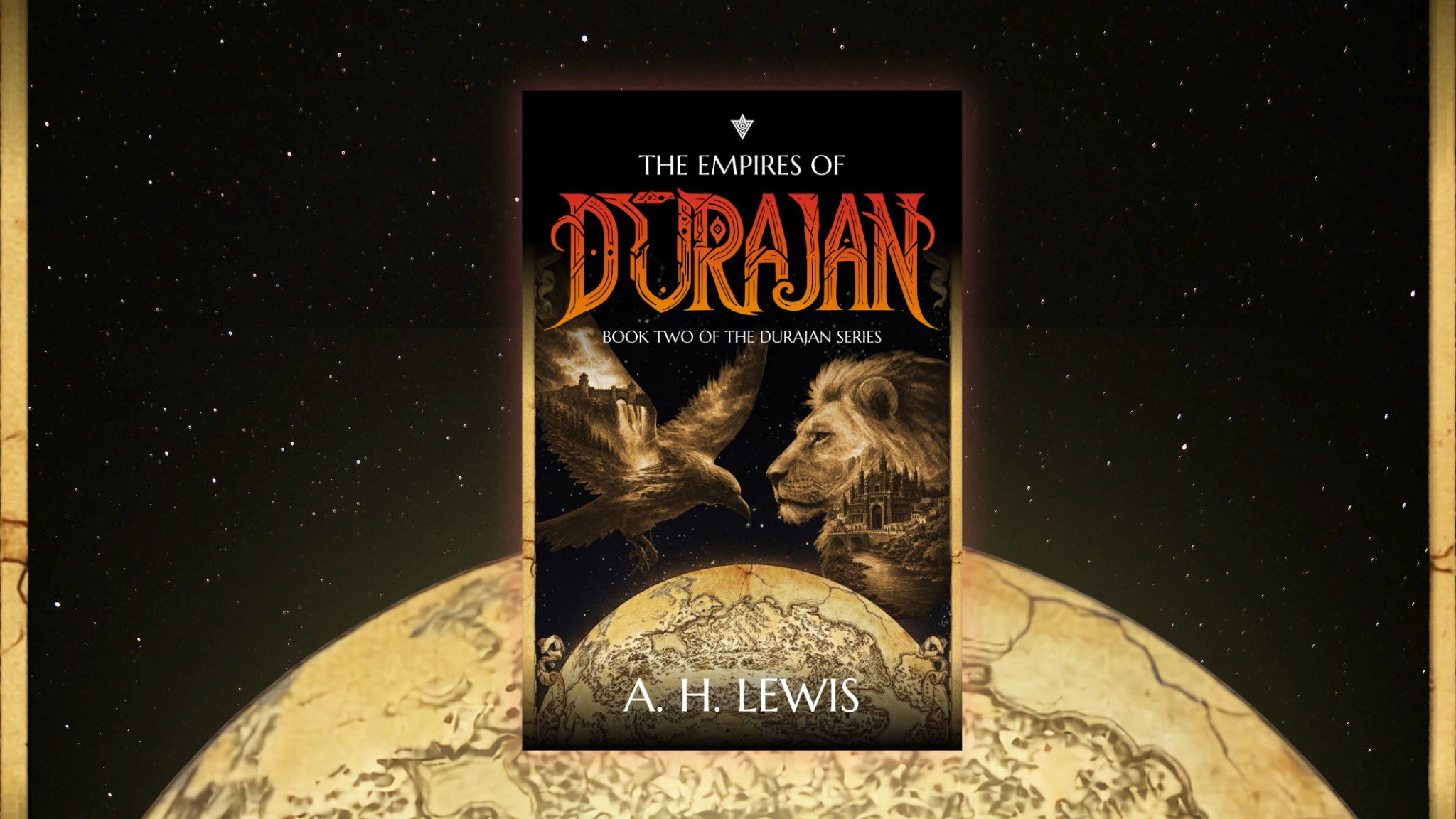
The Empires of Durajan: Book Two of the Durajan Series by A. H. Lewis
Epic fantasy often asks a familiar question: who rises, who falls — and who’s left holding power when the dust settles?
In The Empires of Durajan, A. H. Lewis shifts the focus. The outcome matters, but the real interest lies in what comes after — when the dust doesn’t settle so much as reveal a world still in flux, still being argued into existence.
That uncertainty takes shape across a divided landscape. In the south, Dothemia begins to define itself not just through strength, but through memory — what it has endured, and the kind of refuge it hopes to become, even when that means relinquishing ground it once fought to hold. In the north, Stormraven is hardening into something more forceful, shaped by loss and a sharpened sense of what survival requires. Together, they suggest two possible futures. Whether those paths can coexist remains an open question.
A Dream Under Pressure
There’s no single hero to guide us through that tension. Instead, the story unfolds across an ensemble of leaders, warriors and citizens whose lives intersect in ways both intimate and far-reaching. Dothemides, a ruler balancing public responsibility with the weight of family, offers one anchor. Alongside him, the queen Umaru moves through the story with a quieter but no less decisive influence; her choices are often felt before they fully surface, particularly in the way her loyalties extend beyond Dothemia’s borders. In the north, Svirva emerges as a commanding presence in her own right, tasked with holding together a people increasingly strained by fear, mistrust and uncertainty.
Much of the story unfolds through moments of friction and recalibration — characters moving between regions, rebuilding fragile connections, and confronting the personal and political consequences of what has already been set in motion. Lewis moves between perspectives without rushing to connect them, letting relationships and tensions build at their own pace. What happens in one place rarely stays contained; choices echo outward, sometimes quietly, other times with force.
Belief and the Bonds Between
That sense of ripple effects defines the book. Power is present, of course — in leadership, in territory, in the structures of daily life. But belief runs just as deep. Faith shapes decisions, divides communities, and offers meaning where certainty is in short supply. Characters aren’t simply reacting to events; they’re trying to understand what those events mean, and what kind of future they point toward.
Not all threats announce themselves. Even as these regions begin to stabilize, other forces continue to adapt beyond their borders, working more subtly through influence and pressure, even reshaping belief itself. The Nakarran Creed lingers at the edges of the story in this way, less a constant presence than something that shifts and reappears, exploiting division and uncertainty. The conflict that emerges isn’t always visible, and it rarely resolves cleanly.
Lewis leans into that tension rather than smoothing it out. Leadership is rarely clean or decisive. It’s heavy, often uncertain, tied to consequences that extend well beyond any single moment. The same holds true for the relationships at the center of the story. Bonds form across lines that might otherwise seem fixed — cultural, political, even personal — and those connections complicate every choice that follows.
The prose matches the scope. It’s measured, occasionally lyrical, and more interested in tone than speed. Scenes linger where they need to: a quiet exchange, a charged return, the subtle shift in how a character is seen by others. There is action, but it doesn’t dominate. What stays with you are the accumulations — pressure, memory, change that hasn’t fully declared itself yet.
A Different Kind of Question
The cast is large, the world fully realized. Meaning emerges over time, shaped by how these characters move through uncertainty rather than how quickly they resolve it. As the second installment in a larger series, the novel doesn’t close the loop so much as deepen it, strengthening relationships, sharpening divides and setting the stage for what comes next.
What lingers isn’t a single turning point or dramatic reveal. It’s the sense of a world still taking shape, guided by people who are doing the same — adapting, questioning, at times resisting the roles they’ve been given. It’s an expansive, layered story of interconnected lives navigating a world where belief and identity are in flux, shaped by pressure from without and reflection within.
The Empires of Durajan ultimately leaves you with a different kind of question: not who will win, but what will remain when the future finally arrives.
The Empires of Durajan is available for preorder now.
About A. H. Lewis
 A. H. Lewis is a lifelong storyteller drawn to questions of faith, memory, and what endures when all else is stripped away. The Durajan Series is the fulfillment of a promise he made to himself, a return to the creative spark that never left, even when time, love and responsibility set it aside.
The Awakened World and the Durajan began in the margins: scattered notes, late-night thoughts and questions with nowhere else to go. Over time, they became something he could no longer keep to himself. This book is both a love letter to the tales that shaped him and a meditation on quiet strength, resilience and the power of reclaiming identity.
Buy this Book!
Amazon