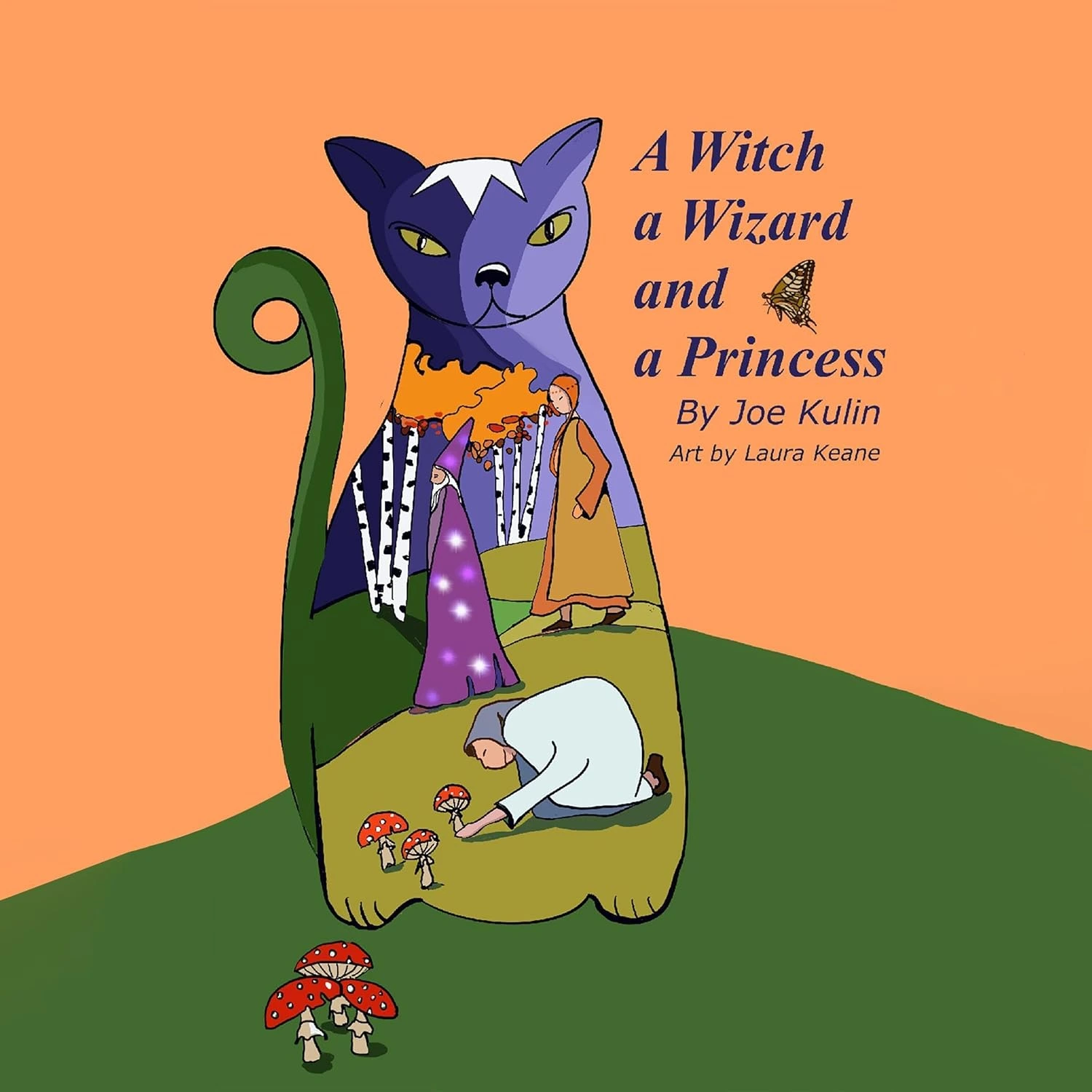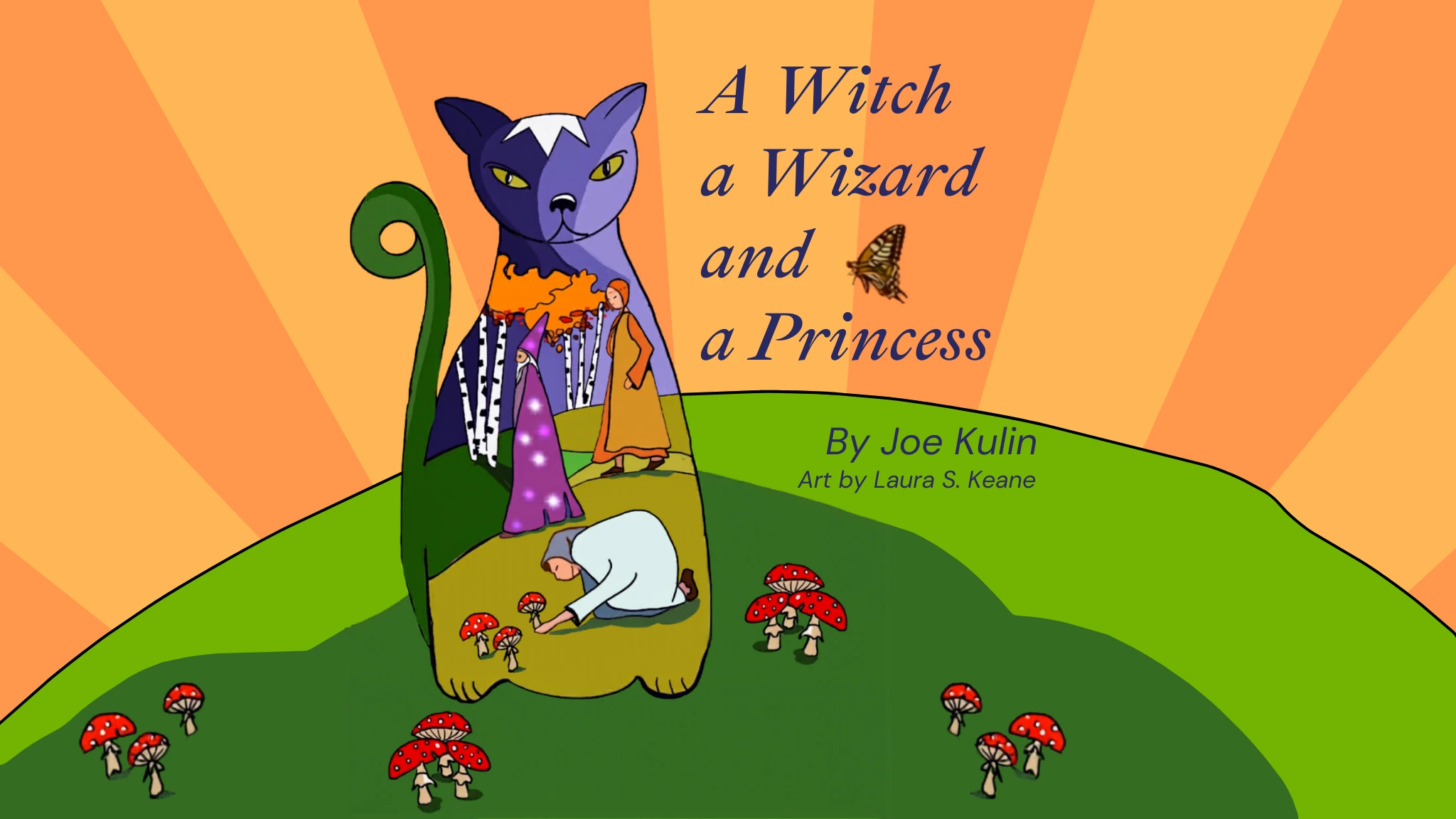
A Witch, a Wizard, and a Princess by Joe Kulin
What if the greatest magic isn’t casting spells — but learning who you really are?
In A Witch, a Wizard, and a Princess, Joe Kulin offers a sequence of interconnected fairy-tale adventures that, at first glance, feel comfortably familiar: a curious princess, a shadowy forest, a mysterious witch and a dangerous wizard. But as the story unfolds, it becomes clear that this is not simply a tale of good versus evil. It is a story about identity and transformation — and the quiet, often difficult work of becoming oneself.
The book follows Princess Serena, who begins her journey in the safety of palace life but feels an unspoken restlessness. When villagers begin disappearing in the nearby forest, Serena ventures beyond the castle walls and into a world shaped as much by inner forces as by external danger. Soon, she encounters Thyme, a wise and enigmatic witch who gives her both a magic necklace and a powerful mantra: “I am, I wish, I can.” It is a phrase that becomes central to Serena’s growth, guiding her through a series of trials that test her courage, judgment and sense of self.
Her first great challenge comes in the form of Matterious, a wizard who traps unsuspecting travelers and transforms them into objects that reflect what they most desire. Serena’s cleverness allows her to defeat him — temporarily — but their encounter leaves a lasting mark. In a later confrontation, their shadows collide, setting off a subtle but profound shift: each begins to take on aspects of the other. Serena grows irritable and unsettled, while Matterious becomes unexpectedly content, even reflective. What begins as a struggle against an external threat gradually turns inward, culminating in a ritual that restores balance — though not entirely.
From there, the story expands into a broader tale that blends romance with real danger and consequence. Serena’s bond with Ivan, a humble woodsman, challenges the rigid expectations of royal life, leading to defiance, exile and ultimately a reimagining of what a meaningful life might look like. The narrative continues with the birth of their son Igor, whose kidnapping by a greedy rival king leads to a tense standoff — one resolved not through force, but through restraint and a sense of honor.
A Pitch-Perfect Narration by Peter Coyote
Narrated by Peter Coyote, the audiobook brings a steadier, more grounded tone to the story’s shifting moods. Coyote demonstrates a seasoned, unshowy control of the narration, differentiating characters through subtle tonal shifts that make the story easy to follow without calling attention to the performance itself. His delivery leans into the book’s folkloric qualities, giving each chapter a sense of calm, deliberate unfolding.
That restraint works particularly well in moments of magic, where the narration treats the extraordinary as something almost ordinary — reinforcing the sense that this is a world where such things simply happen. The result is a performance that supports the story rather than competing with it, allowing the underlying ideas to come through clearly.
Another audio highlight is the interstitial music by Laraaji that serves as a bridge to each of the five chapters. It perfectly captures the magical fairy-tale atmosphere of the storyline.
A Children’s Book with Depth
But treating A Witch, a Wizard, and a Princess as a simple children’s fairy tale would miss much of what makes it interesting. Kulin reframes the idea of transformation in a way that feels both playful and quietly unsettling. Characters are not simply changed by magic — they are changed by what they desire, fear or fail to understand about themselves. When Serena and Matterious exchange aspects of their inner worlds, the story suggests something more complex: that understanding another perspective, even unwillingly, alters us in ways that cannot be fully undone.
Matterious, in particular, emerges as more than a conventional villain. His arc mirrors Serena’s in unexpected ways, and by the final act, he plays a role in resolving a threat that reflects the same kind of greed and hunger for power that once defined him.
For younger readers, the book works as an engaging sequence of magical adventures filled with vivid imagery and clear stakes. For older readers, there is something else beneath the surface — an exploration of identity, material desire, and what it means to live well.
In the end, the story suggests that true magic lies not in changing the world around us, but in understanding — and mastering — the forces within.
About Joe Kulin
 This audiobook is based on Joe Kulin’s illustrated children’s book, which received high praise from Kirkus Reviews. His intention is to have a full-length animation made from the story. Kulin has also published articles and interviews in Parabola Magazine and the Utne Reader. As a former publisher of Parabola: the magazine of myth and tradition, he became acquainted with the world’s folklore, myths and fairytales. He has also produced an eight-part audio series, “Native American Stories for Children.” Originally from Brooklyn, Joe lives in Northampton, Massachusetts, near his extended family. He continues to be actively engaged in yoga, Tai Chi, meditation and reading esoteric literature, as well as serving as a literary agent in the mind-body-spirit genre. He is one of the world’s great cat lovers.
Buy this Book!
Amazon