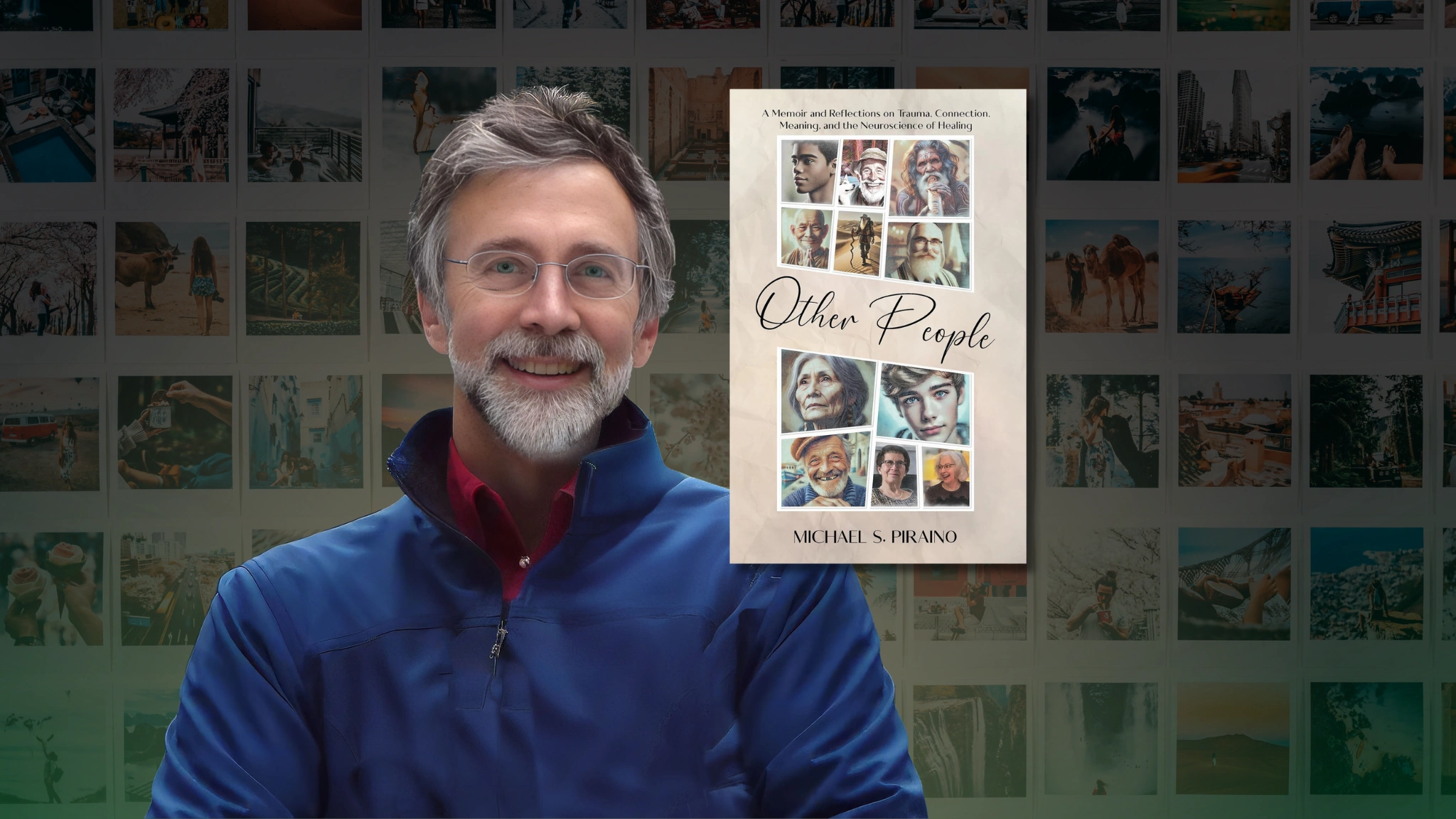
The title puts the focus squarely on those around you rather than yourself. Did you ever consider centering this memoir more on your own inner journey, and what made you decide that other people deserved the spotlight?
I did think about that. Most memoirs naturally center on the inner journey, and in many ways this one does as well. But as I reflected on my life, it became clear that whatever healing or meaning I found was never created in isolation. It was always shaped — often unexpectedly — by other people. So I found myself drawn less to the facts of what happened and more to the quiet revelation of how those moments came to matter.
That perspective comes from something deeply ingrained in me from an early age: a family tradition of appreciation. We were taught, not explicitly but through example, to pay attention to others — their struggles, their quiet strengths, the burdens they carried that might not be visible. That same attentiveness extended to the natural world as well, as if everything around us held meaning if we slowed down enough to notice.
So the title Other People felt less like a shift away from my own story and more like an honest acknowledgment of how that story was formed. My inner journey exists, but it is inseparable from the people who walked alongside me, challenged me and, in many cases, helped me heal without even knowing they were doing so. Looking back, I think many of those moments share something in common. They were small acts, often quiet ones, that leaned the scale, just a little, toward meaning.
You waited 56 years before fully disclosing your trauma to family and close friends. What finally gave you the courage to write about it publicly, and what do you hope male survivors in particular take away from reading your story?
It took me a long time to understand that silence can feel like protection, but it often also becomes a kind of quiet confinement. For many years, I told myself that what had happened didn’t need to be spoken — that it was something to carry, not share. But over time, through my work and my own reflection, I began to see how much of that silence was shaped by something larger than me.
Male victimization has a long history of being overlooked or minimized. It exists within a tangle of myths, stereotypes, and unfounded beliefs about men who come forward — one of the most persistent being that such things rarely, if ever, happen. While it’s true that men experience sexual violence less frequently than women, the reality is that the numbers are still significant, and the impact is profound.
I remember attending a conference on sexual violence where, during a break, a presenter told me in a forceful, almost angry tone, “men are not victims; they are perpetrators.” And that was the end of the conversation. But it wasn’t the end of the question for me. If anything, it stayed with me — an example of how deeply these assumptions run, even in places where understanding should be widest.
What gave me the courage to write publicly was not a single moment, but a gradual realization: that telling the truth might not just be about my own healing, but about making space for others. I had spent a lifetime working alongside people whose stories had been overlooked or misunderstood. Eventually, I understood that my own story belonged in that same circle of acknowledgment.
For male survivors, I hope the book offers a quiet reassurance — that what happened to you matters, that your experience is real and that you are not alone. And perhaps even more than that, I hope it suggests that healing does not require you to carry your story in isolation. Sometimes it begins with something small: a word, a gesture, a moment of being believed. In this, I aim to gently lean the scale toward connection.
Your friend Tony’s response — “What are we going to do about it?” — is one of the most powerful moments in the book. How did that single word, “we,” shape the person you became and the career you built working with vulnerable youth?
Tony’s question stayed with me in a way I didn’t fully understand at the time. It wasn’t just what he asked—“What are we going to do about it?”—it was that single word, we. In a moment that could have deepened my sense of isolation, he quietly replaced it with connection.
What followed wasn’t a grand plan, but a series of small, improvised steps. Together, we found ways to respond — talking, sometimes sitting in silence and eventually discovering things I could do on my own, like writing in a journal. At the time, none of it felt like a strategy. It felt like survival, shaped by friendship.
Years later, I came to understand that many of those instinctive choices are now well supported by neuroscience. Practices like putting experience into words, creating a sense of shared presence and finding even small forms of agency are all ways the brain begins to reorganize itself after trauma. What we were doing, without knowing it, was building the foundations of resilience.
That early experience shaped not only who I became, but the work I was drawn to. In my career with vulnerable youth, I came to see that healing rarely begins with answers — it begins with relationship. With someone willing to stand beside you and say, in one way or another, we… and in doing so, to lean the scale away from isolation and toward hope.
You describe your Sicilian grandmother’s ability to make people feel good by always adding a little pasta to the scale rather than taking it away. Was that the kind of lesson you absorbed consciously as a child, or only understood in hindsight?
I don’t think I understood it consciously at the time. It wasn’t presented as a lesson, and it certainly wasn’t explained. It was simply the way things were done. My grandparents, my parents, and even my brothers moved through the world with a kind of quiet generosity that showed itself in small, consistent actions.
My grandmother never had to tell us how to be compassionate. You saw it in the way she leaned the scale just slightly toward giving rather than taking away. That gesture — so simple, almost invisible — carried a kind of moral clarity. It said that people matter, that kindness can be practiced in the smallest of moments.
Because of that, these values didn’t feel imposed or even taught in the usual sense. I absorbed them, almost without notice, through the rhythm of everyday life. It was only much later, looking back, that I understood how deeply those patterns had shaped the way I try to live.
In my own way, I think I’ve spent much of my life trying to do the same — to lean the scale toward kindness… to add something, however small, to the lives of others.
The book weaves together personal memoir, neuroscience, and spirituality in a way that’s unusual. How did you decide what kind of book this would be — and who did you picture as your reader while you were writing it?
I didn’t begin with a clear sense of genre. In some ways, the book became what it needed to be in order to tell the truth as fully as I could. The personal stories, the neuroscience, and the spiritual reflections all felt like different ways of approaching the same question: how do we make sense of what happens to us, and how do we find our way toward healing?
As I was writing, I found myself holding two readers in mind. One was imagined, but very real to me — a young person, perhaps sixteen, feeling alone and confused in the aftermath of neglect or abuse. In many ways, that reader was both myself at that age and the many young people I’ve worked with over the years. I wanted the book to reach that person quietly, without overwhelming them, and to offer something steady; something that might help them feel less alone.
The second was a real person — a wise man with a quiet voice, whose spirituality was rooted in a gentle attentiveness to the present moment. I can still picture him sitting across from me, hands loosely folded, speaking slowly, as if each word had first passed through silence. From him, I learned that everyday life is full of sacred opportunities, if we are willing to notice them. He carried his understanding lightly, without needing to name or explain it.
In a sense, the book was written in the space between those two readers — one searching for understanding, the other embodying a kind of quiet wisdom. I hoped to write something that could speak to both: something honest enough for the one who is struggling, and gentle enough that the other might recognize it and, perhaps, smile. And if it leans toward connection or meaning for either of them, then it has done what I hoped it might do.
Nature — the Cascades, rivers, stones, dogs — plays almost as large a role as the people in your life. Do you think our disconnection from the natural world is part of why so many people struggle to find meaning and recover from trauma?
I do think we do ourselves a disservice when we fail to befriend the natural world. So much of modern life pulls us toward busyness — toward noise, urgency and distraction — while meaning often reveals itself very differently, through slow attentiveness to what is simple and unadorned.
In my own life, time spent with mountains, rivers, stones and even the quiet companionship of a dog has never felt separate from healing. I think of those early mornings at Mount Rainier, when first light touches the upper slopes — so quietly you almost miss it if you’re not paying attention. Nothing announces itself, and yet everything changes. The mountain doesn’t ask anything of you in that moment. It simply invites you to notice, to be present, to receive what is revealed there.
Some of my deepest understanding of this has come from Indigenous friends and teachers, who speak of the natural world not as scenery, but as relationship. There is a way of listening — slowly, respectfully — that begins to shift how we see. Over time, you begin to feel that these mountains, these waters, these stones are not distant or inert… they are part of us. In a sense, they are our ancestors, holding memory in forms we are only beginning to understand.
When we lose that connection, I think we lose something essential; a grounding, a context, a sense of belonging that helps us make meaning of our lives. And when we return to it, even in small ways, something begins to settle. Not everything is resolved, but the scale shifts — away from isolation, and toward a wider sense of connection that can support healing.
You close the introduction by saying you continue to look for more puzzle pieces. After writing this book and revisiting your whole life story, what puzzle pieces are you still searching for?
Finishing the book didn’t feel like completing a puzzle so much as recognizing how many pieces are still in motion. If anything, the writing made me more aware of how much meaning continues to unfold over time.
What I find myself searching for now is a deeper sense of reconnection — to the people, places and moments that seemed to find their way into the book because they mattered, even when I didn’t fully understand why. There is a kind of quiet gravity to those presences. They stay with you, and over time, they begin to reveal new layers of meaning.
We live in a world that often feels tense and fragmented, and I think that makes this kind of reconnection even more important. Not as a way of escaping what is difficult, but as a way of seeing it more clearly, and holding it tenderly with a different kind of attention.
So part of what I’m still searching for is how to listen more slowly — to people, to memory, to the natural world. How to remain open to what continues to emerge. And perhaps, in doing that, to offer something back — a way of being that might help others feel less lost, less unseen, less alone.
If there is a direction to that search, it’s this: to keep finding small ways to bring calm and clarity into places that feel overwhelmed… to lean that scale more clearly toward presence, toward understanding and toward hope.