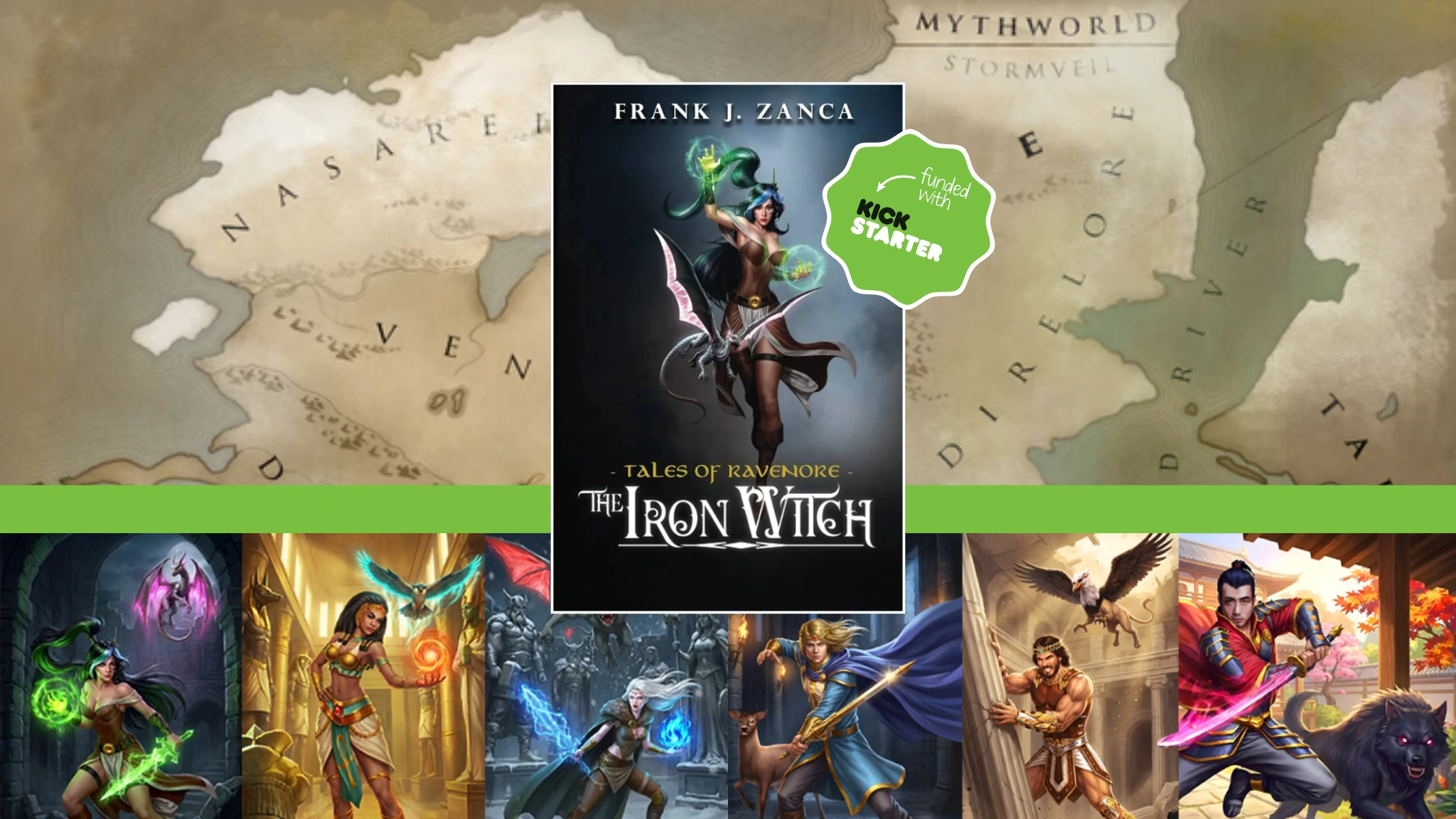
As audiobooks continue their rapid rise — and as crowdfunding reshapes how books reach readers — more authors are exploring new ways to tell stories beyond the printed page. For Frank J. Zanca, an award-winning screenwriter, producer and novelist, the answer lies in blending cinematic storytelling with direct audience support.
His latest project, Tales of Ravenore: The Iron Witch, is now at the center of a Kickstarter campaign to fund a full-cast audiobook — an ambitious step that reflects both his creative roots and the evolving landscape of independent publishing.
At its core, Ravenore is a classic fantasy tale: a young girl awakens in a mysterious, magic-charged forest with no memory of who she is, only to discover she may hold the key to a looming war uniting the Five Reigns against a powerful sorceress. But for Zanca, the story is just the beginning.
“I love world-building,” he says. “I like crafting worlds where the reader can lose themselves … where almost anything is possible. However, the characters still need to be grounded so the reader identifies with their plight and goals.”
That balance — expansive setting paired with emotionally grounded characters — has guided Zanca’s work across mediums. Before turning his focus to novels, he built a career in film and television, working as a producer and screenwriter on a wide range of projects. That background continues to shape not only how he tells stories, but how he develops them.
In fact, his process is anything but conventional.
Storytelling As Performance — Regardless of Format
After spending more than a year and a half writing a previous book through traditional prose revisions, Zanca adopted a new approach: writing his novels as screenplays first. He then conducts read-throughs with actors, refining dialogue and pacing before converting the script into prose.
The result is storytelling that is inherently performance-driven — something that naturally led to the decision to produce Ravenore as a full-cast audiobook.
Zanca has hired voiceover artist Alice Davis as the book’s narrator, but with such a wide variety of characters in his work, “it only made sense to have a cast of voices to really flesh them out and bring them to life,” he explains.
From a Nordic-inspired vampire who revels in the macabre to gruff, gravel-voiced creatures reminiscent of orcs, each character carries a distinct voice and cultural identity. That diversity reflects the world of Ravenore itself, where the five kingdoms draw inspiration from historical civilizations ranging from feudal Japan to ancient Egypt.
For Zanca, a single narrator simply wouldn’t capture that range.
A full-cast production, while creatively appealing, also comes with higher costs — one of the key reasons he turned to Kickstarter.
“I can do pre-sales via Kickstarter to help me pay for the edits and printing,” he says. “Supporters can also communicate directly with me … and I can sign all of my books and comics for the backers, which makes the products I deliver that much more special.”
Collapsing the Distance Between Creator and Consumer
It’s a model that reflects a broader shift in publishing, where crowdfunding platforms are increasingly used not just by first-time authors, but by experienced creators looking to expand what’s possible. In Zanca’s case, Kickstarter isn’t an experiment; it’s a familiar ecosystem. He has backed hundreds of projects and launched multiple campaigns of his own.
“I like supporting other creators, who’ve grown in number over the years. I learn from what others have done … to make the page easy enough to follow and give potential backers all the information they need,” he says.
That dual perspective — as both creator and supporter — speaks to one of crowdfunding’s defining features: the collapse of distance between storyteller and audience.
“It brings them closer together,” Zanca says of the platform. “It allows the reader to feel more involved in the process … and they can ask questions that are responded to directly by the writer.”
This sense of connection is especially powerful in genres like fantasy, where readers often seek not just a story, but a world to inhabit. Kickstarter, with its tiered rewards and community-driven energy, has become a natural fit for that kind of engagement.
At the same time, Zanca is mindful that readers consume stories in different ways. Some prefer audiobooks for their immersive, on-the-go accessibility; others still favor the tactile experience of print or the convenience of digital formats. His goal is to meet them where they are.
“I like to have versions of all three of these mediums for each of my readers,” he says.
Building More Than Worlds: Transmedia Properties
Ultimately, the Kickstarter campaign is just one step in a larger vision. Zanca sees The Iron Witch as the beginning of a trilogy — and potentially something even bigger. And with his background in film and television, as well as board game design (particularly RPGs), the options are limitless. A look at his long list of backer rewards reveals he’s created collectible pins, along with plush dolls and miniatures of characters based on his literary output. His fantasy words extend into full-fledged transmedia properties.
But for now, he’s focused on the backbone — the books. “I am hoping to create a large enough fanbase to continue writing the next two books and completing the trilogy,” he says. “The end of this one does feed into the next story. It’s an exciting world, and I would love to revisit it and flesh the kingdoms out even further.”
In that sense, the campaign is not only about funding an audiobook. It’s about building momentum for a growing story world and inviting readers to help bring it to life.
As publishing continues to evolve, projects like Tales of Ravenore suggest a future where storytelling is increasingly collaborative, immersive and creator-driven — where the line between audience and participant becomes ever more fluid.
Readers interested in backing the project can visit Zanca’s Kickstarter page here.