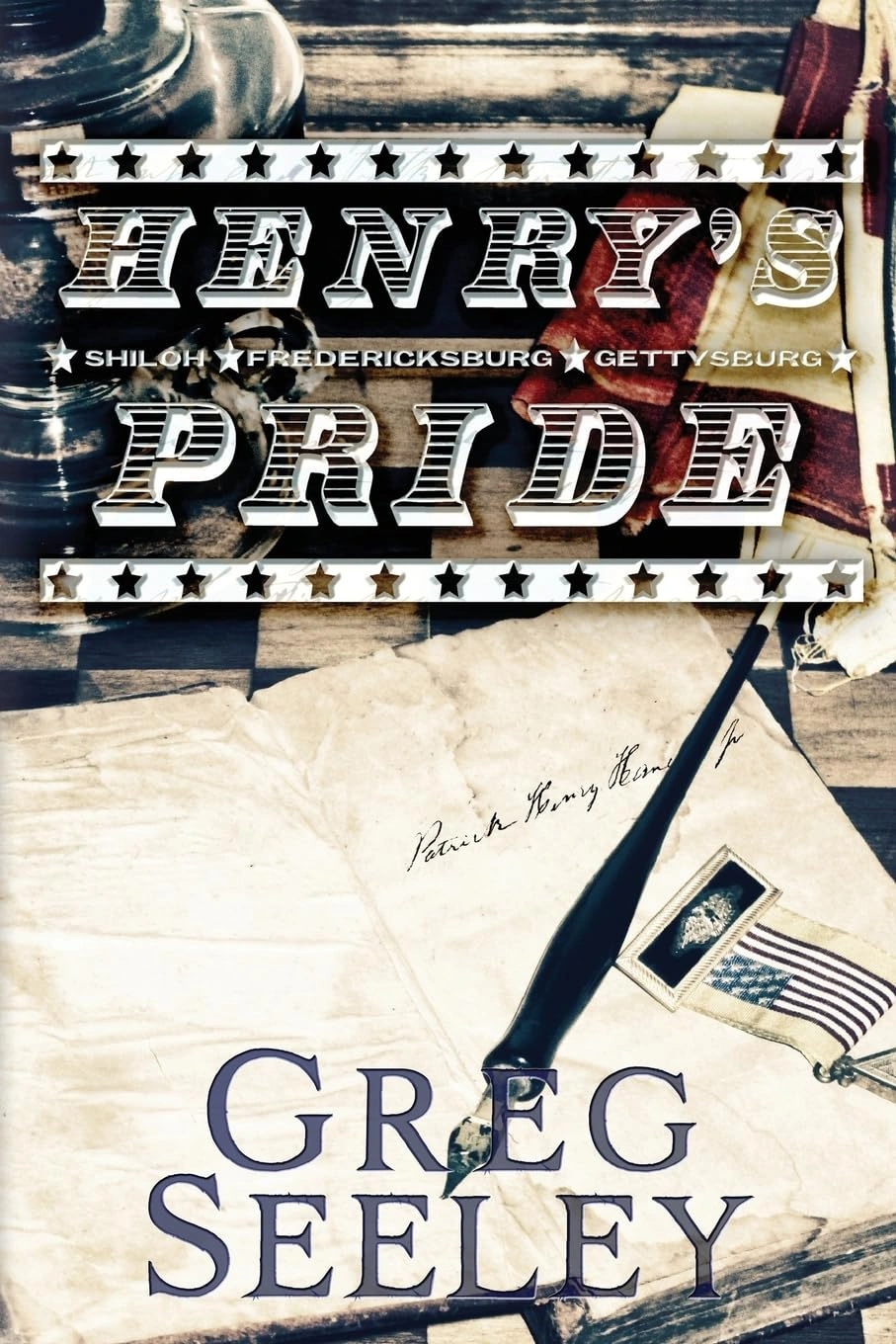
Henry's Pride by Greg Seeley
Greg Seeley’s Henry’s Pride is a richly imagined work of historical fiction set against the backdrop of the American Civil War. Inspired by the actual letters and journals of the author’s great-grandfather, Ira Seeley — a soldier who served with the 29th Iowa Infantry Regiment — the novel transforms a family inheritance into a multi-threaded story that is as emotionally honest as it is historically vivid.
A Journey Into Memory and War
The story opens with a Phillip Hancock, a retired attorney in his late seventies, driving out to a crumbling, nearly forgotten Minnesota town and walking through an overgrown cemetery, pausing at the weathered headstones of men and women who once carved their lives out of the prairie. From that quiet beginning, Seeley pulls us backward into the fire of the Civil War, and what follows is anything but quiet.
At the heart of the novel is Henry Hancock, a Union sergeant whose stubborn sense of duty earns him the nickname “The Lion” among his company. Henry is a wonderfully rendered protagonist: neither a hero in the Hollywood sense nor a broken man, but someone trying to hold himself together through what he candidly calls “the nation’s nasty business.” His letters home, written in the period style Seeley carefully researched and replicates, crackle with authenticity and feeling. This is a man reaching through smoke and distance toward the people he loves.
What distinguishes Henry’s Pride from so many Civil War narratives is its perspective. Seeley does not content himself with the Union side alone. He gives us Darius Morgan, the young heir to a Georgia plantation, fighting for the Confederacy to protect the only world he has ever known; Hamilton Stark, the morally repugnant but psychologically complex overseer left behind at Pine Hill; and Theodore, a young runaway slave who finds his way north to the Hancock farm in Minnesota, bringing with him a quiet dignity that makes him one of the novel’s most compelling figures. Each storyline is developed with care, and together they create a panoramic portrait of a nation at war with itself.
The Human Cost of Conflict
The battle sequences are among the best passages in the book. Seeley’s depiction of Shiloh — seen through the eyes of both Henry at the rifle line and his brother Jonas in the artillery — is visceral. Jonas’s story is heartbreaking: a gentle, reluctant soldier whose eardrums are ruptured by cannon fire, plunging him into a silence that becomes its own kind of nightmare. The scenes of Jonas’s delirium on the battlefield are among the most harrowing and memorable in the novel, a reminder that the wounds soldiers carry home are not always the ones that bleed.
Seeley trusts his characters and his history to do the work, and they do. The letters that punctuate the narrative — to and from home, between soldiers and the wives and siblings left behind — give the novel a documentary texture that grounds all the fiction in something that feels lived and real. These are people, not symbols. They doubt, they grieve, they make terrible choices and they keep going.
Henry’s Pride is a son’s tribute to his forebears, a student’s tribute to history, and a storyteller’s tribute to the simple, enormous truth that war changes everyone it touches. Greg Seeley has written a novel that deserves to find the wide readership it merits.
About Greg Seeley:
 Greg Seeley was raised on a farm north of Afton, Iowa. He graduated from the University of Northern Iowa with a major in history and received his Master’s Degree from the University of Iowa. Greg is a retired certified public accountant and lives in Overland Park, Kansas with his wife Carolyn, a retired math teacher. Henry’s Pride is Greg’s first novel. He is also the author of a book of verse entitled The Horse Lawyer and Other Poems.