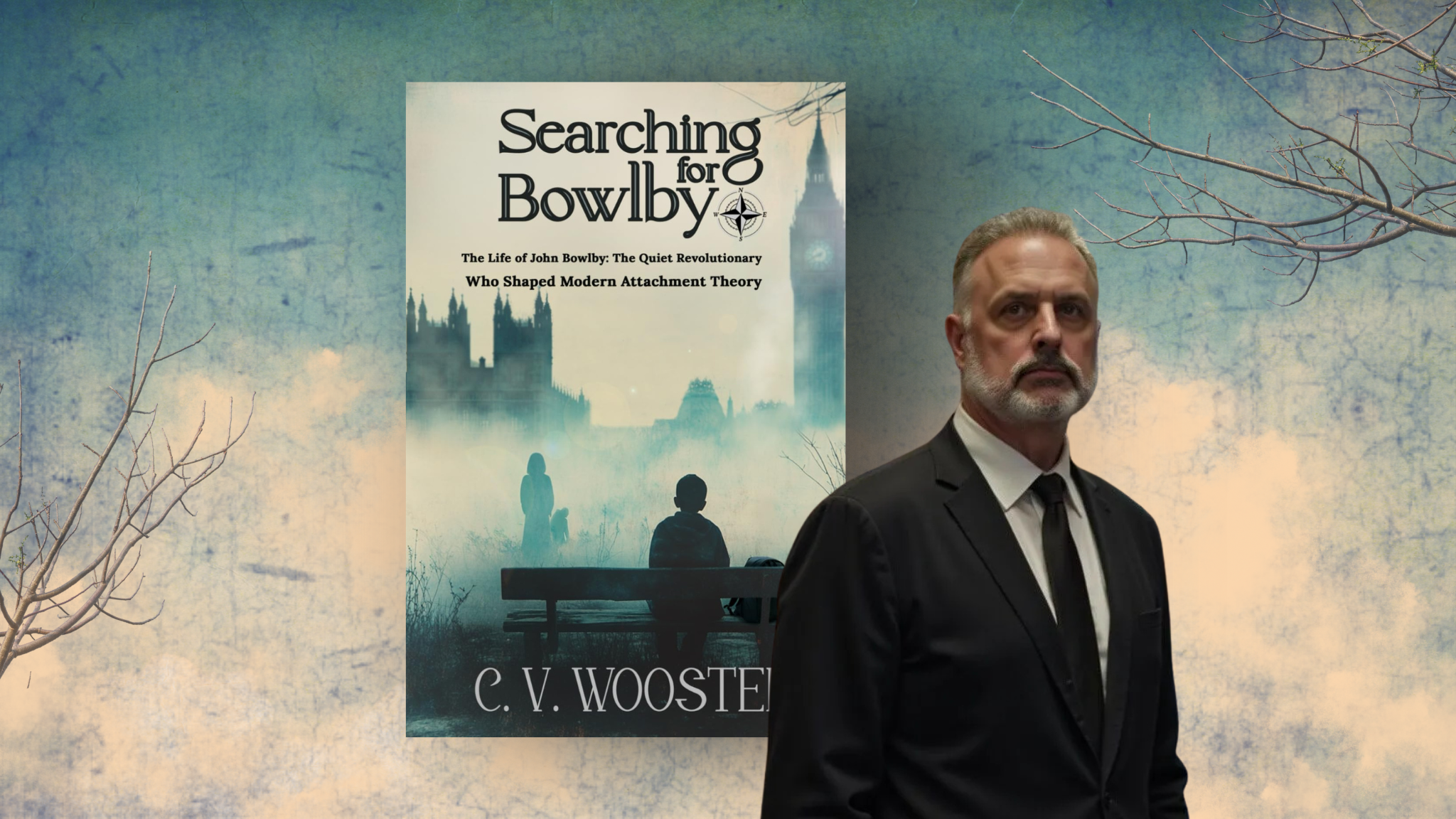
Searching for Bowlby intertwines biography and memoir to illuminate the life of John Bowlby: the pioneering psychologist who redefined how we understand love, loss, and human connection. But in tracing Bowlby’s theories of attachment, Wooster also found himself confronting his own.
In this Q&A, author C.V. Wooster reflects on the balance between research and reflection, the blurred line between biography and confession, and what it means to seek understanding. Not just of a groundbreaking thinker, but of oneself.
- You write in your dedication that you “lived with words unwritten” for six decades before publishing this book. What finally gave you the courage to let your words “step into the light”?
For most of my life, I carried stories the way some people carry scars – visible only if you know where to look. I grew up with trauma and challenges that shaped me in ways few would ever truly understand, and for years I mistook survival for silence. Writing was always there, but I kept it in the dark, afraid that giving voice to it would reopen old wounds. What finally changed was realizing that healing doesn’t come from hiding – it comes from expression. I reached a point where not writing felt heavier than writing ever could. Searching for Bowlby became both a reckoning and a release – a way to transform pain into purpose, to turn survival into something resembling art. Letting the words step into the light wasn’t about courage so much as acceptance: that what nearly broke me might one day help someone else make sense of their own story.
- You describe this project as both “a search for Bowlby” and “a search for yourself.” How did the act of writing blur, or clarify, the line between biography and memoir?
Every biographer brings a shadow of themselves into the story, but Bowlby’s work on attachment made that shadow impossible to ignore. The more I learned about his theories, the more I saw my own patterns – my teaching, relationships, even grief – reflected back. The research demanded objectivity; the writing demanded honesty. The two blended until biography became mirror work.
- You write that “we give what we did not get,” suggesting that Bowlby’s own childhood pain became the foundation for his theories. What discoveries about his personal history most surprised you?
The emotional austerity of his upbringing startled me. Bowlby’s nurse was dismissed when he was four, and that rupture – something most biographers mention briefly—was, I believe, the spark that ignited everything that followed. He spent a lifetime turning that loss into understanding. What surprised me most wasn’t his intellect but his tenderness: a man trying to quantify love without ever having truly received it.
- You mention contemporary echoes: dating coaches, therapists, even YouTube creators who use his concepts. What do you think Bowlby would make of this modern resurgence?
He’d probably raise an eyebrow first – and then take notes. Bowlby was a scientist but also a reformer; he wanted attachment theory to improve lives, not just sit in journals. I think he’d be fascinated – and maybe a little alarmed—by how his ideas have been packaged for the algorithm. Still, I suspect he’d see the silver lining: people searching for connection in a disconnected age, trying, however clumsily, to heal what he first named.
- Your writing blends historical narrative with deeply reflective prose. Did you ever struggle to balance factual storytelling with the more introspective, personal elements of your search?
Constantly. I wanted to honor the precision of a historian and the vulnerability of a memoirist without shortchanging either. The facts are the bones, but the reflection is the pulse. The balance came when I stopped trying to separate them – when I realized that the emotional truth of the story was part of its historical truth. Bowlby wasn’t just a theorist; he was a wounded boy who grew into a man trying to make sense of why love hurts.
- The title, Searching for Bowlby, implies an ongoing quest rather than a final discovery. After finishing the book, do you feel the search is over—or is it still continuing in some form?
I don’t think the search is over—if anything, I hope it’s just beginning for readers. Bowlby has long lived in the shadows of Freud and Jung, two names that became cultural shorthand for psychology itself, while his own contributions quietly transformed how we understand love, loss, and human connection. I know his story intimately now, but there’s still more to uncover—more nuance in his letters, more humanity in his silence. My hope is that Searching for Bowlby doesn’t close a door but opens one. Perhaps a reader will go deeper, reexamine his theories, challenge them, or bring his work to new audiences. In that sense, the search becomes collective—a continuation of his legacy by those willing to look closer at a man who was never meant to be forgotten.
About C.V. Wooster:
 Described as a Renaissance man, C. V. Wooster has a deep passion for diverse subjects, seamlessly blending creativity, intellect, and compassion in everything he does. With BA degrees in English Literature and History, MA degrees in Political Science and Multi-Cultural Education, and as an NBCT-certified teacher, he has dedicated decades to shaping and inspiring young minds. His commitment to education is further demonstrated by his doctoral dissertation on the subject of classroom technology integration, written when such technology was just beginning to emerge.