“‘We have to stop putting all this pressure on ourselves. It’ll work out eventually.’
“I am so goddamn sick of everyone telling me that.”
So —
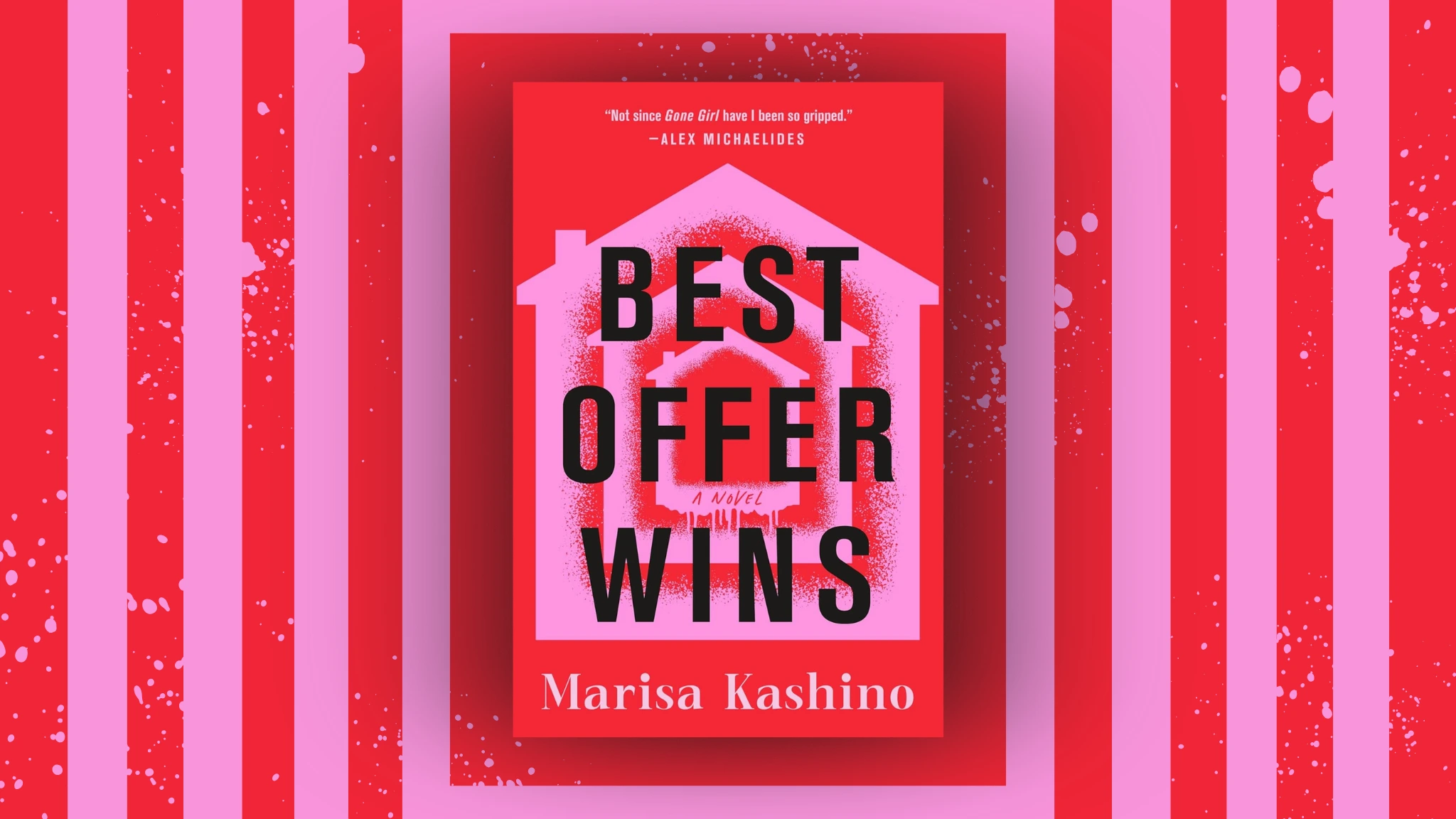
As Marisa Kashino’s Best Offer Wins begins, here’s where we are:
Thirty-seven-year-old Margo Miyake and her husband, Ian, have been house-hunting in the Washington, DC, suburbs for eighteen months now. The tiny, cramped apartment they’re living in was supposed to be only temporary, but they’ve lost eleven bidding wars, their plans to have a baby have been put on hold, their marriage has gotten squabbly and her boss has started dropping pointed comments about Margo getting distracted at work.
The house. If only they can land the house, Margo knows everything will be all right. And then she gets a call from her real-estate agent about a perfect house in a perfect neighborhood and she hears the perfect ten words: “No one else knows about it! It’s not listed yet.”
And if Margo has anything to do with it, it never will be. How far will she be willing to go? Oh, you have no idea …
Surveillance, reconnoitering? Anyone would do that! Stalking? Come on, it’s just getting to know the owners. Blackmail? Well, you need an edge, don’t you? Everybody else has an edge. What don’t you get about that?
And that’s when things start to get really crazy …
Dark, bitingly funny, compulsively readable, Best Offer Wins is a shocking and shockingly entertaining look at class, race, ambition, obsession, the indignities visited upon us every day and the lengths to which we will go to get what we think we deserve.
How far would you go?
Maybe you just don’t know yet.
Turning the Housing Beat into Fiction Gold
After seventeen years as a journalist, Marisa Kashino knows quite a bit about her subject. Her time at Washingtonian magazine partly included overseeing real estate and home design coverage and her time at the Washington Post involved a section devoted to the home.
“I couldn’t even begin to quantify how much of it made it into the book. Safe to say, a lot! I can give you one specific example — at the Post, I was mostly an editor, but one of the few stories I wrote there myself was about couples who split up because of stressful home renovations. I happened to be working on that piece at the same time I was beginning the first draft of Best Offer Wins. So much of what I learned from reporting it had to do with the emotional and psychological baggage that we each bring to homeownership and the concept of a ‘dream home.’ I absolutely drew on some of that material when I was crafting Margo and her husband Ian’s contrasting backstories and the ways in which their different upbringings could create tension.
“The whole idea for the book definitely stems from the years I spent covering real estate as a reporter, including during the particularly deranged housing market triggered by Covid. I heard a lot of wild stories about desperate buyers and mobbed open houses and listings getting 60 or 70 offers. As a millennial, the housing crisis already felt like a defining problem for my generation, but this was the moment when it boiled over to an obscene degree.
When the Housing Crisis Turns Deadly
“Fast forward a couple years — I was thinking of writing a thriller and an uber-competitive house hunt seemed like the perfect context for one. I remember walking into the kitchen one morning and saying to my husband:.
What if a buyer was so desperate, she did X? (no spoilers!). So, once I had that idea for the big twist that comes late in the novel, it was just a matter of plotting my way to that point.”
Margo’s spiral is an astonishing one, starting small and then going to appalling places, all of which she rationalizes as completely necessary. How much of that was in Kashino’s mind early and how much developed over time? Was there any point at which she thought: Is this too much? And thought: No?
“Oh god, yes, I wondered constantly while I was writing the draft if I was making her too despicable—if readers would loathe her too much to want to go along for the ride. Even so, this was the protagonist I wanted to create from the second I sat down to write the book. I love an antihero. I love female characters who do terrible things. I especially relished letting an Asian female character behave so badly, given the stereotype of Asian women as docile and subservient. But probably most importantly for this particular story, I felt this was who Margo had to be for the satire of it all to land right. So, yes, there were many points at which I thought: Is this too much? But even if my next thought was ‘yeah, maybe,’ the thought after that one was always ‘oh well!’
“That was one of the best parts about writing a first novel—I felt like I had nothing to lose. I had no idea if it would ever see the light of day, so I just did the thing that was the most fun for me.”
A Little Bit of Margo in Marisa
There are definitely parts of Margo in Marisa, as well:
“Ha. Yes! Even if we don’t share the same views on certain things, we do share a similar sense of humor, including an affection for a well-deployed F bomb. Margo also feels very much like an outsider in a city that often runs on who you know and where you went to school. For that piece of her, I certainly drew on some of the insecurity that I felt when I first moved to DC many (many) years ago from the West Coast, without an Ivy League degree or a phone full of connections. And finally, I relate — as I think many women can — to the rage that’s often simmering for Margo just beneath the surface. I’m pleased to report that I’m much better at managing it than she is, though I absolutely found it cathartic to create a fictional character who leans so fully into her fury.”
How did the book go from “nothing to lose” to actually seeing “the light of day?”
“I was still an editor at the Washington Post when I decided to write Best Offer Wins, so I worked on the manuscript almost entirely on weekends. That might sound like a drag, but I honestly couldn’t wait to lock myself away and work on it (shout out to my husband for walking the dogs and reminding me to eat!). I was so addicted that I finished that first draft in only three months, just before Christmas 2023. I put it down for another month or so, then came back to it with fresh eyes and revised it myself. I then had a trusted friend read it. She gave me some great notes, which I incorporated on the next revision.
How “Best Offer Wins” Found Its Perfect Match
“By that May, I decided to query a few agents, just to see what would happen. I queried six—mostly agents I found in the acknowledgements of novels I loved. I was fortunate to get offers of representation from two of them, including Meredith Miller at UTA. I queried her at 4:45 on a Friday afternoon that I will never forget. She responded around 6, asking for the full manuscript. I couldn’t believe she’d emailed me back so fast and I totally cried. I signed with her a few weeks later. (Cherry on top, she invited UTA’s Ethan Schlatter to join our team, too, so I have two amazing agents there.)
“In early July 2024, I met with several publishers who were interested in the novel. We were prepared to go to auction, but then Celadon swooped in with a preempt. During our meeting, I’d gotten a great vibe from Ryan Doherty, who is now my editor there, so I was happy to negotiate just with him and call off the auction. We wrapped everything up on another Friday that I will never forget!”
But wait! There’s more! Hulu will be making the book into a limited series, with Greta Lee to star!
“I was lucky to have an embarrassment of terrific options when it came to choosing a partner for the adaptation. My goal was to find partners whom I could wholeheartedly trust with my baby. I have an executive producer credit, but I’m mostly just excited to see what Greta Lee and our showrunner Suzanne Heathcoate dream up for Margo’s life on screen!”
Next up is another “mashup of thriller and satire” that she’s not ready to take about yet, but promises it’ll be a “fun, twisty ride.” If it’s anything like Best Offer Wins, that’ll be a promise easily kept.