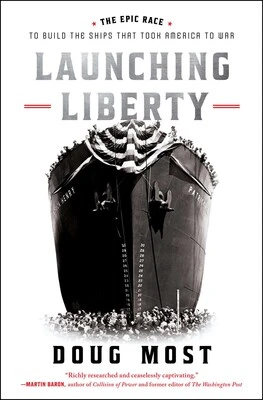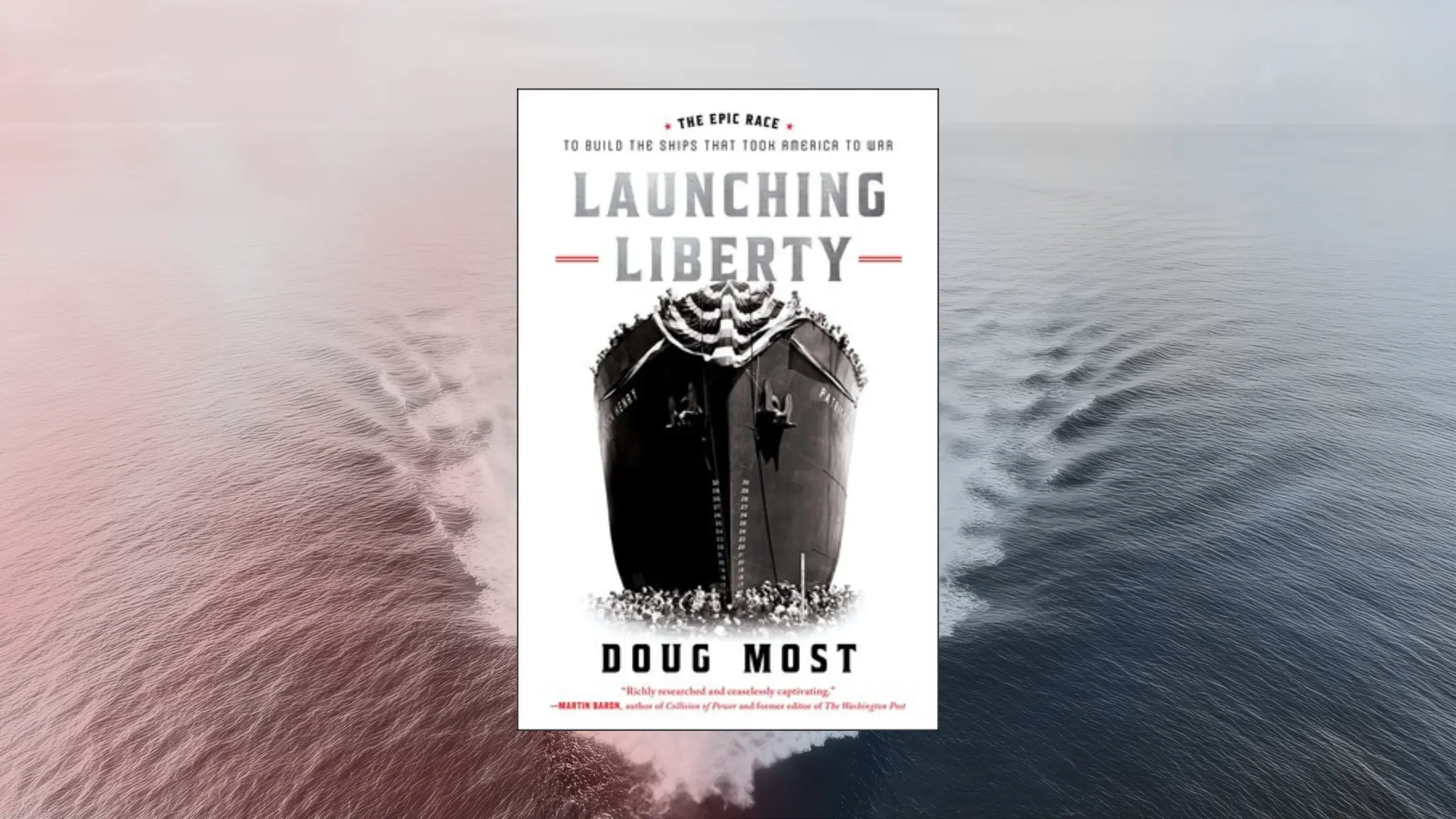
Launching Liberty: The Epic Race to Build the Ships That Took America to War by Doug Most
Journalist, author, and Boston University Assistant Vice President Doug Most has thoroughly researched and expertly documented the construction of America’s cargo or Liberty ships, a largely overlooked but important aspect of WWII history. This remarkable achievement is documented in his recently published non-fiction work Launching Liberty, subtitled The Epic Race to Build the Ships that took America to War. An army or navy cannot completely function without the full complement of military weapons of war: all types of transport including airplanes, tanks, jeeps, and humble sturdy dinghies, along with medical supplies, ample food, clothing, and sufficient mobile camp equipment for hundreds of thousands of service men and women. A Quartermaster’s nightmare anytime, but it is especially so during wartime. Enormous cargo vessels designated as Liberty ships were built rapidly in response to the urgent need to deliver the essential supplies across the Atlantic and Pacific Oceans.
Roosevelt’s “Ugly Ducklings”
This riveting book details the extraordinary story of how, in partnership with private industrialists, President Franklin Delano Roosevelt built 2,710 vital freighters, each longer than a football field, in less than five years. FDR called them “Ugly Ducklings” but a single ship could feed three million men for a day and a fleet of them could supply an army for years. As FDR noted, a primary goal was: “Build ships faster than the enemy could sink them.” Fourteen vessels were launched on September 27, 1941, designated Liberty Fleet Day, the first being the SS Patrick Henry built by the Bethlehem-Fairfield Shipyard in Baltimore. This event was preceded by a rousing speech from FDR which concluded with “Give me liberty or give me death” and the statement that this class of ship would bring liberty to Europe.
The Workforce That Built a Fleet
Launching Liberty shares some of the inspiring stories of the architects, business leaders and ordinary anonymous workers including the “Rosie the Riveters” and “Wendy the Welders” who rose to this enormous challenge as patriots protecting freedom and democracy through their arduous labors. When completed, these vessels were manned primarily by the Merchant Marines, an all-volunteer civilian workforce that courageously sailed in harm’s way throughout the war. An estimated 1 out of 23 Merchant Mariners lost their lives during WWII.
Using an innovative British design, Liberty cargo ships were initially built under the government’s Emergency Shipbuilding Program with a contract to supply 50 transport vessels for the United Kingdom. These were to replace English ships that had been lost, sunk or damaged beyond repair during the first two years of WWII prior to the USA’s entry into the war. Eighteen American shipyards were dedicated to constructing these ships between 1941 and 1945 utilizing mass-production techniques learned from studying Henry Ford’s Detroit automobile assembly lines. The dedication and ingenuity they displayed came to symbolize the USA “can-do-it attitude”. In order to employ an adequate workforce to operate 24 hours per day, seven days per week, Union barriers had to be amended to allow the employment of women, older adults and those then characterized as ‘people of color’.
Henry J. Kaiser and the Revolution in Shipbuilding
Doug Most rightfully credits industrialist Henry J. Kaiser’s foresight and leadership for revolutionizing traditional shipbuilding methods by applying the principles of assembly line production of cargo ship component parts to streamline the process. Although, Kaiser’s formal education ended at the eighth grade, he never shirked hard work in his resolve to assist his parents and siblings. He possessed an inventive mind, grit, ambition and determination to learn what was needed to complete infrastructure construction projects. He was already 49 years old when the Henry J. Kaiser Company he founded in 1914 partnered with railroad builder Warren Bechtel to form a consortium of construction companies christened the Six Companies, Inc. to accomplish the massive project of building the Hoover Dam. Kaiser-Bechtel had a 30% majority ownership interest in this joint venture shared with MacDonald and Kahn, Utah Construction, Morrison-Knudsen, Pacific Bridge and J. F. Shea Companies. Henry Kaiser lacked experience in dam building but successful managed the project, remarkably bringing it to completion two years earlier than projected and two million dollars under budget (the equivalent of over 45 million savings in today’s money).
This success virtually guaranteed his participation in the construction projects of the Bonneville and Grand Coulee Dams. Consequently, his inexperience in shipbuilding was not viewed as a handicap when the time came to bid for new shipyards. Among the first two of the 18 shipyards were Kaiser’s shipyards in Richmond, California and Portland, Oregon with the latter managed by his elder son. Once the mudflats of Richmond were stabilized and a workforce hired, these shipyards became models of efficiency, readily apparent from the fact that construction time was soon reduced from 8.5 months to days. The SS Patrick Henry had taken 244 days to build. Through the use of prefabricated sections built in warehouses, the average construction time for sister ships dropped to an astonishing 33 days. The SS Robert E. Peary set an unmatched record when it was launched 4 days and 15.5 hours after the keel was laid for a not to be repeated publicity stunt.
Of the 2,710 Liberty ships built, 1,490 were constructed in these two west coast locations. Kaiser trained inexperienced workers who were pleased to receive the then better than average beginning wages of 95 cents per hour with overtime available. Slender, strong women made ideal welders as they were able to fit into the tight spaces between steel plates. Workers flooded the tiny town of Richmond straining housing resources which resulted in residents taking in boarders and some even renting out barns and sheds. Kaiser Child Care Service Centers funded by the Maritime Commission were open 24 hours a day in both Richmond and Portland enabling both parents to work and reducing absenteeism. The company also enticed shops, cafes and schools to open in boomtown Richmond which had previously been bereft of adequate services.
Legacy of the Liberty Ships
One of the most significant benefits presented was to provide health care for the workers similar to that done for dam builders working on the Grand Coulee project. Kaiser’s message to Washington was “A healthy workforce is no less vital to the Liberty ship program than an abundance of steel.” He prevented Dr. Sidney Garfield from being sent overseas with the US Army in order to oversee his vision of a health care facility. Kaiser then purchased a derelict four-story building in downtown Oakland and with a loan from Bank of America’s President and owner A.P. Giannini, then swiftly renovated the space into Permanente Hospital, a state of the art facility named for a nearby creek. This was the inception of the statewide Kaiser Permanente system. Several first aid stations were also provided on site at the shipyards. Additionally, workers were offered a pre-payment insurance plan that covered their families at the exceptionally affordable rate of 7 cents per day. More than 90% of the employees took advantage of this unprecedented offer for the best medical care most had ever experienced.
The combination of introducing mass production techniques to shipbuilding, satisfactory wages and healthcare for the workforce yielded immediate results in both productivity and worker satisfaction. Although patriotism and altruism could certainly be cited as motivating factors behind Kaiser and his fellow shipbuilders, they might also be viewed not only as enterprising industrialists but also as wartime profiteers. Kaiser’s introduction of healthcare, improved employee benefits and advancement opportunities, however, should not be minimized.
Postwar, Kaiser was involved in aluminum, steel and automobile production as well as the Henry J. Kaiser Family Foundation which focuses on health policy and research.
Some of these cargo vessels were hastily converted in 1943 for relatively short-term use as troop transports. In 1942, SS Stephen Hopkins, built by Kaiser Permanente Metals in Richmond, CA, was the first American ship and the sole Liberty ship to sink a German commerce raider when a ship-to-ship gun battle resulted from the Captain’s refusal to surrender his cargo vessel. Unfortunately, the Liberty ship also sank shortly after with lives lost; 15 survivors managed to drift to Brazil after surviving a month at sea in a lifeboat. The final Liberty ship constructed, SS Albert M. Boe, was delivered on October 30, 1945 shortly after the war’s end.
Launching Liberty: The Epic Race to Build the Ships that Took America to War is a fascinating chapter in American maritime and wartime history. Doug Most has written the captivating story of the optimism, perseverance and industrial creativity that helped the Allies prevail in a devastating world war. This substantive work of non-fiction is richly annotated, with a lengthy bibliography and useful index. As a footnote, about 2,400 Liberty ships survived the war. A third of them continued to be used for military cargo before being scrapped. They were a tremendous boon for shipping magnates who enhanced their wealth after acquiring them at scrap cost. Greek entrepreneurs such as Aristotle Onassis purchased 526 while Italians bought 98.
SS John Brown survives as an educational museum ship in the Baltimore Harbor and SS Arthur M. Huddell, restored and renamed SS Hellas welcomes visitors in Greece. A third ship, SS Jeremiah O’Brien, part of the original D-Day armada, made a final voyage to Normandy and back in 1994 for the 50th anniversary ceremonies and is now berthed in the San Francisco Harbor.
Doug Most has launched an important work with Launching Liberty reminding us of the sacrifices, courage, and sheer hard work that comprised but a portion of the efforts required to rescue the precious and endangered freedom passed to us by our forebears.
About Doug Most:
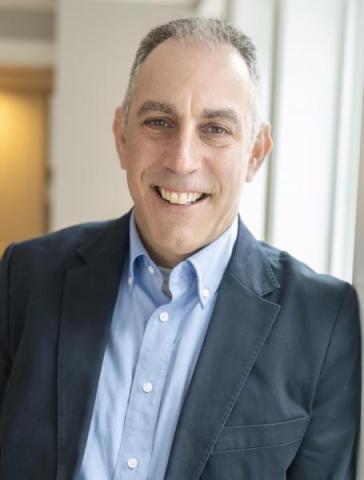 Doug Most is a veteran journalist in Massachusetts, author of three books, and now the Executive Editor and Assistant Vice President at Boston University. He’s worked at newspapers in Washington, D.C., South Carolina, and New Jersey. He spent 15 years as magazine and features editor at The Boston Globe, and has written for national magazines, including Sports Illustrated, Parents Magazine, and Runner’s World. His latest book, Launching Liberty, due out in August 2025 from Simon & Schuster, tells the human story of the Liberty ships of World War II. The Race Underground is the narrative history of Boston and New York struggling with dangerously overcrowded neighborhoods, and desperately searching for relief, and ultimately finding it through the painstaking construction of subway tunnels beneath their streets. Most’s first book, Always in our Hearts, was a true-crime story based in New Jersey about two teenagers who hid their pregnancy from their parents and killed their baby to avoid responsibility.