I have a confession, y’all — I’m one of those readers who waits until an entire series is out before reading, just so I don’t have to suffer through cliffhangers. Did you gasp in outrage?
You should, because I’m also one of those authors who loves to write them. I write a lot of series, and my favorite scene is the ending—when I drop readers over that ledge, giggle to myself, and make them wait months for answers. (Actually, if I could write faster, I would. I promise.)
I swear I’m not being deliberately cruel. Cliffhangers, to me, are part of the fun—both as a reader and a writer. They can and should be integral to storytelling: the twists, the emotional impact, and the setup for what’s next. That said, there’s a fine line between cliffhangers that make me desperate for the next book and the ones that just piss me off.
So let’s talk about both the frustrating and the fantastic sides of cliffhangers.
WHAT READERS CAN’T STAND
Predictability
If readers see the twist coming, what’s the point?
Long Waits
As a writer, I do apologize for this one. I wish I could shorten the gap, but it’s not entirely in our control. Writing and editing take time, and if traditionally published, scheduling and marketing play a big role too.
No Payoff
Some cliffhangers are just teases — no real payoff, or a bait and switch. For example: when the next book starts with “Just kidding, everything’s fine.” Writers, don’t do this. If you include a cliffhanger, make it count—and make the resolution hard-earned.
Cheap Device for Sales
Yes, cliffhangers can boost sales. But when used only to sell the next book, readers notice. They’re smart — they can tell when a cliffhanger serves the story versus when it’s there for marketing.
Breaking the Core Promise
Denying resolution to a book’s central promise — solving the mystery, resolving the conflict, or delivering the happy-ever-after (or at least happy-for-now)—feels like betrayal. Instead, hang your cliffhanger on anything else: a side character, a new couple, a new conflict, or an overarching plotline the reader already expects to span the series.
WHAT READERS LOVE
Anticipation & Momentum
When done well, cliffhangers tap into our natural curiosity. They make us need to know what happens next. Why do we love mysteries or romance? Because of the tension and anticipation — will they, won’t they, how will they?
Memory Retention
The cliffhanger is probably the literary device used most to entice the reader to want the next book, because… Readers forget. But did you know there’s a reason? It’s called the Zeigarnik effect — a psychological phenomenon where people remember unfinished or interrupted tasks better than completed ones. That’s why a well-done cliffhanger helps readers remember how much they want the next book, even if the wait is long.
Serial Satisfaction
In a well-planned series, cliffhangers feel integral to the journey. They move the story forward or introduce the next conflict. The key is to make the cliffhanger meaningful to the plot and characters — not just a ploy for preorders. It should add emotional weight without ruining the story that just ended.
Emotional Stakes
This is the heart of an effective cliffhanger. Don’t just drop a plot twist — tie it to emotional stakes. When the moment hits the characters in a way that makes readers ache for resolution, that’s the sweet spot.
Buzz & Discussion
Online book communities are one of my favorite parts of being a reader and author. I grew up without anyone to share my favorite books with, and now I get to talk theories and reactions with readers around the world. The number one thing they reach out about? The cliffhangers.
Readers, what do you think about cliffhangers? Love them? Hate them? It’s a continuing love-hate relationship? This author would like to know!
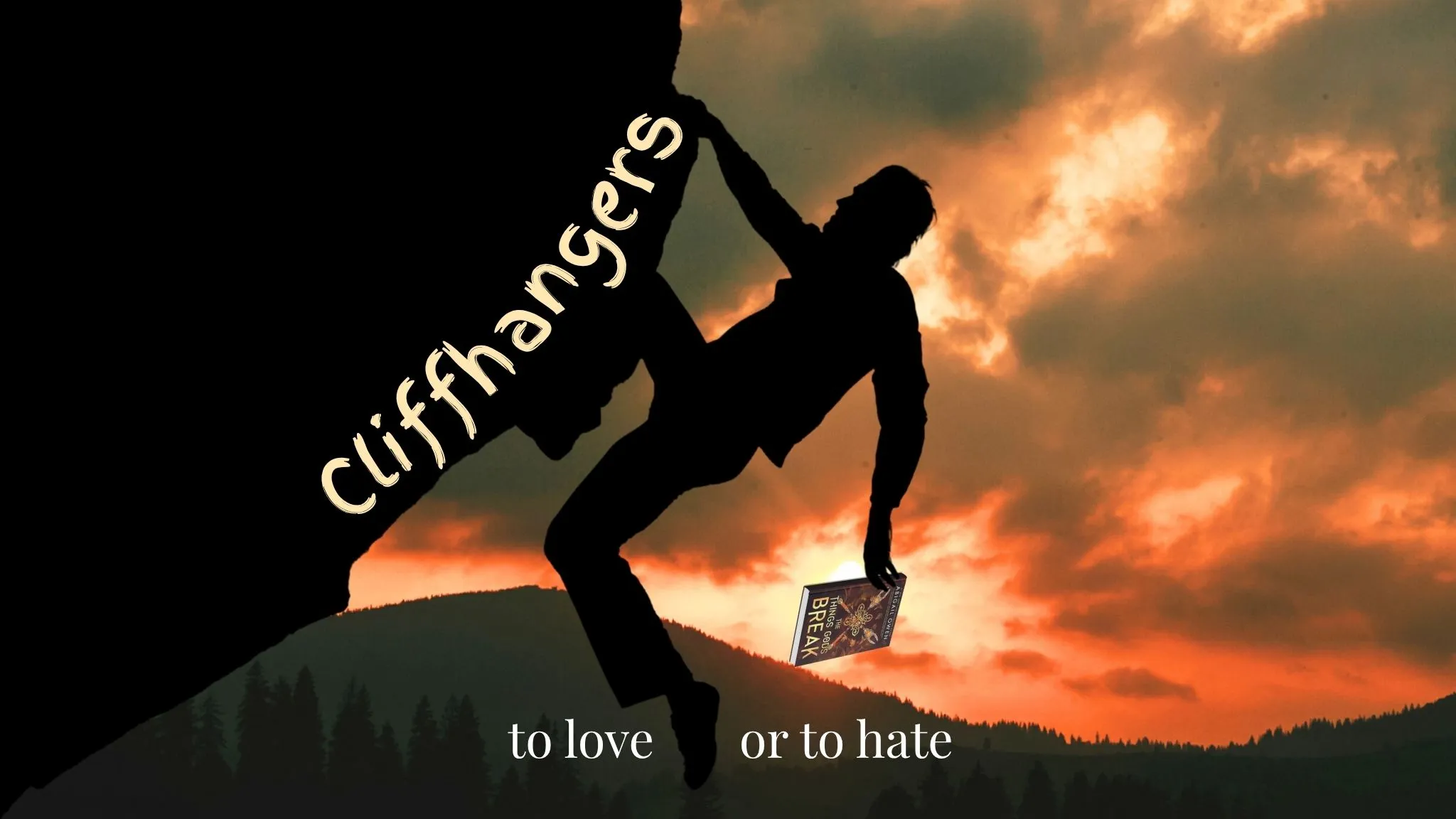
P.S. Fair warning: my latest release, The Things Gods Break, definitely ends on a cliffhanger. I mean, it’s book two in a trilogy. You know I had to do it. 😉