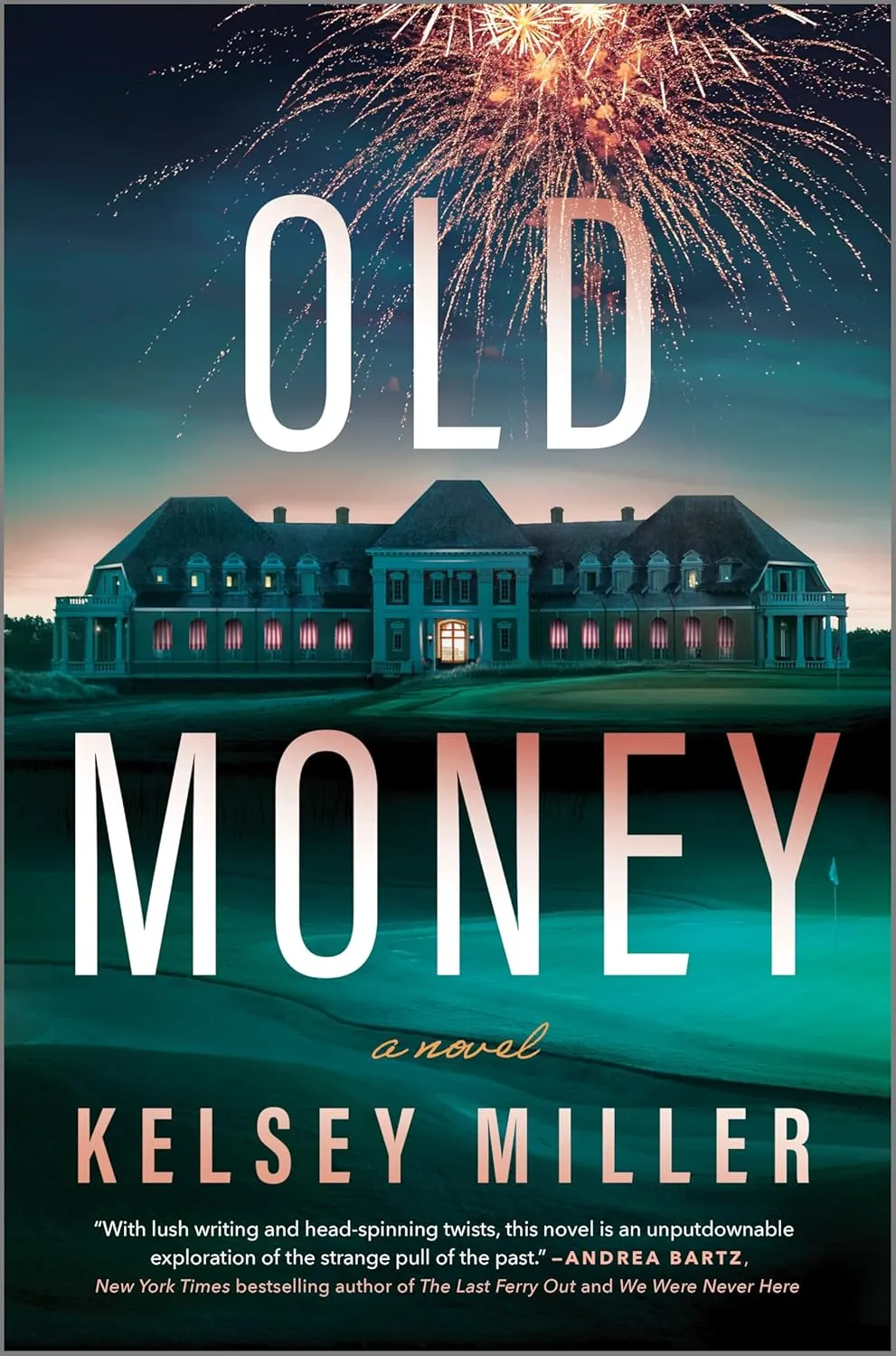
Old Money by Kelsey Miller
The truth is, everyone knew who killed Caitlin – everyone knew back then, too. It was a massive crime in a tiny village, and about two hundred of the most powerful residents were standing about ten yards away when it happened.
Twenty years ago, in the elite, idyllic, history-laden Hudson Valley village of Briar’s Green, a 16-year-old girl named Caitlin Dale was found beaten to death and floating in a swimming pool during a July Fourth celebration at the ultra-exclusive Horseman Club. Suspicion fell upon a young man named Patrick Yates III, the son of a senator and the great-grandson of a Vice President, but he was never even formally investigated: “Families like the Yateses didn’t face the same sort of consequences as everyone else.”
Alice Wiley has come home to remedy that.
In Kelsey Miller’s Old Money, Alice, then 11 years old, was the only witness to what happened that night to her cousin, but her account was swept under the rug. Now, on the twentieth anniversary of the murder, with the crime now the subject of a book, a miniseries and a podcast, interest has reawakened, and Alice has returned to the village to burn the place down. Metaphorically speaking, of course.
She has no idea what she’s gotten into. Determined to find the evidence she feels the police never sought, she digs into the town, the people, the country club, chasing down records, interviewing possible witnesses, concocting stories as she goes so that nobody realizes what she’s up to.
Oh, Alice. Once again, everybody knows.
And then someone else dies.
“You do have things to lose, Alice,” she is told. “Many things. Many people.”
If only she had listened.
“The first flickers of the idea came to me in 2019,” the author says, “when I was on a long flight home from St. Petersburg, Russia, where I’d been on a research trip. The trip itself had no influence on the book — it was for something else I was working on — but I think there’s something about flying home from an adventure that makes your mind get a little adventurous. At least, that’s the way I explain it to myself! I was sitting on a plane, thinking about the concept of nostalgia, and how profoundly it can shape our lives and our identities. Experiences become memories and memories become stories, and there’s huge power in the stories we tell about ourselves.
“I was also thinking about culture-wide nostalgia, and in particular, the fixation on certain old or unsolved crimes. There are some stories we just keep revisiting and re-telling, but of course, we’re not necessarily getting further clarity in the process. If anything, tragically, these stories often get more muddled in the retelling.
“I kept thinking about JonBenét Ramsey, whose murder had (and has) been covered in the media virtually nonstop since she was killed — even more in the months and years around the twentieth anniversary of her death. I’d certainly consumed some of that coverage, and yet, sitting there, I couldn’t think of a single hard fact about the case. Was it solved? Were they still investigating? Didn’t they have a suspect at some point? I had no idea. I could conjure her image instantly, but I only had a vague recollection of her actual story.
“I thought about what it must be like to be one of the ‘players’ in these stories that we fixate on for decades — especially if no one knows about your involvement. How strange it must be to try and navigate the world in that position. And what do you do with your story when everyone else is telling it?”
True crime does seem to be everywhere – books, documentaries, miniseries, shows like Dateline. Why does Miller think that is?
“Oof, I know there is a thoughtful, nuanced, psychologically informed answer to this question, but I think the short, messy version is that people enjoy the thrill of being horrified by something. Not all people, but a lot — the same way a lot of people like rollercoasters.
“There’s also an element of ‘there but for the grace of God go I.’ Virtually all of these true-crime stories start with an ordinary person with an ordinary job, living a life we can relate to. And something happens. The darkness descends. I think we all know in our guts that we have darkness within us, and so does everyone else in our lives. We’re all vulnerable to victimhood one way or another, and we’re probably also all capable of doing more harm than we realize. I think when we consume these true-crime stories, we’re kind of poking at that deep, dark knowledge inside us.”
Did she herself have experience with an enclave such as Briar’s Green or a place like the Horseman Club? With being one of the non-privileged “normies” of the town?
“Yes and no! I drew a great deal of atmosphere from the village of Sleepy Hollow, where I spent part of my childhood, and which does have a big, beautiful, historic country club. I drew upon it so much, in fact, that I made some very deliberate changes to the landscape when writing the story — mostly for my own sake. I needed to make it different enough that I wouldn’t feel hemmed in or beholden to the reality of this place while writing.
“Sleepy Hollow has its own storied history and lore, and the idea of tweaking it for my own purposes just felt wrong and not useful to the story I was telling anyway. Furthermore, there has never been a murder at that country club (as far as I know?). There has also never been a concierge or, to my knowledge, a butler there — at least probably not since the turn of the century.
“Aside from President Roosevelt, no one mentioned in my story has a real-life parallel. That includes Alice, although I certainly lent her plenty of my own life. Part of the reason she works as a personal assistant is that I did too, once upon a time. And yes, to a degree, I do relate to her experience of feeling like an outsider, but my family and upbringing were not the same as Alice’s. That’s another area where I made some very big, specific changes — which again, allowed me more freedom to use the similarities I did keep.
“I would also add that there are some circles where virtually everyone is walking around feeling like a ‘normie.’ If you’re in a room with a family like the Yateses — and of course, those families do exist — then pretty much everyone else feels some degree of insecurity. It changes the chemistry of the room (or the village, in the case of Briar’s Green), and you can’t really shake it off until you step outside of it. I think I learned that lesson a lot earlier than Alice.”
The same “yes and no” applies to Miller’s characters:
“There was a lot more of me in Alice when I first started hashing out the story. In the end, though, I found myself thinking about her like a dear old friend I’d drifted from but still loved — kind of like Susannah, actually [Alice’s onetime best friend]. I think I have commonalities with both of those women, for better or worse, and I have empathy for both of them.
“I admire Alice’s follow-through and her bone-deep sense of right and wrong. But I also relate to Susannah’s frustration with her, and her inability to just grow up and move on — or at least not punish others for doing so. I know there have been times in my life when I have been the Alice in the friendship, and other times when I have been the Susannah.”
And now she’s the author! This is actually Miller’s third book — both of the earlier works were nonfiction: a memoir and a book about the show Friends (“That’s absolutely what got me in this headspace — pondering the power of nostalgia and memory.”) And now, she feels the call of nonfiction once again:
“I’ll be honest, I really missed writing in my own voice! When I was in final revisions on this book, I noticed that my text messages were starting to read like mini humor essays — my nonfiction-writer brain was sneaking out. A friend would text me asking what time we should meet for lunch, and I’d send back three hundred words. It was ridiculous!
“So, for now, I’m enjoying writing actual essays and other short-form nonfiction work. I’m sure my book brain will start nudging me again sometime soon, though. Probably the next time I’m on an airplane. I just got my passport renewed, so we’ll see!”
About Kelsey Miller:
 Kelsey Miller is a journalist and the author of Big Girl: How I Gave Up Dieting and Got a Life. Her work has been featured in Glamour, Allure, Teen Vogue, Salon, People, Good Housekeeping, Women’s Health and other outlets. She is the founder of The Anti-Diet Project, one of Refinery29‘s most popular franchises, and was the recipient of the Project HEAL Social Impact Award. She lives in Brooklyn.