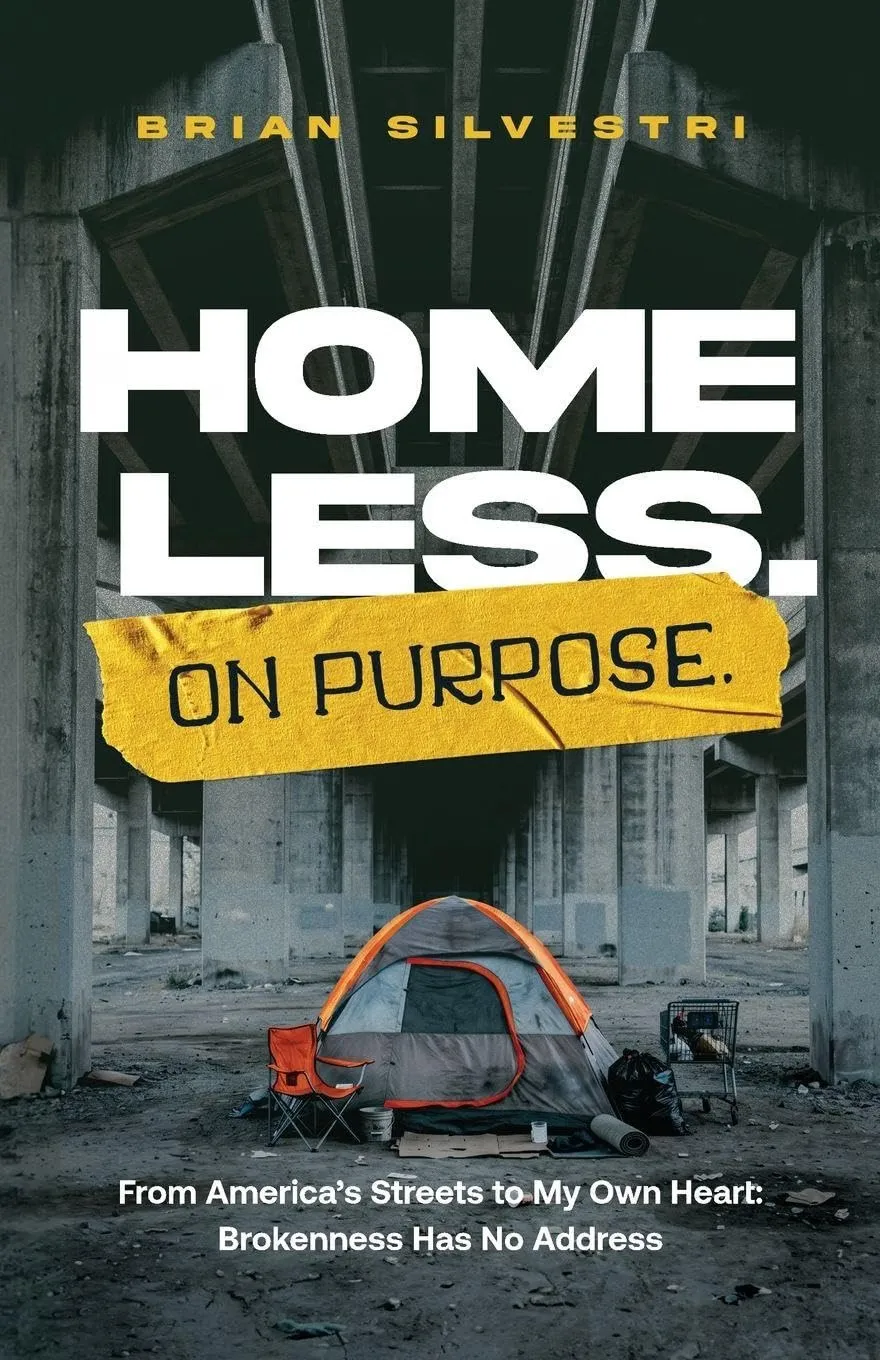
Homeless. On Purpose.: From America's Streets to My Own Heart: Brokenness Has No Address by Brian Silvestri
Some people end up on the street after losing a job. Some get there after a marriage falls apart. For others, illness, addiction or the loss of a loved one. Brian Silvestri spends nights on the street on purpose. Let us explain.
Early in Homeless. On Purpose., Silvestri is stopped at a Washington, D.C., traffic light beside a man holding a cardboard sign. He checks his door locks twice and keeps his eyes on the light. He has already decided what the man really needs is a job. He impatiently waits for a green arrow, and soon his discomfort will recede in the rearview mirror.
Fast forward to January 2020. Silvestri, an engineer and tech entrepreneur, joins a church outreach team in San Diego, where he spends five days and four nights on the streets. Pastor Will Cravens started the trips to find his high school friend Ed, who had become homeless and gone missing. When Cravens first asked for volunteers, he told the parable of the shepherd who leaves his flock to look for one lost sheep. By the time Silvestri signs up, Ed has been found, but the question remains. If it were you or someone you loved, who would come looking?
Who Needs Five Cups of Coffee?
Silvestri returns from his first trip and spots a man in a wheelchair outside a Starbucks. He buys him a coffee, figuring he can do a good deed and still make it to his next appointment on time. Then he notices the four cups already lined up beside the man’s chair.
So he crouches down and asks the man his name. Carlos tells him he was a jockey until a freight train struck him, leaving him paralyzed from the waist down. When Silvestri offers him five dollars, Carlos declines. What he’d wanted that morning was someone to talk to. Years later, the two still text every week and give each other grief about football. Silvestri says Carlos is now like a brother to him.
That first San Diego trip led to a twelve-city outreach project that began in Tampa in January 2021. At a Washington, D.C., encampment called Miriam’s Village, Silvestri sees how readily people there look after one another. When an older woman arrives, residents put up a tent for her in minutes. A woman named Lisa returns to her tent and brings out blankets and a pillow. Silvestri thinks about the rooms in his house that sit empty for months and wonders when he last did something for a neighbor.
In Tampa, Silvestri and his companions christen a patch of ground the Palm Branch Hotel. Then he finds dog poop on his shoe, and Steve discovers some on his sleeping bag. They laugh about it. Later, Silvestri lies awake, listening to every little sound and wondering how anyone could do this night after night.
The Lessons He Brings Home
Silvestri recounts encounters with more than 20 people living on the streets, whose stories show how differently people can come to experience homelessness. In Phoenix, Kevin tells him he used to look at people on the street and think they should get a job, too. Then he lost his own job during the pandemic and found out how hard it was to get back indoors.
In Chicago, Remi shows Silvestri how he and his neighbors built a winter shelter out of milk crates and stuffed them with old newspapers. Then he asks his visitor if he’d like a sandwich. A conversation about basketball leads a man named Dave to admit he once stole from churches and still believes God is punishing him for it. Silvestri is sure Dave can be forgiven. On the flight home, he wonders why he has a harder time believing that about himself.
After hearing men on the streets call themselves worthless, Silvestri begins to reckon with what he came to believe about himself when his father left. He was just three years old. He also recognizes how readily his own frustration turns into words his children might carry with them. In seeking to help others, Silvestri discovers how much the people he set out to help can teach him about fatherhood. There are many kinds of brokenness. Sometimes grace comes from the people we used to pass by.
Silvestri’s plainspoken storytelling has an immediacy to it. You can hear the indignation in Dave’s voice when Silvestri makes the mistake of asking if he’s a Cubs fan. (White Sox, emphatically.) Silvestri is good company, in part because he’s willing to be the butt of the joke. He’s just as willing to let us in on thoughts that put him in an unflattering light, like the ones he has while waiting for that green arrow. This candor also gives him room to think aloud about the difference between shame and guilt, and what happens when we confuse someone’s behavior with who they are.
Silvestri ends with a request. Once a week, give fifteen minutes to someone you’d ordinarily pass by. Ask their name and what their story is, then stay long enough to hear the answer. As Carlos could tell you, a conversation that starts in a parking lot can go on for years, and the stranger you stopped to talk to can become family.
About Brian Silvestri
 Brian Silvestri is a successful business owner, entrepreneur, husband and devoted father of two young adults. With a degree in electrical engineering, Brian has a passion for researching, collaborating and solving complex business challenges. Beyond the corporate world, he is driven by a deep conviction that with compassion, the right heart and Jesus, we can change the trajectory of homelessness and brokenness in America and throughout the world. Brian calls Florida his home, enjoying the beach and walks with his wife of over 25 years.