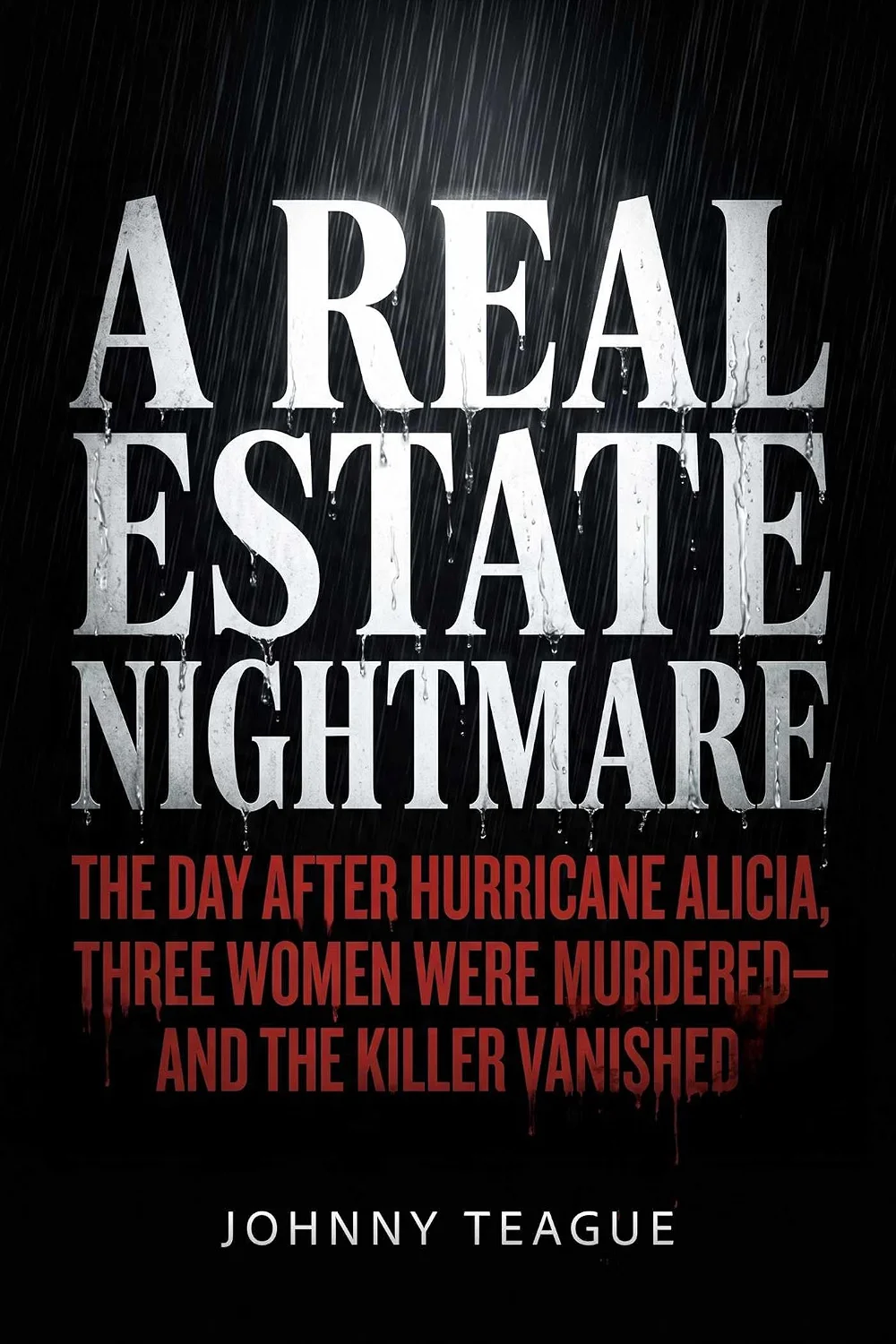
A Real Estate Nightmare: The Day After Hurricane Alicia, Three Women Were Murdered—and the Killer Vanished by Johnny Teague
A wedding ring tucked beneath a couch cushion. A fortune in jewelry hidden in a wastebasket. Three bullets bearing the same letter. These are some of the details Houston detectives had to work with after three women were shot at a real estate office in August 1983. More than 40 years later, their families are still waiting for someone to explain how the pieces fit together.
In A Real Estate Nightmare, Johnny Teague follows the investigation from its first evening through decades of promising leads and missed opportunities. The day before the killings, Hurricane Alicia had battered Houston. On August 19, as the city began recovering, Elizabeth Shumate, Frances Ivey and JoAnn Brown went to the Shumate and Company office on Memorial Drive. That evening, a colleague found them shot. Two were dead; the third would die at the hospital.
A Murder Scene Full of Contradictions
Almost every discovery creates another problem. The office has been ransacked, but substantial valuables remain. Only one woman has been bound. Bullets from two different guns raise a question: were there multiple attackers, or one person carrying two weapons? An appointment recorded under the name of an untraceable pool company suggests someone may have arranged an after-hours meeting.
And then there are those bullets, marked with the letter “A.” What does it signify? An initial? A message? Each interpretation sends the detectives looking in a different direction.
Financial difficulties and troubled marriages draw scrutiny. Other leads take the investigation into prisons and federal witness protection. An anonymous note directs detectives to a buried container supposedly holding evidence. They find the container exactly where the writer said it would be. It is empty.
Teague keeps returning to certain clues, keeps examining the same pieces, as if he’s hoping, this time, we’ll see what was missed.
A Tireless Search for Answers
Homicide detective Mike Phillips gives us someone to follow through all those false starts. Teague stays close to his perspective, tracing suspicions that follow him home and his guilt over a missed opportunity to collect potentially crucial evidence. At a family celebration, his wife Sandy finds him standing in the pantry, unable to fetch the napkins. His thoughts return to the office on Memorial Drive.
Sandy is also a police officer, and their shared understanding allows for both difficult conversations and comfortable silence. Phillips’s partnership with Jake Tanner provides another source of support, along with some welcome humor. These men call donuts “Power Rings.” A trip to appear on Oprah produces an ordeal involving stage makeup that Phillips’s wife and partner enjoy considerably more than he does.
Such episodes give the book a conversational ease. Teague also makes Phillips’s reasoning accessible through familiar comparisons: having several plausible suspects, for instance, becomes a football team’s inability to settle on a quarterback. Prayer enters more private moments, especially when Phillips confronts his own failures and what they may have cost the families.
The strongest emotional material comes through JoAnn’s daughter Patty. Her recollections of her mother’s marriage give a frightening context to objects later found in JoAnn’s bedroom: a knife, a chair positioned to secure the door, a hammer beneath the pillow. Here was a woman making plans to leave — and taking precautions to survive until she could.
A Word of Caution: A Theory Is Not a Verdict
Reconstructed conversations and private thoughts give this true crime account the immediacy of fiction, with scenes that read like a dramatic reenactment rather than a conventional investigative report. Teague also acknowledges changing some names and identifying details, and the later reconstruction of the killings remains a hypothesis. His closing insistence on the suspects’ presumption of innocence is a necessary reminder after so many pages spent weighing their possible involvement. Nevertheless, there are some very compelling theories worth considering.
The murders remain unsolved. Perhaps someone, somewhere, will read this book, realize they have crucial evidence, and come forward. In the meantime, on his study wall, amid commendations, newspaper articles and photographs connected to cases he solved, Phillips reserves a blank space for the day the case closes. A Real Estate Nightmare asks us to consider what it would take, even now, to fill it.
About Johnny Teague
 Dr. Johnny Teague is a pastor, historian, author, and patented inventor. He’s written six books, including Preaching Your Way Out of a Mess (Preaching Magazine’s 2019 Book of the Year) and the acclaimed Lost Diary series. His titles on Anne Frank, George Washington and Mary Magdalene have earned honors from the Association for Jewish Studies, the Goethe Book Awards and Readers’ Choice. When not writing or preaching, he raises Black Angus cattle on his Texas ranch.