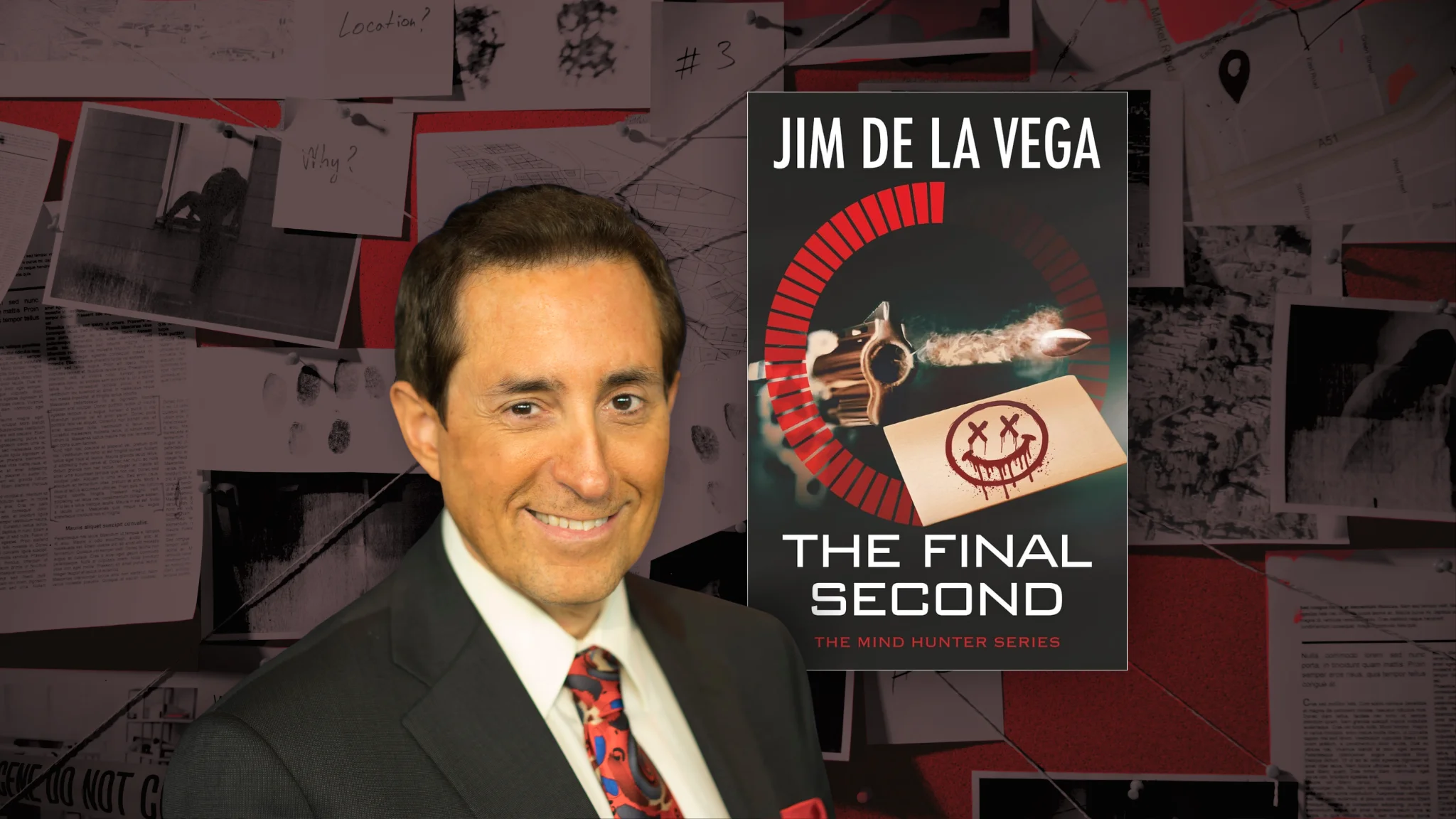
What happens when a convicted serial killer is executed, only for another murder to suggest the real killer is still on the loose? In The Final Second, the second installment of his Mind Hunter series, author and crime reporter Jim De La Vega delivers a psychological thriller filled with deadly mind games, shocking twists and buried family secrets. Drawing on his years of experience covering crimes and interviewing serial killers, De La Vega brings authenticity to the story of forensic psychologist Cassidy Chord as she races to outsmart a ruthless murderer. In this Q&A, De La Vega discusses the inspiration behind the novel and the complexities of criminal psychology.
The Final Second opens with the execution of Eddie Ray Calhoone, a man convicted of being the notorious Blood Smile Killer, only for another murder to occur almost immediately afterward. What inspired you to begin the novel with such a shocking twist?
As a veteran reporter, I’ve covered strange cases, including one in which a person was executed and later exonerated when someone confessed to the crime and provided proof that they had committed it. That happened several weeks after the execution. For this book, I sped up the process.
Cassidy Chord is a brilliant forensic psychologist who has endured tremendous personal trauma. How have her experiences shaped her approach to investigating criminals?
She’s had a hard life, from her childhood to serving in the Army in war zones. So, when bad things happen, she isn’t devastated by them. She’s learned that she can get through anything if she’s smart enough and determined enough to keep going.
Cassidy and her brother, Sheriff Parker Chord, have been estranged for years when the Blood Smile Killer case brings them back together. Why was it important to incorporate their complicated family relationship into the story, and how does their shared history influence their investigation?
Because of Cassidy’s profession, it would have made sense for her brother to contact her when they first started chasing the Blood Smile Killer. But Parker still sees his sister as a little girl, and he remembers the message their parents drilled into his head: “Always protect your little sister.” That’s part of the reason he had kept her away from the case.
The Blood Smile Killer, known as Grin, leaves behind disturbing signatures, cryptic poems, and elaborate psychological clues. How did you develop the killer’s methods and personality, and what interested you most about exploring the mind of someone who views murder as both a performance and a game?
As a veteran crime reporter, I’ve covered serial killers and other criminals across the country. I’ve also talked to a number of serial killers and found that they are anything but black-and-white, as they often appear in books, movies, and TV shows. The smarter ones are by far the scariest because they can look and act so normal.
Throughout the novel, investigators rely on forensic evidence, criminal profiling, and psychological analysis, yet they repeatedly find themselves outmaneuvered. What kind of research went into portraying these investigative techniques, and how did you balance their technical aspects with the fast-paced suspense?
I wanted to put Cassidy up against someone every bit as smart as she is. This is someone who has manipulated a task force into arresting and executing an innocent man. Plus, this person has been doing this for more than five years and therefore has a huge lead over Cassidy.
Jessica Diaz, a television reporter with personal ties to the original investigation, becomes increasingly involved in the case. What inspired you to introduce a journalist’s perspective, and what role does the media play in shaping public perception and influencing investigations?
I became a reporter at the age of 14, and most of my experience has been in TV news. Plus, my wife is the evening anchor at CBS 47. Her name is Kathryn Herr, and she is the intellectual model I used to create Cassidy. As I was writing the book, I kept thinking about what would be happening in the newsroom. The only way for me to find out was to write the scenes and see for myself.
The Final Second is the second installment in your Mind Hunter series, following Cassidy Chord’s experiences in Gone in Three Seconds. How did you approach developing Cassidy further in this novel, and what can readers expect from her as the series continues?
This novel explores her origins and shows aspects of her upbringing in the South. She’s from Putnam County, Georgia, as am I. In fact, her father lives where my parents used to live.