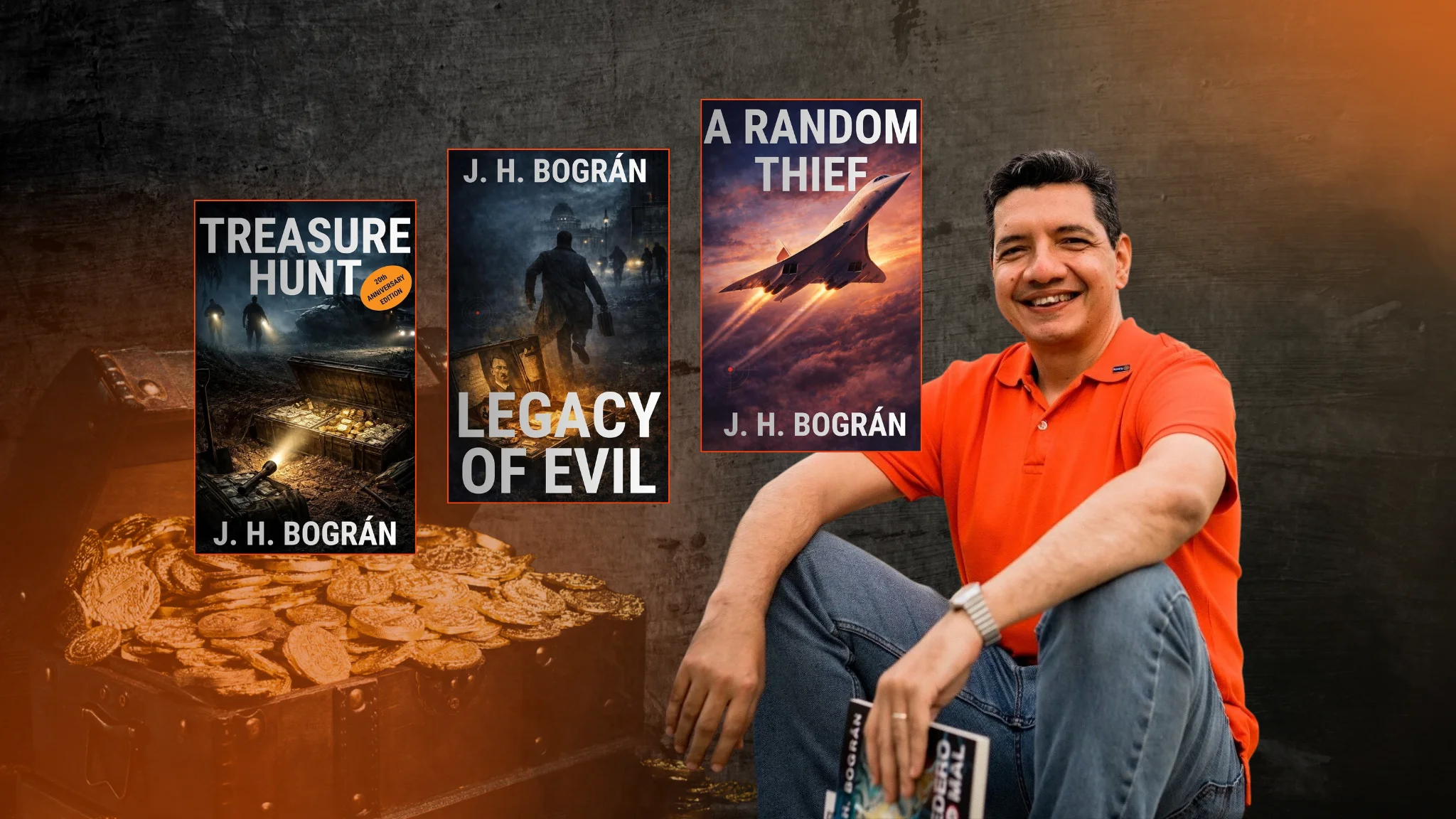
Twenty years after Treasure Hunt first introduced readers to the enigmatic Falcon, author J.H. Bográn is returning to the series that launched his career with both a milestone anniversary and a new adventure. What began as a debut inspired by a real-life hijacking has grown into The Falcon Chronicles, an action-packed series spanning Treasure Hunt, Legacy of Evil and A Random Thief. In this Q&A, Bográn reflects on how he has evolved as a writer over the past two decades, the literary influences that shaped each installment and why he continues to return to the Falcon — a character who, after all these years, still has plenty of trouble left to find.
Treasure Hunt is celebrating its 20th anniversary. Looking back at your debut novel two decades later, what stands out to you most about the writer you were when you first created the story?
The most surprising thing to me was the bravado. That younger writer who dared to do something very difficult: to succeed at publishing while writing in a second language. The other thing that stands out is the craft, or rather, the struggle with it. I remember my first editor complaining about head-jumping and confusing POVs while I stared back uncomprehending. When I read that book again earlier this year, I found myself recalling such conversations, and I’m happy to report I now could see what she meant.
When you wrote Treasure Hunt, did you already envision it becoming the beginning of a series, or did The Falcon Chronicles develop naturally as you continued exploring the characters and their world?
“Envision” is a strong word. Let’s say that I hoped it would become one. It was clear to me that the future of The Falcon (my main character) would depend on the readers’ response. The series has had a long and winding road to publication; for a third entry in the series to appear on the debut’s twentieth anniversary is short of an understatement. However, Falcon made the occasional appearance in other books—think of him as a “guest star” in a TV show—or in short stories. The truth is, the man has been around.
What inspired the central premise of Treasure Hunt, and why do you think the story has continued to resonate with you enough to revisit it for a 20th anniversary edition?
The opening plot of a man hijacking a commercial flight to demand ransom was based on real events. The most famous is, of course, D. B. Cooper, but a fellow Honduran actually pulled the same stunt in the late 70s. He parachuted off the coast and hid inside a cave. To this day, when you visit the cave, the tour guides mention the legend that perhaps money is still hidden there. I figured that story could work as the vehicle for The Falcon. It began with the “What if the man wants to get the money back after coming out of prison?”
Legacy of Evil gave you the opportunity to return to the world you established in Treasure Hunt. What did you want to expand, deepen or approach differently in the second installment?
I usually comment that I wrote Treasure Hunt during my Clive Cussler period, all with a prologue setting up a mystery from the past to impact the present. Now, Legacy of Evil was perhaps during my Tom Clancy period, with its high concept (a man being told he’s the grandson of Adolf Hitler, then running for his life), but also one of his novels in particular. Clear and Present Danger is technically a Jack Ryan story, but it surprised me the first time I read it that Jack Ryan was barely in it. Legacy of Evil has that quality; the Falcon makes few appearances, but it’s a Falcon Chronicle because his actions definitely impact the end of the story.
With A Random Thief, you reached the third book in The Falcon Chronicles. How have the characters, themes and stakes evolved across the three novels?
The author has grown old, but The Falcon has barely aged since I set the story in 2003, just two years after the events of Legacy of Evil. This version of the character shows more stamina. Being the smartest man in the room isn’t enough to save the day aboard the Concorde, and he has to resort to some physical confrontations.
Every book is an adventure, a different one, and I like that episodic feel like for an adventure series.
How do you maintain continuity across The Falcon Chronicles while giving each novel its own identity?
One time I got to interview Lee Child and asked him a similar question about continuity with Jack Reacher. I liked his answer so much that I’m definitely going to paraphrase it: the character feels real to me, and you remember what happened to them the same way you remember your brother breaking his nose in high school. It’s not as much as you remember, but you know the character’s history.
After spending 20 years with Treasure Hunt and continuing its legacy through Legacy of Evil and A Random Thief, what does The Falcon Chronicles mean to you today, and where do you hope to take the series next?
I always have fun writing The Falcon Chronicles, and I can only hope readers feel the same way when they get to enjoy my stories. I have other stories featuring the Falcon, and I will continue to visit him from time to time. You know, to check on him and see what kind of trouble he’s been in lately.