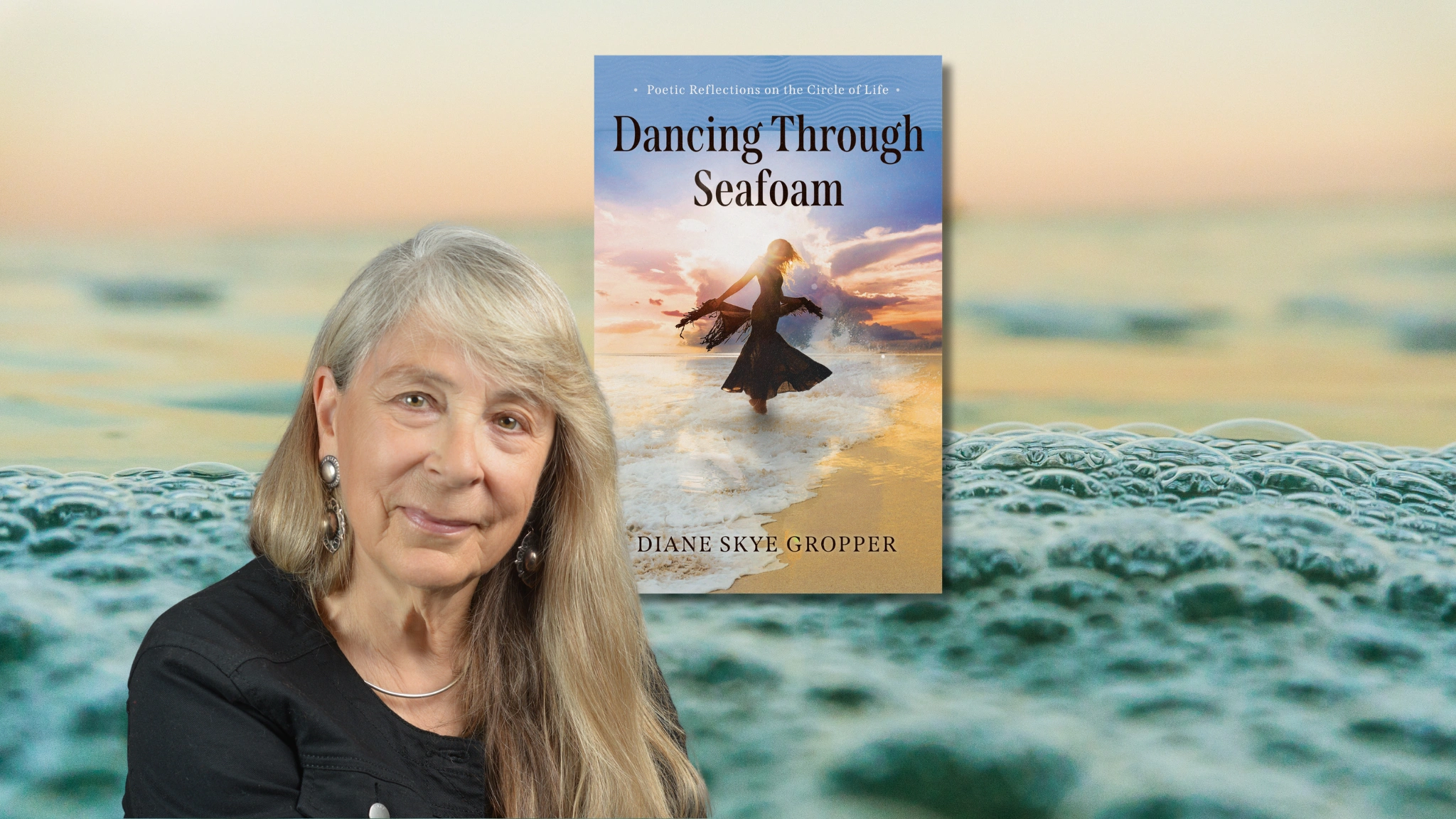
In Dancing Through Seafoam, poet Diane Skye Gropper explores the fleeting nature of life through a personal and spiritual lens. Drawing on decades of studying Buddhism, Native American teachings and other spiritual traditions, Gropper reflects on love, loss, past lives, healing and the connections that endure beyond a single lifetime. In this conversation, she discusses how poetry and spirituality came together in her work, the poignant story behind the collection’s title, and how her poems move from intimate experiences to larger questions about humanity, our purpose and the time we are given.
Dancing Through Seafoam is a personal collection, drawing on your experiences in this life as well as memories of past lives. What made you decide that poetry was the right form for sharing such personal and spiritual experiences?
I didn’t really make a formal decision that poetry was the right form for sharing my personal and spiritual experiences. It just happened that way. To me, poetry is a particularly elevated, ethereal and even magical form of writing, so it is perfectly suited to the elevated, ethereal and magical world of spirituality. Let me back up for a moment and provide some background: I’ve been writing personally and professionally for my entire life, and as part of that I’ve been reading and writing poetry for many years. Meanwhile, I have been studying Buddhism, Native American teachings and other spiritual paths for 40-plus years. So it was very natural for these two streams of experience in my life — poetry plus spirituality — to come together in this collection.
You describe life as a “dance through the seafoam,” something beautiful but fleeting that can disappear almost as quickly as it forms. How did that image come to you, and when did you realize it would become the title and central metaphor of the collection?
The phrase “dancing through seafoam” actually came from a poem in the collection about a child of mine who died — see “In Absentia.” In it, I write that in my dreams, I often see this child (she was a girl) dancing like a gypsy through the seafoam on Cape Cod—one of my favorite places on earth where my family and I have spent a great deal of time. As I put the book together, it occurred to me that this is an apt metaphor for the multiple lives we live, according to Buddhist, Native American and other spiritual paths. All these paths teach that we travel the circle of life not once, but many, many times, taking on a new identity in each life so we can learn and grow and inch our way up the evolutionary spiral towards enlightenment. Each life, however, goes by in the blink of an eye, like a dance through the seafoam that disappears almost as fast as it forms along the seashore. One moment it is, and you are there—and the next both are gone. To my mind, this was the title and central theme that the book was looking for.
Your spiritual perspective has been shaped by more than 35 years of studying Buddhism and other spiritual paths. How has that journey changed not only what you write about, but the way you approach writing itself?
My ongoing spiritual studies have not changed my writing or the way that I approach it. But these studies have changed me—and continue to do so—and that evolution has naturally expressed itself in my writing. Buddhism, in particular, has provided me with an entirely new perspective on humanity’s perennial dysfunctionality as well as on the family and personal difficulties I have experienced in my life. As Buddhism describes it, we are all stewing in the pot of what’s known as samsara—an endless cycle of rebirth, suffering and death that all beings travel again and again. Our job as souls is to use each life we are given to learn and grow and further our evolutionary standing so that we can pull ourselves out of samsara by reaching enlightenment, where we can help others do the same. This is the extraordinary potentiality—the shimmering diamond—that each of us holds within, and it is up to each of us to access it. That perspective has helped to give me a mission in life, and as part of that mission, I’ve chosen to share my spiritual experiences and insights with others through my poetry.
The book is divided into three sections, moving from personal connections to spiritual lessons and to concerns about humanity and the planet. How did you arrive at that structure, and what journey did you hope readers would experience as they moved through it?
Interestingly, the poems I wrote for this book naturally fell into those three groups. When I stepped back to look at them as a whole, it was quite striking, and grouping the poems as such enhanced the impact of each section by connecting and building upon the power of each poem in the section. But at the same time, the review that BookTrib wrote of my book really hit it on the head when it noted that this collection “moves” through three sections that “gradually widen its scope from the personal to the global.” I wanted my readers to feel a sense of movement or momentum in the book—a sense that the book was going somewhere—that would keep them plugged in and motivated to finish reading it. In addition, I wanted the collection to be relatable, to have relevance to the reader’s everyday life—something that today’s poetry often lacks due to excessive abstractness. Moving from the “personal to the global” accomplished both these ends.
Love, loss and the enduring connections between souls recur throughout the collection. How has writing poetry helped you understand or heal relationships that were complicated or unfinished?
Writing about things—i.e., the process of getting things down on paper, so to speak—can be very healing, whether poetry is the form of writing or not. That’s why journaling can be such an effective healing technique. In this collection, the poems I wrote about my father (“The Falconer”) and my mother (“Sierra Madre”), among others, helped me close out some long-standing emotional loose ends. But what has really helped me understand and heal relationships, past and present, is the spiritual study that informs my poetry writing in this collection. Like all of us, I am sometimes hurt or disappointed (or worse) by what people in my life or people more generally say and do. But I have learned to step back to remember three basic spiritual truths: We are all subject to samsara; we all make the best decisions we can—or perhaps the only decisions we can—in light of where we stand in our personal evolution; and everything that happens, including world events, is meant to occur. As one of my Buddhist teachers puts it: “Let go of the thought that things should be anything other than exactly what they are.” When I keep these truths in mind, it diminishes the pain of what is happening and helps me accept, heal and move on. I do not naively assume that everything in my personal life or on the world stage will turn out okay. Things may well not turn out to be okay. But if that is the case, it was meant to be as a means of learning.
After readers finish Dancing Through Seafoam, what do you most hope they will see differently about their own lives, relationships and time here?
I certainly do not expect to change the spiritual and religious views that people hold and honestly have no interest in doing so. I do hope, however, that my readers are inspired by the powerful themes and language and emotion of my poetry and that they feel bigger and better for having read it. I am also told that my poetry has an evocative, uplifting quality that I hope is an antidote to the discord and darkness of today’s world. As I often say, you don’t have to be a Buddhist or believe in multiple lives or even be spiritual to connect with my poetry. You just need to be alive.