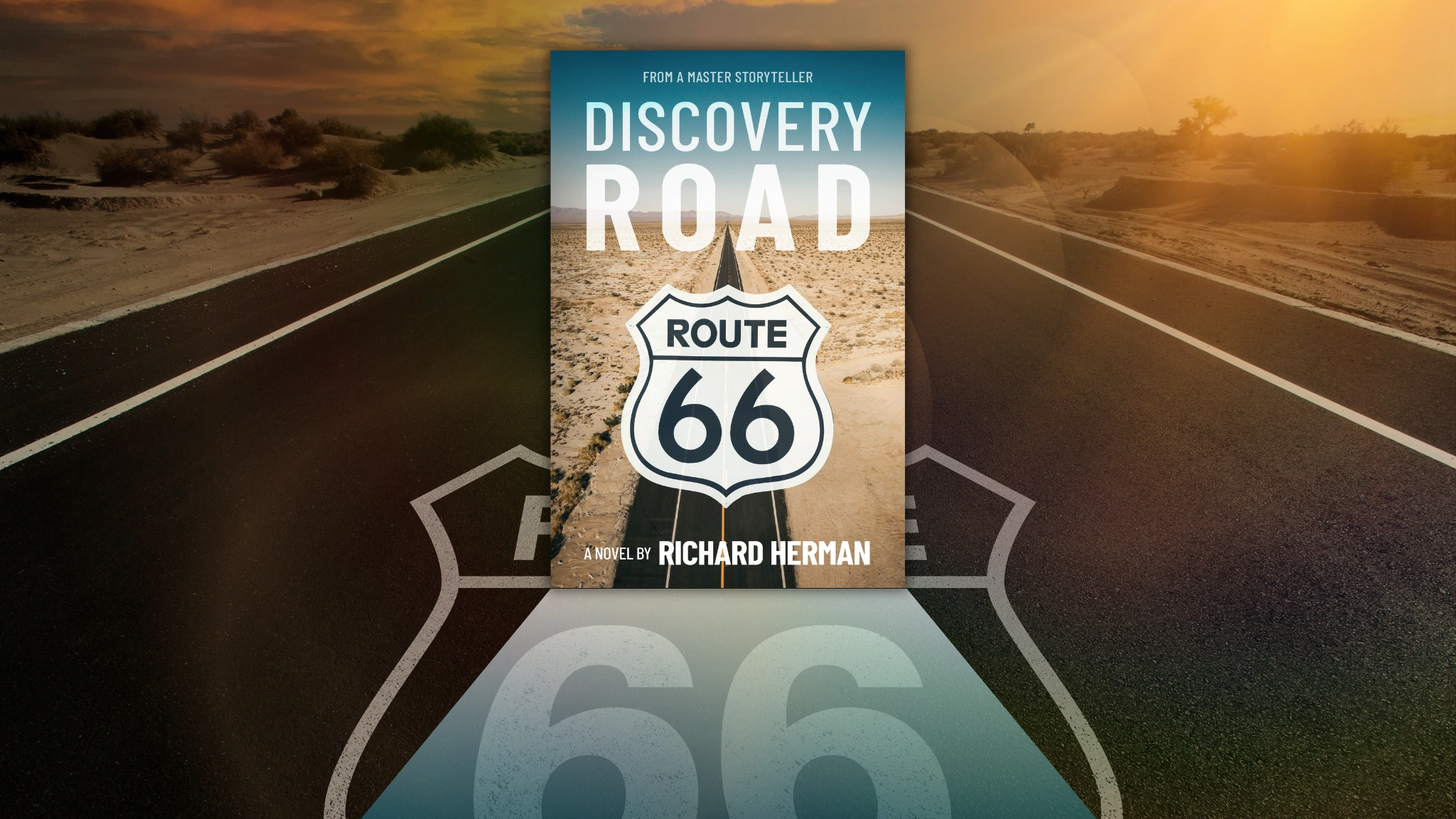
For author Richard Herman, a lifetime of adventure has provided no shortage of inspiration. After 21 years in the Air Force and 242 combat missions in Vietnam, Herman turned to fiction, launching a writing career with the national bestseller The Warbirds. Since then, his experiences in the cockpit, on the water and on the open road have continued to shape his storytelling. His latest novel, Discovery Road, was inspired by a 2,200-mile journey along Route 66 — traveled “the wrong way,” from Los Angeles to Chicago. In this Q&A, Herman reflects on the experiences that made him a writer, the characters who have stayed with him and the unforgettable road trip that helped him finally write the story he had always wanted to tell.
What first inspired you to become a writer?
I had just retired from the Air Force after serving 21 years. The economy was in the doldrums, the airlines were not hiring, and I was surprised to learn that there is not a big demand for aerial assassins. My wife said that I had fantasized about writing a novel, so why didn’t I give it a try? I sat down and went to work while she found a job in a local art store and used her English accent to palm off the inventory on unsuspecting Sacramento citizens. Eighteen months later, I typed The End to The Warbirds. It was the way I said goodbye to the Air Force and the F-4 Phantom fighter jet.
It took four years to find a publisher, and much to my surprise, it was a national best seller. Talk about inspiration!
What’s something about you that people might be surprised to learn?
Most folks would be surprised to learn that I am spring-loaded to the aggressive position when things go wrong. Without a doubt, it was a factor in surviving 242 combat missions in Vietnam, but it can be troublesome in civilian life. It does play a role in my writing, and when a scene is not working, or the plot is falling apart, I hit the delete key with gusto. Then an overpowering urge to fix it kicks in. The fallout has led to some interesting results, and as a result, I never quite fit into an established genre. When the fix is producing a good story, I let it develop, regardless of where it takes me.
I have mellowed with age and often wonder what could have been if I had cooled my jets at a few critical junctures, like when I had been diddled in a publishing contract. But that’s another story.
Which of your characters do you relate to the most, and why?
Without doubt, the character I most relate to is Jack Locke, the protagonist in The Warbirds. He is the archetype of the “all stick, rudder, and balls, but no forehead” fighter pilot image of Top Gun. He is incredibly good in combat but a disaster in normal life. In one respect, he’s all that I hoped to be but couldn’t even come close to. The irony is that there are fighter pilots like him that we need when the shooting starts. The problem is what to do with them when they are not needed in peacetime. The Warbirds is a search for the answer.
What experiences in your own life have influenced your writing?
Years ago, I remember reading that “Experiences are the essence of life.” I was young and dumb at the time and thought it was a trivial statement. Time has since proven it was not trivial but a statement of the obvious, and experiences flying a variety of aircraft have shaped my writing and given it purpose.
I did not want to just tell a tale of flying but of the stresses, fear, and agony that claimed everyone who is involved. It is not just the aircrews but also the people who made it happen. I remember too well sweating out a mission when the folks on the ground were doing their best to end my day, probably because I had just dropped a bomb on them. Or the worry of a young crew chief from Alabama that we would bring his aircraft back in one piece. Or the agony of a wife learning her husband was not coming home.
But there were moments of sheer joy, and I will never forget bringing a battle-damaged C-130 back to the States and landing at Hickam Air Force Base at Pearl Harbor as the sun rose, framing the memorial to the Battleship Arizona.
One of the joys of writing is doing research and learning of the experiences that framed the lives of so many others. It is a learning experience in itself to listen to the events that marked so many lives. No one can match the bravery of a young Jewish pilot who spent eighteen months in a Nazi POW camp in WWII or the skill of a twenty-year-old English lad flying a Mosquito fighter-bomber against a Gestapo headquarters. As a storyteller, I tried to make that all come alive and not fade away, lost in a history book.
What do you enjoy doing when you’re not writing?
I can never fully escape the writing life and enjoy reading a well-told tale. Any new book about Winston Churchill or T. E. Lawrence will capture my attention in a heartbeat. For years, I vacationed on a small sailboat, cruising the Pacific Northwest with my sailing buddies. After one “sporting” day on the water, someone mentioned Ulysses and The Odyssey, and that led to Caly’s Island. It is a tale of five geezers sailing the Pacific Northwest in their small sailboats. Things get interesting when they get caught in their own Odyssey. Of course, no modern fantasy would be complete without a boy and his dog.
I love classic cars and have restored a 1967 Austin-Healey, a 1971 VW Bug convertible, and a 1968 Austin Mini. But advancing years have ended my sailing days and playing with cars. Life took a different turn after Covid-19 ended, and my wife and I started cruising the western U.S. in a small van. In 2023, we explored Highway 66. But we did it backwards, traveling from Los Angeles to Chicago. Needless to say, that journey struck a few sparks. But more on this later.
If you could have dinner with any author, living or dead, who would it be?
I have a vision of sitting down to dinner with Wallace Stegner, who passed away in 1993. He was eighty-four and was in an auto accident. Not the best way to go, but I would prefer that to dribbling away with the Big A. Stegner has been described as “the king of Western writers,” and he was. He also gave meaning to creative writing, which he taught at Stanford University for years. The number of authors he influenced was impressive.
My introduction to Stegner started with Angle of Repose. In many ways he low-keyed the narrative, but he never lost his way and ended up in a strange place. I know he certainly influenced my writing.
I hope I could ask enough questions to discover how he made the transition from Westerns to Crossing to Safety, one of my favorite novels. I suspect it is strongly autobiographical, but I have never researched that. But to say he knocked it out of the park is a classic understatement.
Questions—oh, do I have questions. But regardless of the answers, it would be a dinner for the ages. Talk about an experience!
What’s something you’re passionate about that you haven’t had a chance to write about yet?
I cannot count the times I’ve been asked about the novel I always wanted to write but haven’t. I love to travel and, given half an excuse, will hit the road in the blink of an eye, and I always wanted to write the great American novel about Route 66. Yeah, right. John Steinbeck, I’m not. One of my writing buddies was lamenting about opportunities lost, and I decided to do something about it. So I went to work on Discovery Road. But first, I had to experience the reality of the Mother Road. My wife and I loaded our van and turned onto the highway just outside Los Angeles. Ten days later, we stopped just outside Chicago. All the travelogs and few stories about Route 66 go east to west. We had driven over 2200 miles the wrong way. And I had the story I always wanted to write.
It’s a pithy tale of an ex-convict and her nine-year-old daughter thrown together with a failed college professor in a small van as they make their way to Chicago on Route 66. I threw in a pet snake to complicate matters. And what happens to them! And like Stegner, I was in a far different place than in The Warbirds.
It has been a fantastic journey, and it took two years before I could write “The End.” Now, when asked about the story I always wanted to write, I just smile.