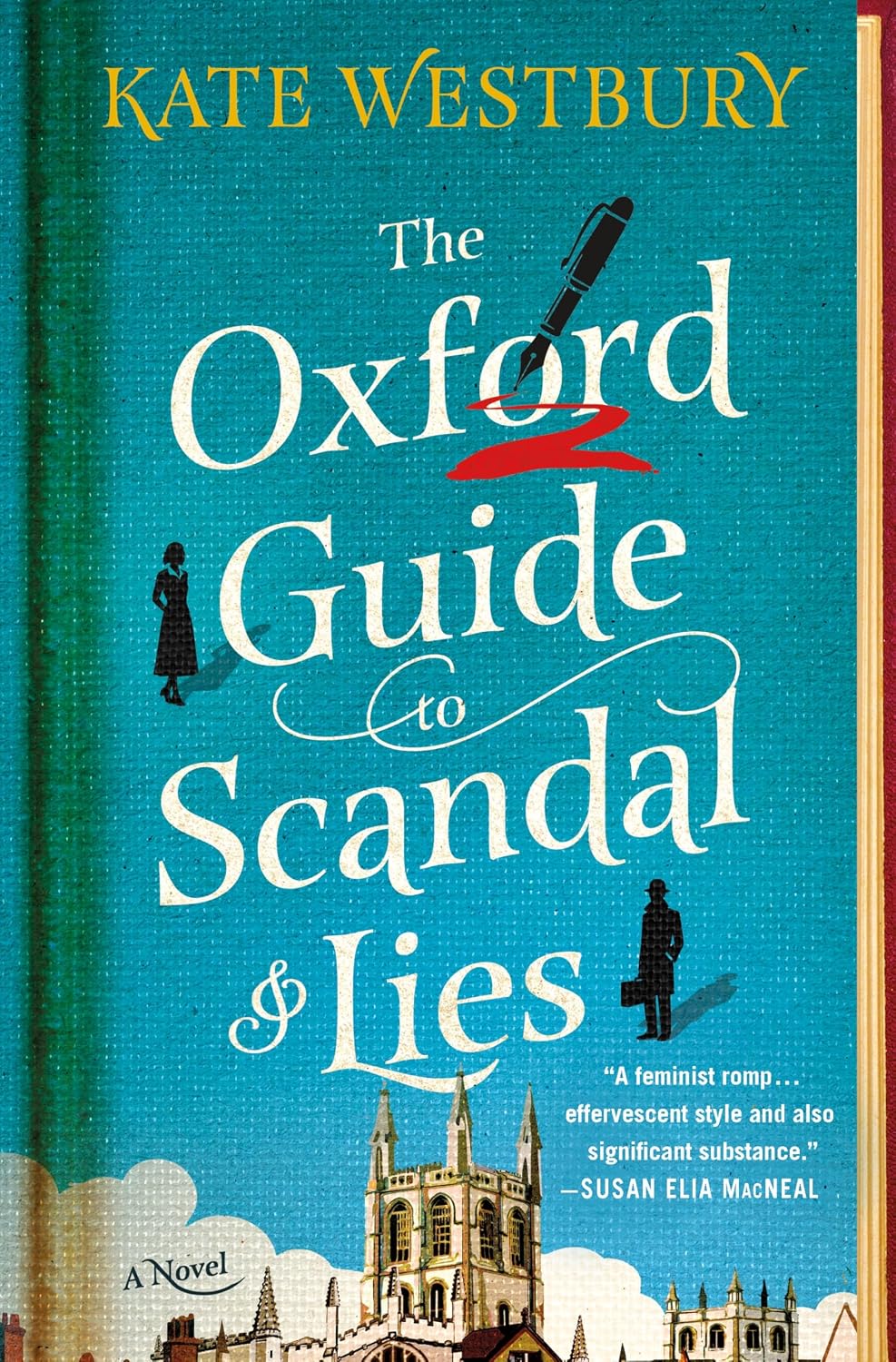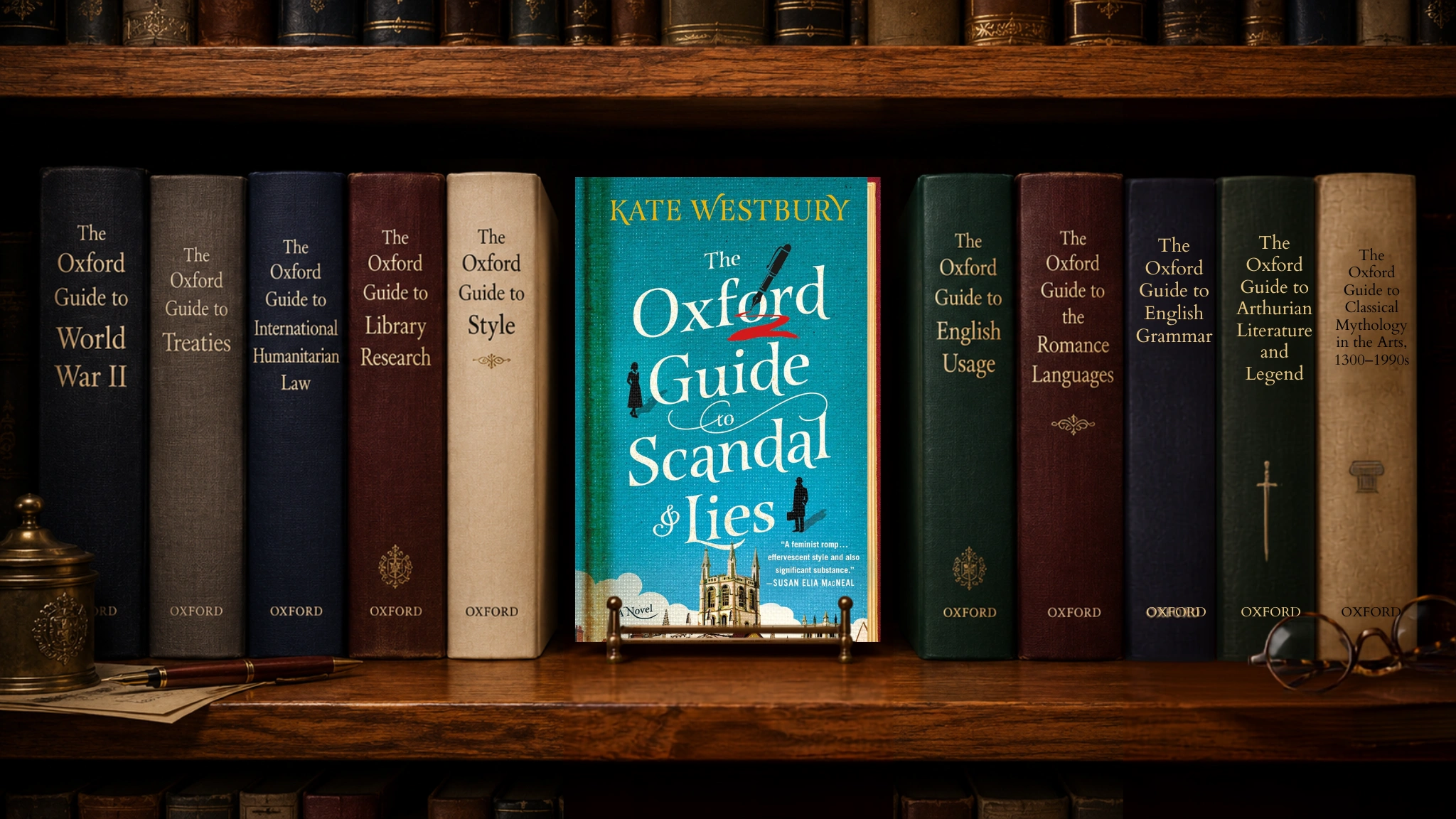
The Oxford Guide to Scandal and Lies by Kate Westbury
Desperate men are the most dangerous men of all.
Oxford University, November 1950. In Kate Westbury’s The Oxford Guide to Scandal and Lies, two students clash over a library carrel, an experience unpleasant enough that neither is likely to want to repeat the encounter. Especially when the encounter is over a dead man. But there we are.
First-year Ginerva Bishop, 22, comes from a privileged family and her life would seem golden, except that her mother is dead, her father is indebted, and, to save the family, she’s being pushed to marry a Duke’s son, a prospect she abhors.
Second-year Sidney Braithwaite, 26, is a miner’s son whose two years of intelligence work in France during the war, and the death there of the woman he loved, still give him nightmares.
One is curious, impulsive and intuitive; the other is cautious and scarred, but what brings them together is the heart attack that laid out a man who intersected both their lives, a school librarian named Tolliver, who turns out to be an intelligence agent investigating reports of a Soviet spy. And it wasn’t a heart attack. It was cyanide.
Sidney has the experience and knowledge. Ginerva possesses the knack of charming people and, to Sidney’s surprise, some unexpected skills, such as lockpicking. The result is that they get along like … well, they don’t:
Sidney: “You’ve got to come at this slowly. Move too fast, and you’ll show your hand.”
Ginerva: “Move too slowly, and you’ll never have a hand worth playing.”
But they are yoked together by circumstance, so move they must, even though neither of them has any real idea of what they’re up against. A lot of people around them have secrets to hide and will do anything to escape exposure. Treachery, retribution, murder — they’re all on the table. And so is the unlikeliest outcome of all: love.
Bright, twisty, effervescent, filled with genuine suspense and irresistible characters, The Oxford Guide to Scandal and Lies is a book true to its title — and will leave you wanting more.
A New Twist on the Typical Oxford Mystery
“When I started writing historical mysteries,” Westbury says, “I dug into postwar England because it interested me and felt like a less crowded market, but the specific elements that came together for the book — academia, espionage, Golden Age mysteries — have always captured my imagination. I love how pieces of my favorite things came together for this story, and I’m so glad it became my debut.
“It started, however, as a straightforward Oxford mystery until my very wise agent pushed me to find another angle to make it stand out. I already had Agatha Christie’s sleuthing duo Tommy and Tuppence on my vision board as inspiration for Ginevra and Sidney’s dynamic, and the espionage element of those stories made me consider how Cold War spies could make for an interesting twist for the mystery side of mine. When I realized John le Carré was an MI5 agent while an Oxford undergraduate, that became the eureka moment that fused everything together.
“Oxford Guide also started with only Ginerva’s POV, but Sidney’s voice was so strong I couldn’t ignore him for very long. He became the emotional engine of this book for me personally, but I love hearing whom readers connect with more.”
Westbury faced some challenges, though: “My imposter syndrome almost kept me from ever starting Oxford Guide. I am neither British nor have I ever visited England: Why would I think I can write this book? My heart’s persuasive counterargument was that I had been an enthusiast of British books, TV and movies my entire life, and that had to count for something in the imagination department. Why not at least try?
The Challenges of Writing in a Historical Voice
“Writing historical can be daunting, especially for a chronic over-thinker like me. My youngest child was also one year old while I was drafting, so my working time was at a premium and library trips were difficult. To keep myself on task while researching, I collected key sources on 1950s Oxford life to form my own mini reference library at home, and having all those indexes at my elbow without due dates or fines looming over me was invaluable. (It helped that my next project idea was also Oxford-adjacent, so I considered these books a doubly good investment.) JSTOR was also very helpful for finding primary sources, and I especially loved that midcentury journal articles doubled as research and character work, listening to academic voices from the past.
“It was both fascinating and exasperating how often setting the story in 1951 gave me world-building or vocabulary problems. I would often be just a few years off whatever item or word I wanted to use … but alas. It certainly highlighted how quickly the world was transforming after the war. I recently ran into this issue again, hoping to use a transistor radio in book two, but they were not available commercially until 1954!
“My goal was to evoke the time period without feeling like a stereotype, especially highlighting how England was still dealing with the effects of war. To that end, I tried to immerse myself in the world in little ways. I made inspiration boards with pictures from the period, listened to a lot of Perry Como (not British, of course, but delightful), and studied video clips from late 1940-50s England and Oxford whenever possible. I was especially excited when I found the Survey of English Dialects project recorded by the University of Leeds to capture midcentury voices going extinct, such as Sidney’s native Cumberland accent. Primary sources are helpful for researching details, but they’re essential for capturing the texture of a time period, too.
“The voice of this book was the easiest I’ve ever adopted for a project, but there are a handful of midcentury British novelists among my favorites, so I naturally gravitate toward that style. That said, I was constantly muttering under my breath while writing different characters’ accents to double-check if the cadence and word choices felt correct. (I can hear accents in my head quite clearly, but please do not ask me to mimic one on the spot.) Even though the story is written in third person, I tried to keep the voice of Ginevra and Sidney’s respective chapters slightly different through word choice and rhythms, but it was very hard not to make Gin the default, because she’s so fun to write.”
The Long Journey to Publication
The realities of publishing had her muttering under her breath, too:
“I remember trying to write a mystery when I was 14 and giving up, closing my laptop with melodramatic despair. A decade later, I had an empty summer between jobs and decided I would try again with guidance from a craft book on how to structure a plot. I was teaching third grade at the time, so it felt natural to play around with middle grade. A couple of years later, I was chosen for an intensive writing mentorship, and I signed with my first agent in 2016. It was all very exciting, but those were also hard years, writing as a stay-at-home mom with young children. Most of my working time was squeezed into naps or while wearing the baby and bouncing on a yoga ball as I typed. When my agent and I parted ways in 2020, it felt like a lot of promising steps had led to nowhere, and I’d failed.
“The very best thing for my writing felt like the absolute worst in the moment. In 2021, my husband’s job unexpectedly moved us to a different city, and that whiplash coinciding with being in the query trenches made me re-evaluate my writing path, too. I had put so many years into middle grade manuscripts and kept muddling on out of stubbornness. But what did I actually want to write? Did I want to keep writing at all?
“Without hesitation, I decided to try adult historical mystery.
“In retrospect, it’s silly I didn’t make this switch earlier, but I kept shying away from writing a mystery because I was afraid of failing at the thing I loved so much. As hard as the household transition was, it made the mental shift in writing easier, too, and I had a wonderful time working on a 1950s manor house mystery that brought me to my current lovely agent a year later.
“When Oxford Guide publishes, it will be 13 years since the summer I decided to give writing a real try. Those years included five moves, two agents and countless manuscripts. I’m always happy for people who have faster success in publishing, because I wouldn’t wish this length of journey on anyone, but I hope it encourages writers who have slogged through the query or submission trenches for years. There’s no cutoff deadline for getting the big yes.”
She has one final thing to add: “I was diagnosed with breast cancer exactly a year after Oxford Guide sold, which turned this debut year into a bittersweet rollercoaster. Juggling all the nerves of launching a book, writing another book and undergoing treatment has been overwhelming at times, and I am so grateful to my family and friends, my agent and the Minotaur Books team for their support. My village has made all the difference, and I’m so ready to celebrate all the labor and dreams that have culminated in The Oxford Guide to Scandal and Lies.”
About Kate Westbury
 Kate Westbury grew up a voracious reader of detective fiction, and unraveling plot twists became her favorite pastime. She now puts her whodunnit obsession to good use writing historical mysteries. Beyond the page, Kate teaches Latin and dreams of moving to an English village with crimes to solve.