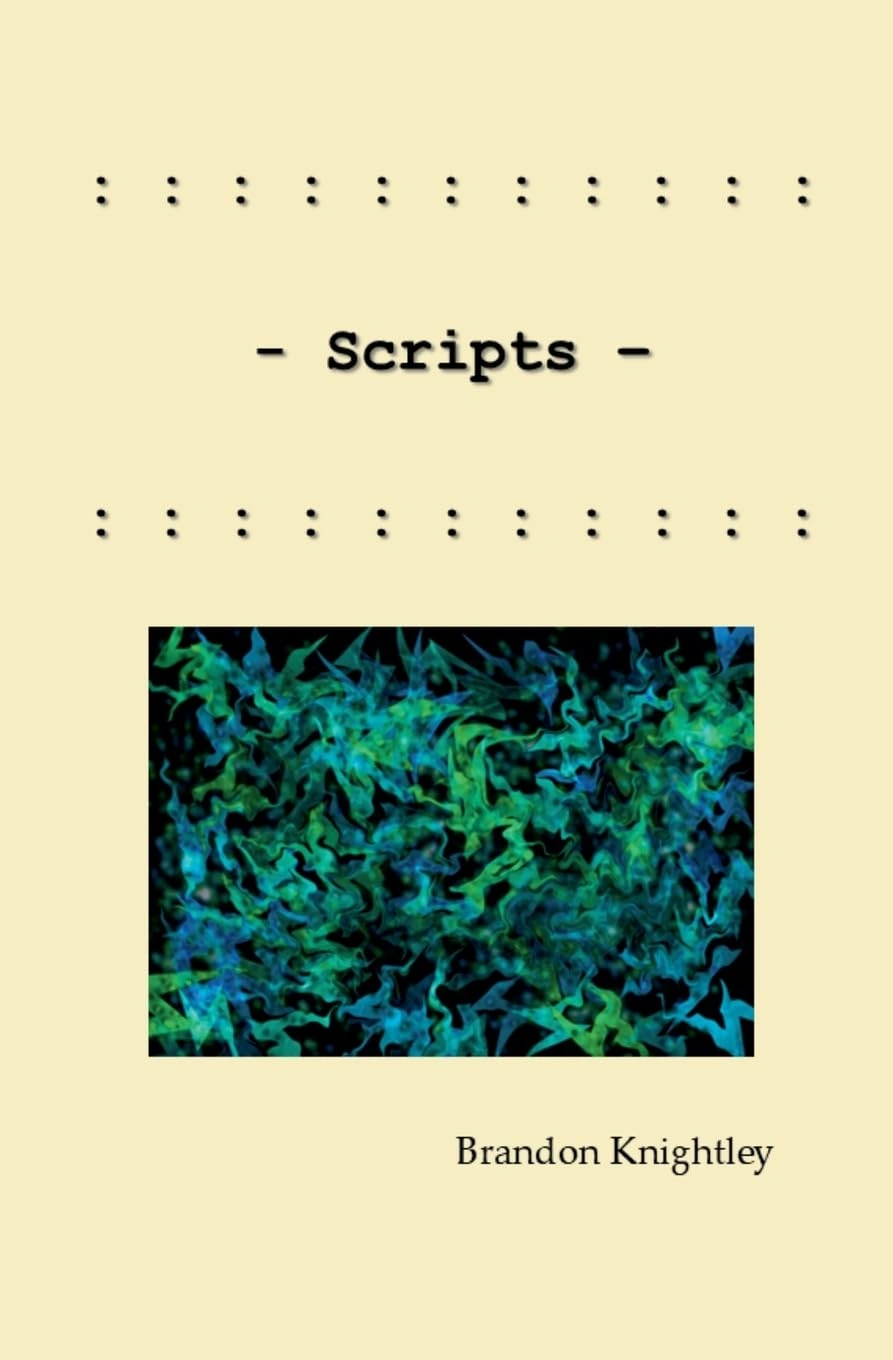
Scripts by Brandon Knightley
Set somewhere in mid-twentieth-century America, Brandon Knightley‘s Scripts centers on Arlene, a young woman of uncommon intelligence trapped in a marriage of contemptuous indifference. Her husband Charlie is not a villain in any operatic sense; he is something colder and more recognizable: a man who has decided, without ever quite articulating it, that his wife does not need to exist as a person. Knightley renders this dynamic with restraint. When Charlie comes home unexpectedly and stands just feet from Arlene’s hidden typewriter — her secret, her self — the scene achieves a tension of the best psychological fiction, not through confrontation but through its terrifying absence.
The Secret Life Beneath Domestic Silence
The typewriter is the novel’s central symbol, and Knightley handles it with tact. When Arlene finally places it on the table in her curtained alcove, surrounded by blank paper in the afternoon light, the moment carries an almost sacred weight. Here is a woman discovering, late and furtively, that she has something to say. What she might type remains largely unspoken — which is, of course, the point.
What makes Scripts inventive and moving is its structural conceit. Woven between the chapters of Arlene’s narrative are a series of two-person dramatic scripts, each depicting a man and a woman in some charged moment of relation — a dying marriage, a graduation-night proposal, two people navigating the emptiness of domestic routine. These scripts are then followed by brief scenes of other couples reading them aloud together: a ritual that has become, for these readers, a form of intimacy, a safe arena for feeling things they cannot otherwise express. The book’s title, it becomes clear, operates on multiple levels — the theatrical scripts, the social scripts we perform in marriage and courtship, and the inner scripts we write and rewrite about who we are and who we might have been.
The dramatic scripts themselves are accomplished pieces of writing. “Victory,” which opens the book, drops us into a marital confrontation of such precise, blazing bitterness. The dialogue crackles with the logic of a long, failed intimacy, in which each insult is also an archaeology. “Graduation Night,” by contrast, is suffused with the tentative sweetness of young love finding its words for the first time and is more affecting for following so directly in “Victory”‘s wake.
Knightley’s prose is patient and exact. His descriptions of Arlene — her long neck, her glasses, the way her mouth moves involuntarily when she is moved by something — build, over the course of the novel, into a portrait of great tenderness. He is also capable of unexpected grace notes: a childhood memory of Arlene pushing through a field of tall grass and finding, alone on the other side, a new kind of solitude that is not loneliness but something close to freedom.
Scripts is a book about the kind of goodness that goes unseen, about people who enrich the lives of others without being recognized for it and about the private inner lives that survive, and sometimes flourish, beneath surfaces of apparent submission.
Scripts will stay with you — in the image of Arlene at her typewriter, in the light through an embroidered silk curtain, in the voices of two women on a sofa discovering, again and again, that reading together is its own form of love.
About Brandon Knightley:
 Brandon Knightley is an American writer and teacher with a deep interest in the intersection of philosophical questions and real-life decision-making. He believes that the disciplinary elements of education should ultimately promote the creative expression of the individual. Accordingly, he creates fictional characters in his stories and then sets them free to explore the world in surprising ways. His favorite author is Jane Austen.